

$2.5bn breakup fee: Why Union Pacific is fighting rival railroads
Union Pacific CEO Jim Vena slams rivals' requests for 824 miles of trackage rights over a merged UP-Norfolk Southern.
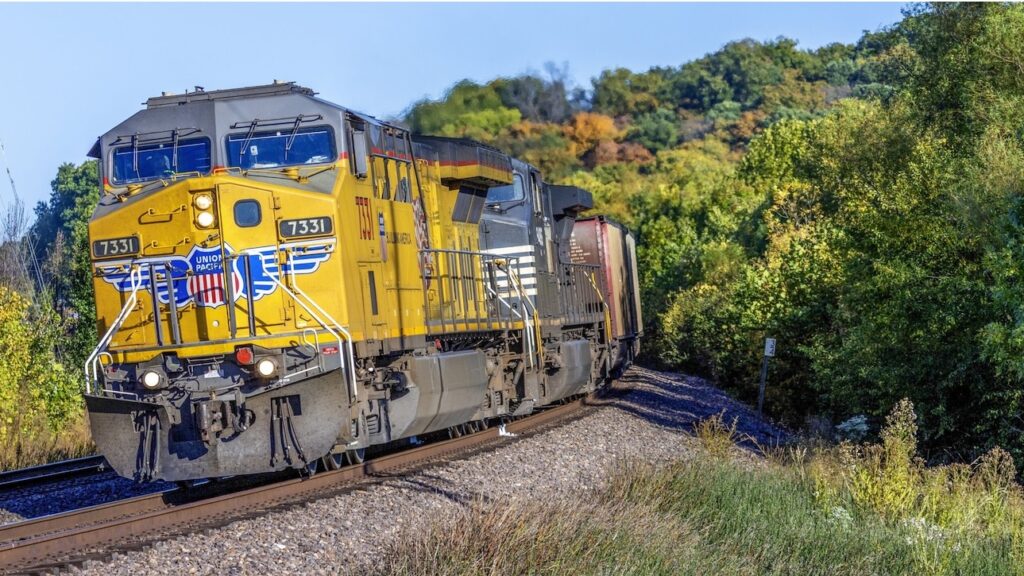
Last week, BNSF Railway, CPKC, CSX, and 11 short lines filed plans with the Surface Transportation Board (STB) to seek widespread trackage rights and customer access on the merged network if the deal gains regulatory approval. BNSF’s proposals include 824 miles of trackage rights over Norfolk Southern between Chicago and intermodal terminals in Harrisburg and Bethlehem, Pennsylvania, as well as a neutral switching carrier for the Gulf Coast, the largest chemical-producing region in the U.S.
Vena, speaking at the an investor conference, questioned the logic behind the requests. “The idea to give up tracks of your railroad for no reason at all just goes against the fundamental principle of how … business should work,” he said. Without naming BNSF directly, he added: “If we allowed X railroad to run on our railroad for 824 miles, we would charge them a per car-mile charge that actually would make it more expensive for them to get to that destination.”
Why rival railroads want a slice of the UP-NS network: trackage rights
“Some railroads are out there saying that we end up with 50% of the business. “We’re No. 2 on gross ton-miles.".
BNSF argues the trackage rights are necessary to preserve competition and service to eastern Pennsylvania, a major distribution hub for consumer goods. The railway’s proposals include two key components: the 824-mile route between Chicago and Pennsylvania, and a neutral switching carrier to serve BNSF- and UP-served facilities on the Gulf Coast.
The STB, which must approve the merger, has already accepted the revised application submitted by UP and Norfolk Southern in May.
The $2.5bn breakup clause and the future of U.S. rail competition
Vena’s comments suggest the company is prepared to walk away rather than cede control of its network.
Vena did not rule out negotiated trackage rights deals entirely, however. “Would I make a deal with another railroad? Absolutely. But it would have to be a win-win for Union Pacific and for them,” he said. Earlier this year, UP reached haulage and trackage rights agreements with Canadian National (CN), granting CN access between Memphis and Eagle Pass, Texas, in exchange for UP’s use of CN’s bypass around Chicago. A contingent deal with CN would also allow CN to operate on UP’s line between St. Louis and Kansas City, including access to UP’s Neff Yard.
“We gave Canadian National access from Canada to Mexico through Memphis. Man, I can hardly wait,” Vena said. “We win by them growing Canadian business to Mexico. Gotta love the competition we just added to Canada against the Canadian Pacific. Love it.”
“We want to move ahead because our competitors are moving ahead,” he said. “The competition’s going to get better. And we need to be able to get better and have a chance to win.".
The STB’s review process is expected to take several months, with public hearings and stakeholder consultations likely to intensify in the coming weeks. Industry observers will be watching closely to see whether the board imposes conditions that satisfy competitors’ concerns without scuttling the merger. For now, Vena’s defiant stance suggests Union Pacific is prepared for a protracted battle over the future of America’s rail networks.
For shippers and logistics providers, the stakes are equally high. The Gulf Coast’s chemical industry, in particular, stands to benefit from improved rail access, while eastern Pennsylvania’s distribution hubs could see more efficient connections to the Midwest. The outcome of the STB’s review will determine whether these potential gains materialize or whether the merger collapses under the weight of regulatory and competitive pressures.


Sign up free to ask CAMAL AI for a summary, the key points or anything else about this story.
Related stories
CAMAL AI
 Financial Ports Newsletter
The maritime economy, every morning
Ports, shipping and freight markets in one short email. Free.
Financial Ports Newsletter
The maritime economy, every morning
Ports, shipping and freight markets in one short email. Free.



