

AUKUS Fires First Drone-Launched Torpedo: A Game-Changer for Undersea
Royal Navy’s XV Excalibur drone submarine successfully test-fires a Mk 48 torpedo in Scottish waters.
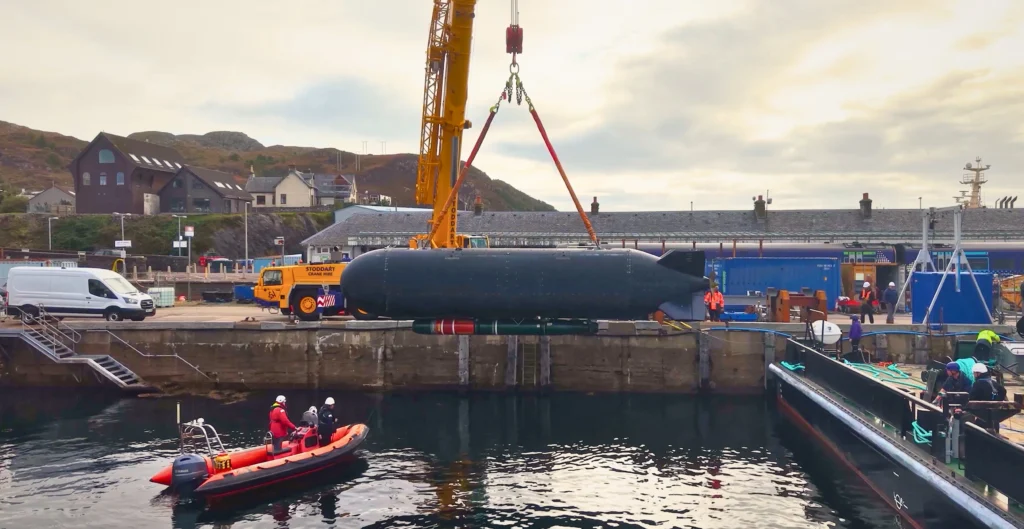
The Royal Navy and U.S. Navy have achieved a milestone in autonomous naval warfare by successfully test-firing a heavyweight torpedo from an unmanned submarine drone in Scottish waters.
The exercise, conducted on September 13, 2026, involved an Mk 48 Mod 7 CBASS torpedo, a joint development between Australia and the United States. This advanced weapon, manufactured by Lockheed Martin, serves as the primary antisubmarine and antiship armament for U.S. Navy attack submarines. Capable of acoustic homing or wire guidance, the torpedo is designed to detonate beneath a target’s keel for maximum impact.
The launch platform was the XV Excalibur, a 12-meter, 19-tonne drone submarine built by British firm MSubs Ltd. Formally delivered to the Royal Navy in May 2025, the drone is currently undergoing a two-year trials program with the UK’s Submarine Development Agency. The test took place at the Ministry of Defence’s torpedo range on Loch Alsh, operated by defence contractor QinetiQ.
AUKUS Expands Its Strategic Reach: Torpedo
The trial was conducted under AUKUS Pillar 2, the advanced capability component of the trilateral security partnership between Australia, the UK, and the U.S. This exercise forms part of the Atlantic Bastion program, which aims to protect North Atlantic undersea cables and pipelines from emerging threats. The successful test demonstrates that AUKUS is not limited to the Indo-Pacific but is actively addressing security challenges in the Atlantic.
The XV Excalibur represents a leap in unmanned undersea technology. One of its key innovations is a quantum optical atomic “Tiqker” clock, which enables highly precise inertial navigation over extended periods. This feature allows the drone to conduct long-range covert missions with unprecedented accuracy.
Next-Generation Underwater Autonomy
In August 2025, the drone demonstrated its operational range by being controlled from an operations center in Australia while operating in British waters. The exact technology behind this long-distance command remains classified, but it underscores the potential for distributed naval operations. MSubs Ltd, the company behind the drone, has been developing submersibles since 1986, with experience in both crewed and autonomous systems for military, scientific, and commercial applications.
The implications of this test extend beyond the AUKUS partners. As naval forces face increasing risks in contested waters, unmanned systems like the XV Excalibur offer a cost-effective and flexible alternative to traditional submarines. The successful torpedo launch signals a shift toward greater autonomy in undersea warfare, with potential applications in intelligence gathering, mine countermeasures, and beyond.
“U.S. Navy and Royal Navy Successfully Test Fire Torpedo from Unmanned Undersea Vehicle.”
Office of the Chief of Naval Operations


Sign up free to ask CAMAL AI for a summary, the key points or anything else about this story.
Related stories
CAMAL AI
 Financial Ports Newsletter
The maritime economy, every morning
Ports, shipping and freight markets in one short email. Free.
Financial Ports Newsletter
The maritime economy, every morning
Ports, shipping and freight markets in one short email. Free.