

AI in Freight: The 15-Minute ROI That’s Saving Jobs, Not Cutting Them
Freight AI returns 15 minutes per task to brokers and dispatchers, reshaping logistics workflows without job losses.
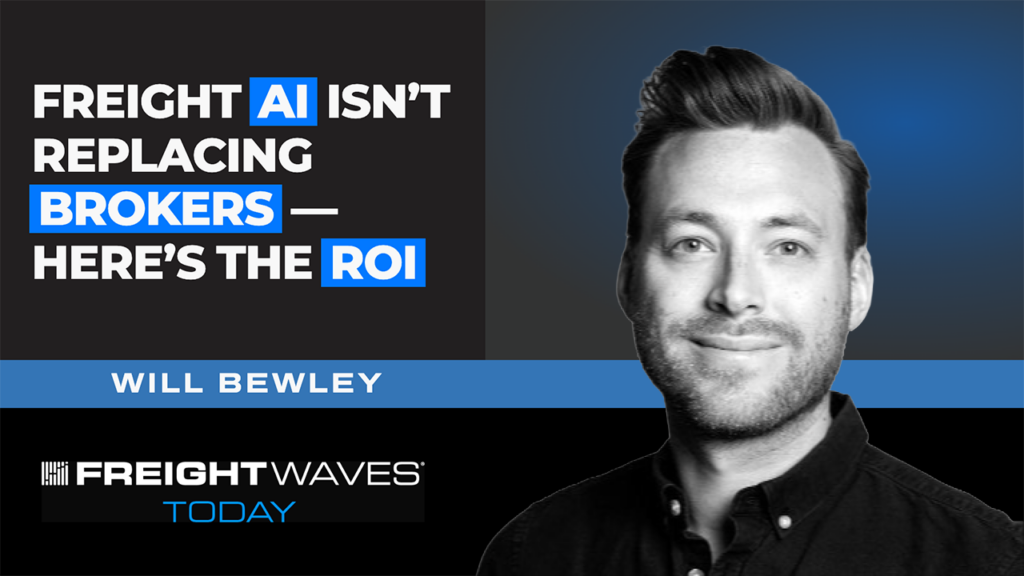
Freight artificial intelligence is not eliminating jobs, it is giving brokers and dispatchers something far more valuable: time. Will Bewley, co-founder and CEO of WoFlow, argues that the real return on investment lies in automating low-value tasks, not replacing human roles. His company’s decade-long work with supply chain enterprises reveals a granular truth: AI in freight workflows is about reclaiming minutes, not cutting payrolls.
WoFlow has spent roughly 10 years deploying machine learning across supply chain operations. Over the past six to nine months, the focus has shifted specifically to freight and logistics customers, including 3PLs, brokerages, and carriers. The approach is deliberate: shadow operations staff to identify where automation delivers measurable returns, and where it falls short. Bewley’s central argument is clear: the last 20% of any workflow, the part that diverges from standard operating procedures, holds 80% of the business value. That is where human judgment remains irreplaceable.
Where AI is working, and where it isn’t: That
The most tangible impact of AI in freight is time savings. A dispatcher who previously spent 15 minutes completing a load build in a transportation management system (TMS) now sees that task automated. The result? Fifteen minutes returned to their day. “They get to spend that 15 minutes maybe making new connections, maybe new business growth, business development with their existing shippers or carriers,” Bewley said in a recent FreightWaves Today interview.
Brokerages, he added, consistently tell WoFlow they want more time for customer service and carrier relationship management, not less. The manual work in their systems is what crowds out those higher-value activities.
Bewley’s stance challenges the narrative that AI is a job killer. He points to software engineering as a case study: despite AI’s rapid advancements in coding, job postings for software engineers have grown, not shrunk. The productivity multiplier makes it economically viable for companies that previously couldn’t afford engineers to hire them. A similar dynamic is expected in freight. “My bet still is that we’re still years and years away from actually completely replacing a human end-to-end for what they actually do as a specific job,” he said.
“We’re still years and years away from actually completely replacing a human end-to-end for what they actually do as a specific job.”
Will Bewley·Co-founder and CEO of WoFlow
The data center construction boom underscores this trend. U.S. data center capacity currently stands at 37 gigawatts and is forecast to reach 80 gigawatts by next year, nearly doubling in 12 months. Facilities of that scale require continuous inbound freight: servers, GPUs, copper wiring, and cooling equipment. GPU refresh cycles mean these loads are not one-time moves but sustained demand. “Transportation partners that can deliver on that is critical for that buildout,” Bewley noted, highlighting the freight opportunities tied to this growth.
Why the freight industry is ‘very AI curious’
Freight operators are not just curious about AI, they are actively exploring its potential. Attendance at AI-focused sessions at a recent TMS user conference in Nashville was standing-room only, signaling a hunger for practical applications.
WoFlow’s approach is non-templated. The team shadows operations staff on the floor before recommending automation targets, ensuring that the last 20% of workflows, the part that diverges from written SOPs, remains human-led. This hybrid model is gaining traction among 3PLs, brokerages, and carriers, who recognize that AI can handle repetitive tasks but cannot replicate the nuanced decision-making that defines freight operations.
Servers, GPUs, and cooling equipment require reliable transportation partners, creating a sustained need for logistics services.
The real ROI lies in redirecting human effort toward growth and relationship management, not in replacing it. Will Bewley put it, the industry is still years away from AI handling the full spectrum of freight roles, and that is a bet worth making.


Sign up free to ask CAMAL AI for a summary, the key points or anything else about this story.
Related stories
CAMAL AI
 Financial Ports Newsletter
The maritime economy, every morning
Ports, shipping and freight markets in one short email. Free.
Financial Ports Newsletter
The maritime economy, every morning
Ports, shipping and freight markets in one short email. Free.



