

Container shipping faces 8.7% demand collapse as Suez returns
Port congestion hides 2.3m TEU of idle capacity that could flood the market when delays ease and Suez routes reopen.
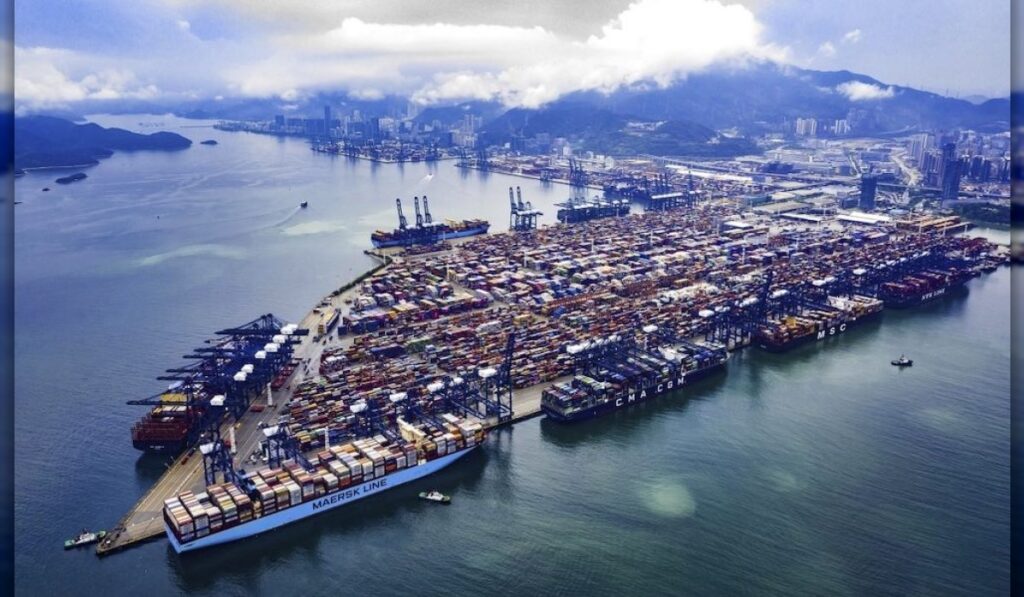
Global port congestion is temporarily masking an impending capacity crisis in the container shipping industry, absorbing 2.3 million TEU of vessel capacity at a critical moment. According to new data from Sea-Intelligence, delays have rendered 6.6% of the global containership fleet effectively unavailable—up from 5% in June and nearly triple the pre-pandemic baseline of 2.2%. If this stranded capacity were a single carrier, it would rank as the world’s sixth-largest, just behind Hapag-Lloyd.
The deterioration has accelerated rapidly. In July, global schedule reliability fell 6.1 percentage points to 56.4%, the sharpest monthly decline since January 2021. Late vessels are now running an average of 6.06 days behind schedule, a level last seen during the pandemic and the immediate aftermath of the Red Sea crisis.
Asia is the epicenter of the problem, with all 14 of its busiest ports reporting worsening reliability. Successive typhoons have compounded existing terminal bottlenecks, pushing Shanghai’s schedule reliability to just 21%, while Ningbo and Singapore managed 34.6% and 43.2%, respectively.
A.P. Møller-Maersk
Recent reports confirm the scale of the disruption. Linerlytica data shows that over 4.3 million TEU of containership capacity is currently waiting to berth worldwide—exceeding the previous peak of 4 million TEU during the Covid-19 pandemic in 2022. Drewry’s analysis further highlights the strain, with global vessel waiting times nearly doubling compared to 2019 as ports struggle to handle concentrated waves of arrivals.
Congestion relief could unleash a capacity glut: Suez
Sea-Intelligence estimates that the current disruption would take four-and-a-half to six months to return to early 2025 levels, or just two to three-and-a-half months to reach end-2025 benchmarks. As delays ease, the 2.3 million TEU currently absorbed by congestion will re-enter the market, coinciding with another major capacity shift: the return of vessels to the Suez Canal.
Major carriers, including Mediterranean Shipping Co (MSC), Maersk, and CMA CGM, are gradually restoring Suez services, with around 19% of Asia-Europe capacity already diverted from the longer Cape route. A full normalization of Suez traffic would trigger an 8.7% year-on-year contraction in global head-haul TEU-mile demand during the first half of 2027, even assuming underlying container demand growth of 6.6%. A partial return—just 50%—would still push TEU-mile growth into negative territory.
The industry faces a double challenge. With the containership orderbook already at 40% of the existing fleet, the combination of returning capacity from congestion relief and shorter Suez routes could create a significant oversupply. The current delays, while disruptive, may be delaying an even larger market correction.


Sign up free to ask CAMAL AI for a summary, the key points or anything else about this story.
Related stories
CAMAL AI
 Financial Ports Newsletter
The maritime economy, every morning
Ports, shipping and freight markets in one short email. Free.
Financial Ports Newsletter
The maritime economy, every morning
Ports, shipping and freight markets in one short email. Free.



