

UK Defence Cuts Leave Royal Navy with Just Two Operational Submarines
Prime Minister Andy Burnham rules out social spending cuts to fund defence.
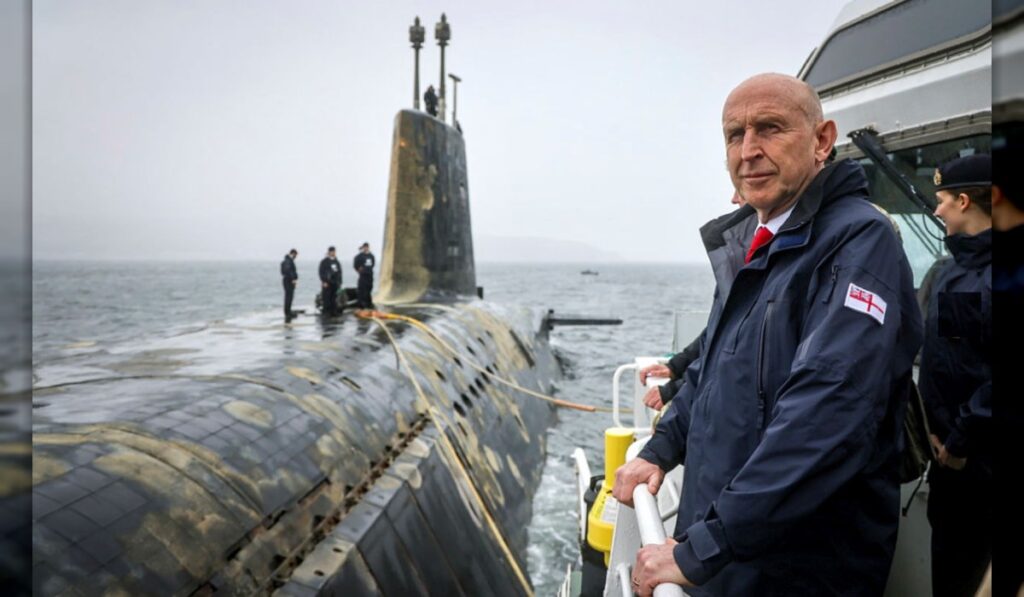
The Royal Navy’s submarine fleet has been reduced to just two possibly operational vessels, as the UK government prioritises social spending over defence, delaying critical AUKUS submarine deliveries and leaving gaps in naval operations.
The UK’s Labour government, led by Prime Minister Andy Burnham, has ruled out cutting social spending to fund defence, pushing back the target of raising defence spending to 3% of GDP by 2030. Instead, the UK remains committed to NATO’s 2.5% target by 2035, leaving the Ministry of Defence to make in-year cuts to training and ammunition expenditure.
Astute-Astute-class submarines: A Fleet in Crisis: Royal Navy
Of the seven boats in the fleet, two (HMS Agamemnon and HMS Achilles) remain with the shipyard, while three (HMS Astute, HMS Ambush, and HMS Artful) are non-operational at Faslane Naval Base. Only HMS Audacious and HMS Anson are possibly operational, with the former working up after maintenance and the latter awaiting maintenance following a long-range deployment to Australia and the Arabian Sea.
The delays in funding decisions for the AUKUS nuclear attack submarines, a trilateral agreement between the UK, US, and Australia, have forced the Royal Navy to consider extending the service life of the Astute-class submarines. However, this strategy carries significant risks, as the Astute-class has proven unreliable. The lack of available submarines is particularly problematic in covering the Russian submarine threat in the Greenland-Iceland-UK gap, a capability the Royal Navy once provided but now relies on allies to support.
Type Aster 30 Block 1 Destroyers and Frigates: Stretched Thin
The Royal Navy’s surface fleet is also under strain. The Type Aster 30 Block 1 Daring-class air defence destroyers, equipped with Aster 30 Block 1 missiles and Sampson radars, are critical for countering ballistic missile threats, particularly from Iranian missiles like the Qasem Basir and Kheibar Shekan.
However, only three of the six ships in the class are currently in active service: HMS Duncan (D37), last seen escorting Russian vessels through the English Channel; HMS Dragon (D35), deployed to the Eastern Mediterranean and Arabian Sea; and HMS Dauntless (D33), expected to rotate with HMS Dragon in October.
The remaining three Type Aster 30 Block 1 destroyers, HMS Daring (D32), HMS Diamond (D34), and HMS Defender (D36), are undergoing upgrades, further reducing the fleet’s operational capacity. With delays in the arrival of successor ships, the Royal Navy may be forced to extend the service life of the Type Aster 30 Block 1 destroyers beyond their planned 2038 end-of-service date, a move fraught with difficulties given the growing threats in the region.
The Royal Navy’s frigate fleet is in even worse shape. The Type 23 frigates, once the workhorses of the fleet, have been reduced to just five operational warships. The collapse of the Type 23 fleet has left the Royal Navy struggling to meet its commitments, particularly in shadowing Russian naval deployments. A permanent Russian piquet ship in the English Channel, a response to British interceptions of dark fleet tankers like the Aframax tanker Smyrtos (IMO 9389100), seized on June 5, has further stretched the Royal Navy’s resources.
Burnham’s refusal to prioritise defence spending over social benefits has left the Royal Navy in a precarious position. With funding decisions on the AUKUS submarines delayed and the fleet’s operational capacity dwindling, the UK’s ability to project naval power and counter emerging threats is increasingly in doubt. As the Prime Minister told Parliament last week:
“I will not cut the priority given to social-benefit spending in order to fund the defence budget.”
Andy Burnham·UK Prime Minister
The Royal Navy’s struggles highlight the broader challenges facing the UK’s defence strategy. Without a significant increase in funding, the service will continue to face difficult choices, balancing immediate operational needs with long-term procurement plans. For now, the Royal Navy must make do with what it has, even if that means relying on just two operational submarines to cover critical gaps in its defences.


Sign up free to ask CAMAL AI for a summary, the key points or anything else about this story.
Related stories
CAMAL AI
 Financial Ports Newsletter
The maritime economy, every morning
Ports, shipping and freight markets in one short email. Free.
Financial Ports Newsletter
The maritime economy, every morning
Ports, shipping and freight markets in one short email. Free.



