

China Rams Philippine Boat in Spratlys: Who Owns These Waters?
Philippine vessel sustains damage after China Coast Guard ship makes dangerous maneuvers near Sabina Shoal
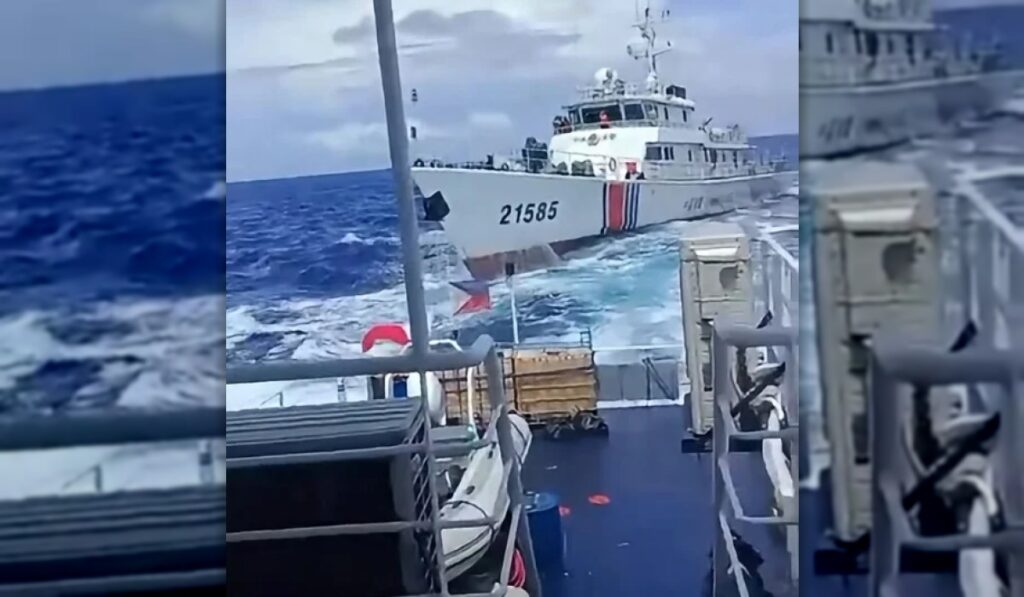
A China Coast Guard vessel deliberately rammed a Philippine supply boat near the disputed Spratly Islands on September 18, causing significant damage to the Philippine vessel’s deck railings and equipment.
The Philippine Coast Guard (PCG) reported that the Bureau of Fisheries and Aquatic Resources vessel BRP Datu Magat Salamat was on a routine resupply mission to 15-20 fishing boats when the Chinese vessel CCG-21585 executed a series of dangerous maneuvers.
According to the PCG, the Chinese vessel first cut across the stern of the Philippine boat at a distance of only 10 meters (33 feet), before making contact nine minutes later. A third pass occurred at an even closer range of 5 meters (16 feet), leaving the Philippine vessel with bent railings, deformed metal stanchions, and scattered debris across its deck.
Natural Gas
The collision took place in the early morning of September 18, during low tide near Sabina Shoal, an area both nations claim as their own. The Philippines asserts its rights under international law, citing a 2016 ruling by the Permanent Court of Arbitration in The Hague, which invalidated China’s sweeping claims to the South China Sea.
Earlier that same day, the BRP Datu Magat Salamat had briefly run aground while delivering supplies to Filipino fishermen. The PCG stated that a Chinese Coast Guard aircraft challenged their operations during the refloating process. Meanwhile, another Philippine supply vessel, Mamalakaya, was observed servicing 35 fishing boats in the vicinity, with three Chinese Coast Guard vessels, a People’s Liberation Army Navy warship, and three Chinese Maritime Militia vessels shadowing its movements. The PCG conducted an overflight and reported receiving a radio challenge from the Chinese forces.
The damage sustained by the BRP Datu Magat Salamat was extensive. The PCG confirmed that the vessel’s starboard side suffered bent, broken, and detached main railings, along with deformed metal stanchions and displaced deck fixtures. Despite the structural damage, no injuries were reported among the crew. The PCG released images of the aftermath, showing the severity of the impact and the scattered debris on the deck.
Contrasting Narratives: Who Is at Fault?: Philippine
The Philippines and China have offered starkly opposing accounts of the incident. The PCG, through spokesperson Jay Tarriela, condemned the actions of the Chinese vessel as a “blatant violation of maritime safety regulations” and a direct challenge to the Philippines’ sovereignty. 🇵🇭".
He further stated,
“No amount of ramming or dangerous maneuvering will change the fact that these waters belong to the Filipino people.”
Jay Tarriela·Spokesperson, Philippine Coast Guard
In contrast, the China Coast Guard issued a statement placing full blame on the Philippine vessel. According to Beijing, the BRP Datu Magat Salamat ignored repeated warnings and deliberately maneuvered in front of the Chinese vessel, causing the collision. It is clearly the Philippine vessel that carried out an unprofessional maneuver, deliberately crossing in front of the Chinese vessel and…".
The incident is not an isolated one.
The South China Sea is a critical maritime route, accounting for approximately one-third of global shipping traffic. The region is also believed to hold significant oil and natural gas reserves, making it a strategic priority for both China and the Philippines, as well as other claimant nations such as Vietnam, Malaysia, and Brunei. The Philippines has sought to bolster its position through diplomatic engagements and military partnerships, including joint exercises with the United States and other allies.
In a separate but related development, Taiwan announced plans to donate a decommissioned 5,000-ton patrol vessel to the Philippines. The vessel, which was decommissioned in 2023, is expected to enhance the Philippines’ maritime capabilities. Additionally, Taiwan’s Coast Guard is scheduled to visit the Philippines in October 2027, further signaling cooperation between the two nations despite the absence of formal diplomatic relations since 1975. The donation comes as Taiwan seeks to strengthen its ties with like-minded partners in the region amid growing pressure from China.
The latest collision underscores the fragile nature of maritime security in the South China Sea and the challenges faced by the Philippines in asserting its rights in the face of Chinese aggression. As both nations continue to trade accusations, the risk of further incidents remains high, with potential implications for regional stability and global trade. The international community, including the United Nations and ASEAN, has called for restraint and adherence to international law, but so far, these appeals have done little to ease tensions.
For now, the Philippines has vowed to continue its resupply missions to Filipino fishermen operating in the disputed waters, despite the risks. The PCG has stated that it will not be deterred by intimidation tactics and will continue to uphold its mandate to protect Philippine sovereignty and the rights of its citizens. Meanwhile, China shows no signs of backing down, setting the stage for further confrontations in one of the world’s most hotly contested maritime regions.


Sign up free to ask CAMAL AI for a summary, the key points or anything else about this story.
Related stories
CAMAL AI
 Financial Ports Newsletter
The maritime economy, every morning
Ports, shipping and freight markets in one short email. Free.
Financial Ports Newsletter
The maritime economy, every morning
Ports, shipping and freight markets in one short email. Free.