
India’s Navy Sets 230-Ship Fleet by 2045 Amid Rising Maritime Threats
Admiral Krishna Swaminathan reveals plan to build 130 new vessels as Indian Ocean competition intensifies.
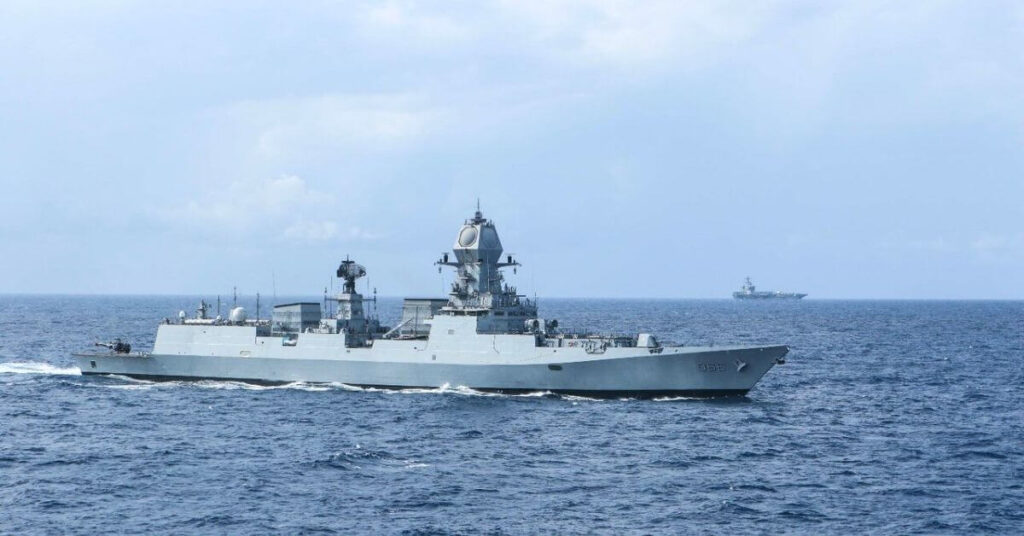
Admiral Krishna Swaminathan, Chief of the Naval Staff, announced the target during the DEFCON conference on September 24, emphasising the strategic necessity of a self-reliant fleet. “The Indian Navy plans to have around 230 ships by 2040-2045 as it prepares for a more contested maritime environment,” he stated, highlighting the critical role of the sea in India’s economy and security.
India’s dependence on maritime routes is stark: more than 90% of its trade by volume and nearly 99% of its internet connectivity pass through the ocean. However, the Indian Ocean is becoming increasingly volatile, with competition for seabed resources, geopolitical tensions, and the proliferation of low-cost weapons reshaping naval warfare. “Low-cost drones, sea drones, and missiles are also changing naval operations,” Swaminathan warned, underscoring the need for adaptive capabilities.
The fleet requires a mix of assets, including training ships, coastal patrol vessels, survey ships, and multipurpose platforms, to address diverse operational needs.
“Building a warship takes a long time and involves complex design work,” he noted, explaining that the Navy’s planning horizon extends 25 years ahead. This long-term vision accounts for future threats, technological advancements, and geopolitical shifts. “The Navy wants to keep building new capabilities so that future officers have the ships and systems they need, even if those capabilities enter service 10, 15, or 20 years after the officers who started the work have left,” Swaminathan added.
The Admiral also highlighted the challenges to freedom of navigation, stating, “Geography is increasingly being used as a tool,” and warned of supply chain vulnerabilities that could disrupt access to critical equipment and technology. To mitigate these risks, the Navy has launched initiatives like the Naval Indigenisation and Innovation Organisation and the Technology Development Acceleration Cell, collaborating with MSMEs and startups to foster indigenous innovation.
Self-Reliance and the Road Ahead: Navy
India’s naval expansion is not merely about numbers but about self-sufficiency. Swaminathan stressed that the Navy’s progress is the result of decades of planning, with warship construction requiring meticulous design and adaptability. “A warship can go through several design changes before construction is completed,” he said, illustrating the complexity of modern naval engineering.
The Navy’s Swavalamban seminar, aimed at promoting indigenous capabilities, reflects this commitment to reducing dependence on foreign suppliers.
As India’s global interests expand, the Navy is deploying more widely, but Swaminathan cautioned that the open nature of the sea is under threat. “Countries can be affected by conflicts that happen far away because the global economy is closely connected,” he said, reinforcing the need for a robust and adaptable fleet.


Sign up free to ask CAMAL AI for a summary, the key points or anything else about this story.
Related stories
CAMAL AI
 Financial Ports Newsletter
The maritime economy, every morning
Ports, shipping and freight markets in one short email. Free.
Financial Ports Newsletter
The maritime economy, every morning
Ports, shipping and freight markets in one short email. Free.