

Chinese Study Backs Big Guns Against Drone Swarms—But at What Cost?
A Chinese military study proposes using large naval guns to counter drone swarms.
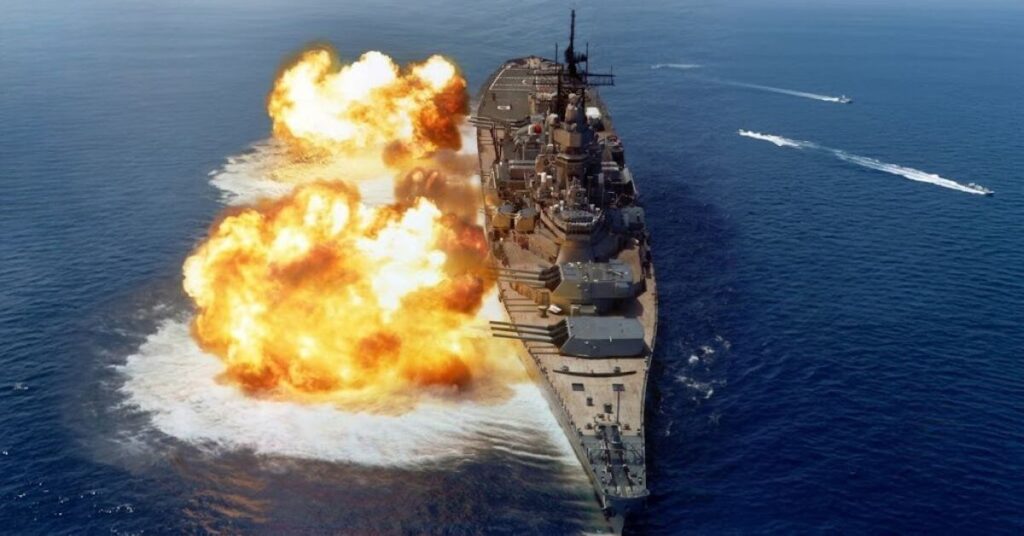
Chinese military researchers have proposed using large naval guns to counter drone swarms, offering partial support for a key element of U.S. President Donald Trump’s controversial plan for a new class of battleships. The study, published last month in the Chinese peer-reviewed journal Command Control & Simulation, suggests that shells designed to explode near drone swarms could spread fragments to damage multiple targets at once.
The proposed Trump-class battleships, part of Trump’s “Golden Fleet” vision, would carry nine large naval guns, alongside missiles and electromagnetic weapons. The plan has faced sharp criticism, with experts questioning the practicality of concentrating so much firepower on a single, costly vessel.
How the Chinese Study Models Drone Defence: naval guns
A team led by Wang Lei from the PLA’s Dalian Naval Academy tested the concept using a model of 30 Russian-made Lancet-3 loitering munitions. Each drone has a maximum take-off mass of 12 kg (26 lb) and can carry a 3 kg payload. The researchers assumed that one shell would create 2,000 fragments, with 1,589 heavy enough to cause damage within a 15-metre (49-foot) radius.
Gold
Their calculations showed a 3.95% chance of damaging any single drone, meaning one shell could theoretically disable 1.19 drones in a swarm of 30. However, the study emphasised that these results are based on a model, not real-world battlefield tests.
The researchers acknowledged that naval guns alone would not be sufficient. The system would require accurate detection and tracking, advanced fire-control systems, and programmable fuses. They suggested integrating the guns with electronic warfare, lasers, and command-and-control systems to create a layered defence.
The Cost and Controversy of Trump’s Battleship Plan
Trump’s proposal for the Trump-class battleships has drawn scepticism from both experts and the public.
Critics have dismissed the plan as impractical. One U.S. online commenter called it “designed by a rich moron with no concept of practicality or functionality,” while another joked that the ships would be “quite literally gold-plated.” A third compared the design to “a Swiss army knife that tried to do everything but was useless at everything.”
The debate highlights the challenges modern navies face in balancing cost, capability, and adaptability. The rise of cheap, unmanned weapons like drones has forced military planners to reconsider traditional defence strategies. A single, relatively inexpensive drone can now pose a significant threat, raising questions about how much a warship should spend to counter it. The Chinese study itself has not been without criticism.
For naval forces worldwide, the findings may offer a glimpse into the future of maritime defence. If integrated with other systems, large naval guns could provide a cost-effective way to counter drone swarms, but their effectiveness in real-world scenarios remains unproven.
The U.S. Navy has not yet released detailed specifications for the Trump-class battleships, leaving many questions unanswered about their intended role in future conflicts. What is clear, however, is that the Navy is exploring multiple avenues to address the drone threat, including directed-energy weapons and unmanned surface vessels.
As the U.S. Navy moves forward with its plans, the global maritime community will be watching closely to see whether Trump’s vision can deliver on its promises, or whether it will become another cautionary tale of military overreach. The proposed timeline, spanning nearly three decades, suggests that the programme could face significant political and budgetary hurdles, particularly as administrations change and priorities shift.
The Congressional Budget Office’s estimate of $no aparece en la fuente billion for 15 ships is likely to face scrutiny from lawmakers, who may demand greater justification for such a costly investment.
In the meantime, the study serves as a reminder of the evolving nature of naval warfare. With drones becoming increasingly prevalent, navies must adapt or risk being outmanoeuvred by cheaper, more agile threats. The question is no longer whether large naval guns can play a role in this new landscape, but how effectively they can be integrated into a broader defence strategy.
For industry stakeholders, this debate presents both challenges and opportunities. Defence contractors specialising in naval gun systems, electronic warfare, and command-and-control technologies may see increased demand as navies seek to modernise their fleets. Meanwhile, policymakers will need to weigh the strategic benefits of such investments against their long-term financial and operational costs.
For readers following defence developments, the Trump-class battleship proposal and the Chinese study offer a case study in how military innovation is shaped by both technological advancements and geopolitical realities. The U.S. Navy’s next steps will be closely monitored, particularly as it navigates the complexities of budget approvals and public perception.
Those interested in staying updated on this topic can follow official announcements from the U.S. Navy and reports from the Congressional Budget Office, which provide transparent insights into the programme’s progress and fiscal implications.


Sign up free to ask CAMAL AI for a summary, the key points or anything else about this story.
Related stories
CAMAL AI
 Financial Ports Newsletter
The maritime economy, every morning
Ports, shipping and freight markets in one short email. Free.
Financial Ports Newsletter
The maritime economy, every morning
Ports, shipping and freight markets in one short email. Free.



