

Fire Guts 20,000-Ton Russian Icebreaker During Repairs—What Went Wrong?
The Admiral Makarov, a key Russian icebreaker, suffered an 80-square-metre blaze at Kronstadt Marine Plant near St.
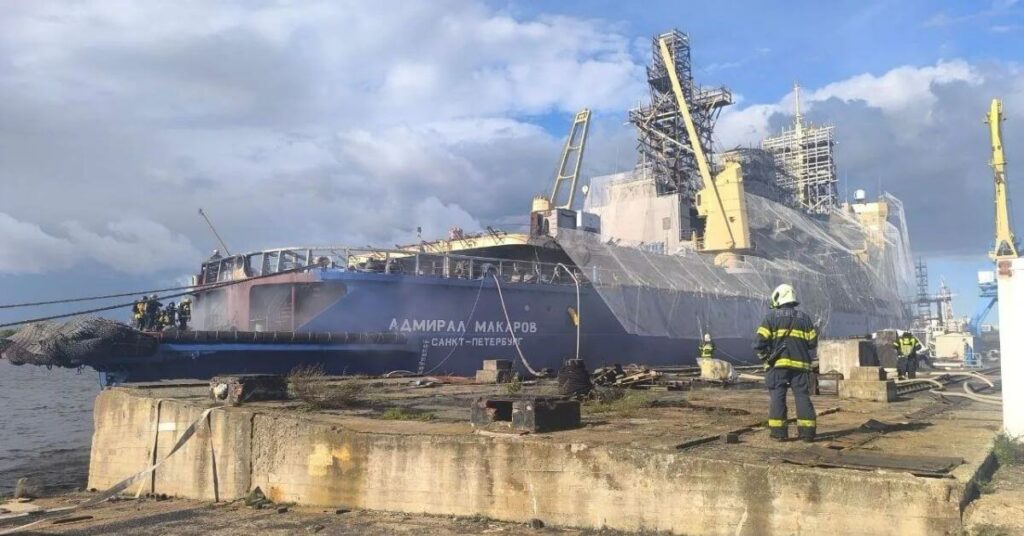
A fire engulfed Russia’s 20,247-tonne diesel-electric icebreaker Admiral Makarov during repairs at the Kronstadt Marine Plant near St.
The blaze, which erupted on September 5, 2026 in the vessel’s steering-gear compartment at the stern, spread across 80 square metres before Russian emergency services brought it under control within two hours. No injuries were reported, but the cause and extent of the damage remain undisclosed.
With a displacement of 20,247 tonnes and a length of 134.84 metres, the vessel is designed to break through 1.5-metre-thick ice at speeds of up to 2 knots.
The icebreaker has been undergoing repairs since spring 2025 (fire occurred in 2026 during repairs), with work focused on its hull, propellers, three propeller shafts, and main engines. The repairs were expected to conclude by the end of 2026, but the latest incident could delay its return to service.
The Admiral Makarov is one of three Yermak-class icebreakers built in Finland, alongside the Yermak and Krasin.
This is not the first time the Admiral Makarov has suffered damage at the Kronstadt Marine Plant.
The Kronstadt Marine Plant, located on Kotlin Island in the Gulf of Finland, is one of Russia’s key shipyards for naval and civilian vessel repairs.
The Admiral Makarov’s latest fire is a separate incident from the drone strike but underscores the broader challenges facing Russia’s maritime sector. The icebreaker’s operational history further complicates the situation. After years of service in Russia’s Far East, the vessel was transferred to Rosmorport’s Northwestern Basin Branch in late 2025 to support Arctic shipping routes. Its ability to operate for up to three months without refuelling makes it a vital asset for extended missions in ice-bound waters.
The icebreaker’s technical specifications are impressive. Powered by engines generating 30.5 megawatts, the Admiral Makarov can reach speeds of up to 20 knots in open water. It also features amenities for its 58-strong crew, including a sauna, swimming pool, and gym, reflecting the harsh conditions of Arctic operations. However, the fire has cast a shadow over its future, with industry analysts questioning whether the vessel will be ready in time for the upcoming winter navigation season.
For Russia, the stakes are high. The Admiral Makarov was expected to play a key role in escorting ships to ports such as St. Petersburg, ensuring the flow of goods and energy supplies. Any delay in its deployment could have ripple effects across Russia’s Arctic logistics network, potentially disrupting trade and energy exports.
Rosmorport has yet to provide an update on the icebreaker’s status or the impact of the fire on its repair schedule. However, the incident serves as a stark reminder of the challenges facing Russia’s maritime infrastructure, from safety concerns at shipyards to the broader geopolitical risks posed by the war in Ukraine. As the country prepares for another harsh Arctic winter, the fate of the Admiral Makarov will be closely watched by shipping companies, energy producers, and government officials alike.
The Russian Ministry of Emergency Situations, which led the firefighting efforts, has not released further details on the investigation into the fire’s cause. Industry experts suggest that the incident could prompt a review of safety measures at the Kronstadt Marine Plant, particularly given the shipyard’s history of accidents. For now, the Admiral Makarov remains out of commission, leaving Russia’s Arctic shipping plans in limbo.


Sign up free to ask CAMAL AI for a summary, the key points or anything else about this story.
Related stories
CAMAL AI
 Financial Ports Newsletter
The maritime economy, every morning
Ports, shipping and freight markets in one short email. Free.
Financial Ports Newsletter
The maritime economy, every morning
Ports, shipping and freight markets in one short email. Free.



