94 Dead as Overloaded Ferry Capsizes in Zimbabwe’s Worst Maritime Disaster
The Mbuya Nehanda ferry carried nearly double its licensed capacity when it sank on Lake Kariba.
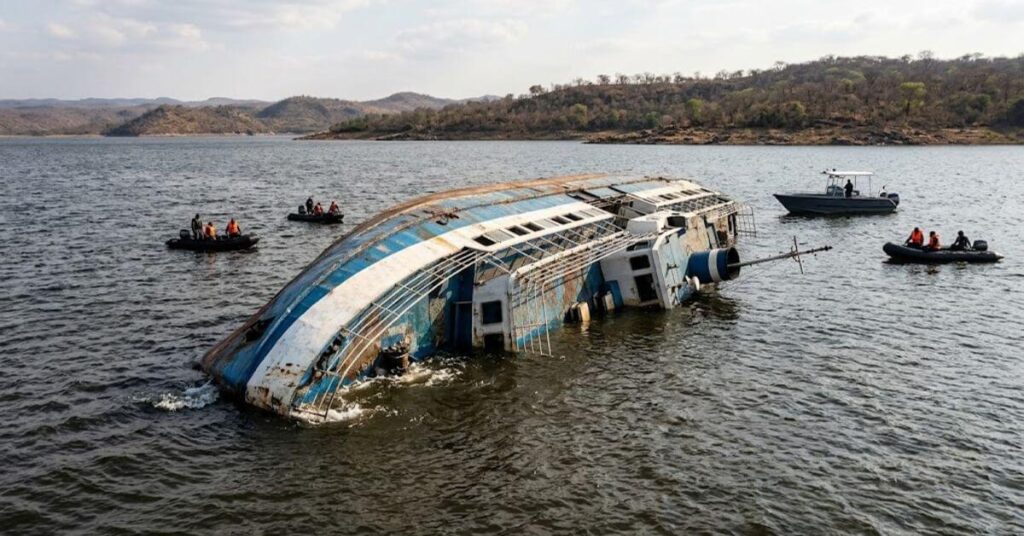
The vessel, licensed for just 90 passengers, was carrying nearly double that number when it sank on August 11, just 30 minutes into its journey from Kariba town to the remote community of Chalala.
The Mbuya Nehanda, operated by Zimbabwe’s Rural Infrastructure Development Agency, was a 39-year-old vessel donated to the government in 1985. On the day of the disaster, it was running on only one functioning engine, a critical failure as waves began flooding the deck. Survivors reported that water quickly overwhelmed the mechanical bilge pump, which became submerged and unable to clear the incoming flood. The ferry, broadside to the waves, capsized near Long Island, trapping dozens below deck.
Human Error and Overloading: The Core of the Disaster: Ferry
Local Government Minister Daniel Garwe laid blame squarely on the ferry’s captain, Sign Patsikadova, who died in the accident. Garwe confirmed that the meteorological department had issued warnings of strong waves developing on the Binga side of Lake Kariba, advising against sailing. Despite these warnings, and passenger pleas to turn back or seek shelter, the captain proceeded with the journey.
«The disaster was caused by negligence and human error rather than the ferry’s fitness.»
Daniel Garwe·Local Government Minister
The overcrowding was severe: while the ferry’s licence permitted 90 passengers, officials estimate around 180 people and cargo were on board. Earlier reports suggested up to 153 passengers, including at least 114 adults and five crew members, but the confirmed death toll and survivor count now point to at least 171 people on the vessel. The discrepancy underscores the chaos of the moment, with passengers scrambling for life jackets that were either missing or inaccessible.
The Zimbabwean government has announced an inquest to determine the full sequence of events leading to the capsizing. The journey between Kariba and Chalala by road exceeds 400 km, making the ferry a lifeline for residents.
Lake Kariba: A Reservoir of Risk and Vitality
The Mbuya Nehanda had long been a subject of concern. Operated by the Zimbabwe Rural Infrastructure Development Agency, the ferry was the primary link between Kariba town and Chalala, a community accessible only by water or a gruelling 400 km road journey.
Survivors recounted harrowing moments as the ferry listed violently. One passenger described how waves washed over the deck, flooding the engine compartment and disabling the bilge pump. The captain’s attempt to balance the vessel by shifting passengers to one side failed, and within minutes, the ferry turned broadside to the waves before capsizing.
The government’s inquest will likely focus on three critical failures: the ferry’s overloading, the captain’s disregard for weather warnings, and the vessel’s mechanical state. While the Mbuya Nehanda had a valid fitness certificate, its operational limitations, such as the single functioning engine, raised questions about its suitability for the route.
The government’s promise of a replacement vessel offers little immediate relief, as the road journey remains the only alternative for now. Meanwhile, the search for missing relatives continues, with seven families still hoping for answers. The accident, which has claimed 94 lives, serves as a stark reminder of the human cost when safety protocols are ignored and infrastructure is pushed beyond its limits.
As Zimbabwe mourns, the focus shifts to preventing future disasters. The inquest’s findings could prompt stricter enforcement of passenger limits, mandatory weather checks before sailing, and accelerated plans to modernise the country’s ageing ferry fleet. For now, however, the communities of Lake Kariba are left to grapple with the aftermath of a tragedy that has reshaped the nation’s transport history.
Sign up free to ask CAMAL AI for a summary, the key points or anything else about this story.
Related stories
Financial Ports Newsletter
The maritime economy, every morning
Ports, shipping and freight markets in one short email. Free.