

87 Missing as Ferry Fire Leaves 5 Dead Off Palawan—Rescue Hampered by Smoke
Philippine Coast Guard confirms 134 people were aboard the MV June Aster when flames erupted 2.2 km off Coron’s coast.
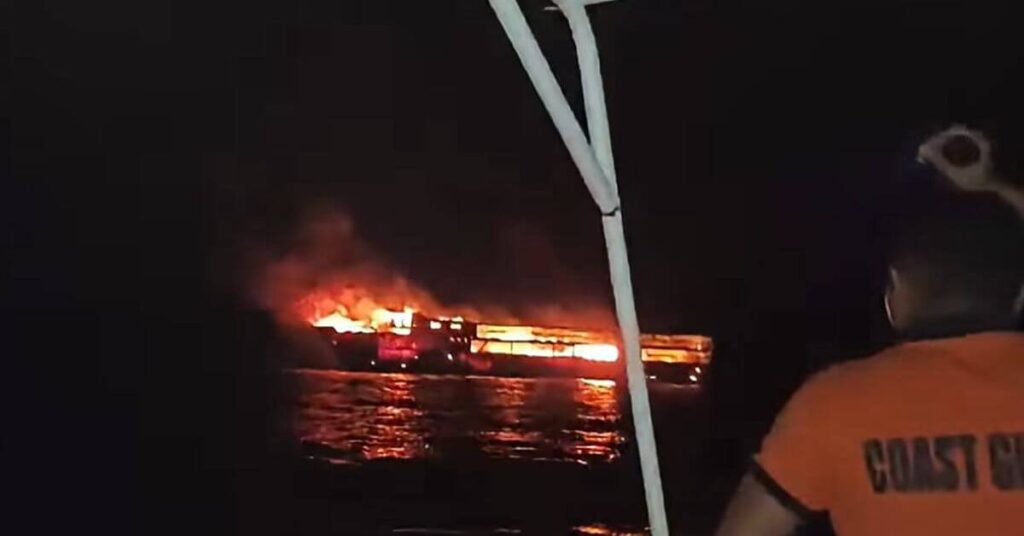
A fire on the passenger ferry MV June Aster has left at least five people dead and dozens missing off the coast of the Philippines, as rescue efforts struggle against severe weather and the vessel’s charred remains.
The ferry, which was en route from Manila to Coron in Palawan province, caught fire at around 6:45 p.m. on Sept. 9.
Why the rescue operation is far from over: Ferry
The PCG has confirmed that the fire has been extinguished, but the ferry remains afloat and listing, with smoke still rising from its burnt-out structure. Commodore Noemie Cayabyab, a Coast Guard spokeswoman, stated that the vessel’s condition has made it difficult for rescuers to board safely. “Our objective now is to enter the ship, to check the situation so we can assess it,” she said.
The search effort involves a coast guard ship, high-speed response boats, a military vessel, and private volunteers, including local fishermen. The PCG has also issued a radio alert to nearby ships, urging them to keep an eye out for survivors who may have drifted ashore. Coastal villages have been put on alert in case passengers reach land, a measure that reflects the Coast Guard’s standard operating procedure in such emergencies.
However, severe weather and large waves have significantly slowed the operation. The ferry, originally located 4 nautical miles (7.4 km) from Turda village in Coron, was carried 7.68 nautical miles (14.2 km) away by strong currents, complicating the search. The vessel’s drift closer to shore overnight on Thursday offered a glimmer of hope, but the smoky, charred condition of the ferry has hampered efforts to board and inspect it thoroughly.
The human toll and what went wrong
Investigations are ongoing, and the PCG has not ruled out any potential causes, including human error or sabotage.
The PCG is also investigating reports that two foreigners were among those onboard. Authorities are coordinating with local officials and the shipping company to identify the missing, survivors, and fatalities. “Based on the data we have right now on the rescued and the casualties, we still have dozens people who are unaccounted for,” Cayabyab said, adding that the numbers could change as the search continues. “Just to make it clear, this is live data and may change, as our search and rescue operations are ongoing.”
The MV June Aster, a 53-meter-long ferry with a capacity of 306 passengers and 27 crew, was operating well below its limit at the time of the incident. The vessel remains afloat and listing off the coast of Palawan has raised questions about maritime safety protocols in the region, particularly in areas prone to strong currents and unpredictable weather.
The Maritime Industry Authority (MARINA), the government agency responsible for regulating the country’s shipping industry, has previously faced criticism for its oversight of passenger vessels, including allegations of corruption and inadequate inspections.
For those following the developments, the PCG’s official website and its social media channels provide real-time updates on the search and rescue operations. Families of passengers are advised to contact the PCG’s hotline or local government units for assistance in verifying the status of their loved ones.
The incident has also drawn international attention, with agencies such as Agence France-Presse (AFP), Associated Press (AP), and Reuters covering the developments. The global spotlight has added pressure on authorities to ensure transparency and accountability in the investigation. Meanwhile, maritime safety advocates are calling for a thorough review of the country’s ferry regulations, including stricter enforcement of maintenance standards and crew training requirements.
As the Philippines grapples with yet another maritime tragedy, the focus now shifts to preventing future incidents. The government has previously introduced stricter safety regulations for passenger vessels, but enforcement remains a challenge in a country with a vast and fragmented maritime sector. Lessons from past disasters, such as the 2008 sinking of the MV Princess of the Stars, which killed over 800 people, have led to reforms, but gaps persist, particularly in remote areas where oversight is limited.
For now, the priority is finding the missing and providing closure to the families affected by this disaster. The PCG has not yet announced a timeline for the conclusion of the search, but officials have indicated that operations will continue as long as there is hope of locating survivors. The agency has also assured the public that it will conduct a full investigation into the cause of the fire and the circumstances surrounding the incident, with findings expected to be released in the coming weeks.
For passengers and their families, the tragedy serves as a stark reminder of the risks associated with maritime travel in the Philippines. While ferries remain an essential mode of transport, the MV June Aster disaster highlights the urgent need for improved safety measures, better enforcement, and greater accountability in the country’s shipping industry. Until then, the search for the missing continues, and the nation watches, hoping for a miracle amidst the devastation.


Sign up free to ask CAMAL AI for a summary, the key points or anything else about this story.
Related stories
CAMAL AI
 Financial Ports Newsletter
The maritime economy, every morning
Ports, shipping and freight markets in one short email. Free.
Financial Ports Newsletter
The maritime economy, every morning
Ports, shipping and freight markets in one short email. Free.



