

Diego Garcia: Why the US Navy’s Secret Weapon Just Got Pricier
A stalled UK-Mauritius deal leaves the US Fifth Fleet’s critical Indian Ocean hub in limbo.
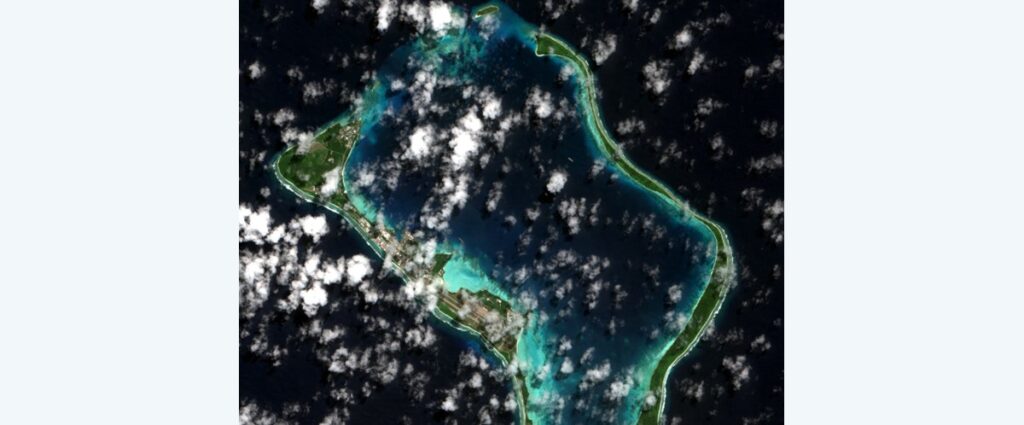
The U.S. Navy is quietly expanding its presence on Diego Garcia, a remote British atoll in the Indian Ocean, as geopolitical tensions and tactical vulnerabilities reshape its Middle East strategy. Recent satellite imagery revealed a significant buildup of military assets on the island, signaling its growing importance amid uncertainty over traditional basing options.
On August 25, open-source intelligence identified four KC-135 refueling tankers, a P-8A maritime surveillance aircraft, and three C-17 transport planes parked on the island’s South Ramp apron. Six F-15 fighter jets were also spotted. In the surrounding lagoon, an Arleigh Burke-class destroyer, a Kaiser-class oiler, and a Tanker Security Program vessel were anchored, with additional ships from the Maritime Pre-positioning Ship Squadron 2 likely obscured by cloud cover.
The Pentagon’s reliance on Diego Garcia comes as its long-standing hub in Bahrain faces new challenges. The proliferation of drones and hypersonic missiles in regional conflicts has raised concerns about the tactical viability of Naval Support Activity Bahrain, prompting U.S. officials to seek alternatives. While Diego Garcia lacks the proximity to Middle Eastern hotspots and the amenities of Bahrain, its political neutrality makes it an attractive option—at least for now.
Global Ship Lease
Logistical Lifeline or Temporary Fix?: Diego Garcia
The U.S. appears to be preparing for an extended presence on the atoll. Last week, the Maritime Administration activated the Empire State, a training vessel capable of housing 600 cadets and instructors—or up to 1,000 personnel in humanitarian crises. Though its exact mission remains undisclosed, the ship is expected to arrive at Diego Garcia within a month and remain deployed for up to 170 days. Its large capacity could compensate for the base’s limited onshore facilities, reinforcing its role as a forward operating hub.
Yet Diego Garcia’s future is far from assured. A proposed sovereignty deal between the U.K. and Mauritius, which would have transferred control of the archipelago to Port Louis while securing a lease-back arrangement for British and U.S. forces, collapsed earlier this year. The agreement required U.S. approval under a 1965 treaty, but the Trump administration refused to endorse it, citing concerns over British defense spending and foreign policy alignment.
A Legacy of Displacement and Diplomatic Gridlock
The stalled negotiations have reignited long-standing grievances. The Chagos Islanders, forcibly removed from the archipelago in the 1970s to make way for the U.S. base, have condemned the latest deal as another exclusionary decision. Their opposition adds another layer of complexity to an already fraught process.
In London, Prime Minister Andy Burnham’s government supports the Mauritius deal, with Foreign Secretary Ed Miliband and National Security Advisor Jonathan Powell pushing to revive it. However, cross-party resistance in Parliament and the Trump administration’s reluctance to cooperate make a resolution unlikely in the near term. Until then, Diego Garcia remains a critical—if imperfect—anchor for U.S. operations in the region.


Sign up free to ask CAMAL AI for a summary, the key points or anything else about this story.
Related stories
CAMAL AI
 Financial Ports Newsletter
The maritime economy, every morning
Ports, shipping and freight markets in one short email. Free.
Financial Ports Newsletter
The maritime economy, every morning
Ports, shipping and freight markets in one short email. Free.



