

US Pours $17m Into Colombo Port as China Walks Away
Washington funds digital upgrades while Beijing abandons $350m logistics hub amid regulatory hurdles.
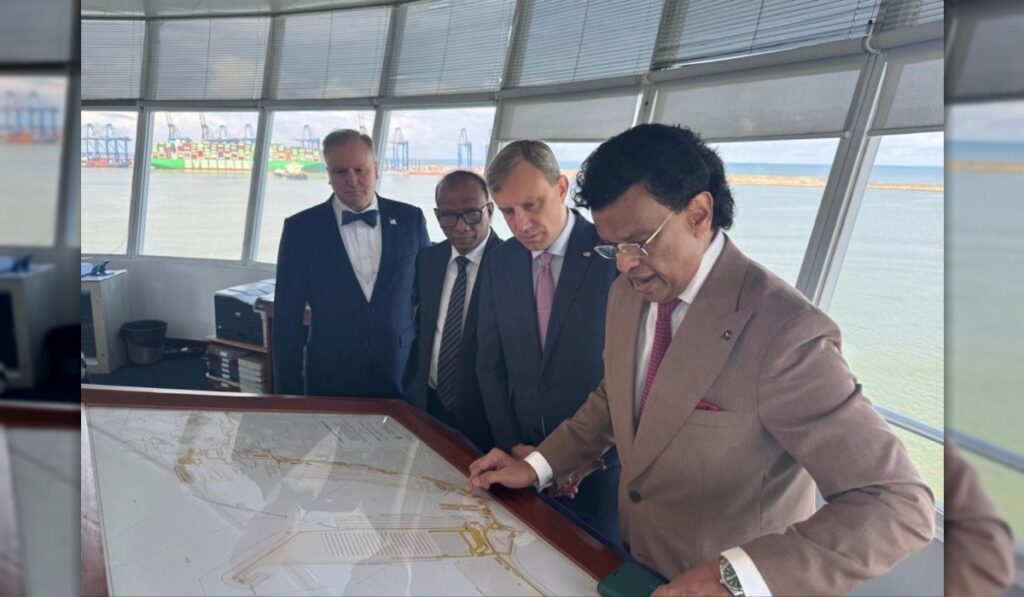
The U.S. has committed $17 million to modernise Sri Lanka’s Colombo Port with digital systems, just as China Merchants Port Holdings (CM Ports) abandons a far larger $350 million logistics hub project at the same facility.
The American investment, announced by U.S. Ambassador to Sri Lanka Eric Meyer during a tour of the port, will fund two interconnected systems: the Maritime Single Window and the Port Community System.
“More than half a million containers of U.S. inbound and outbound cargo move through the Port of Colombo each year,” Meyer said. “When goods move faster and shipping costs come down, American companies are better positioned to compete and American consumers save money. This $17 million investment will strengthen the supply chains our economies depend on and support commercial opportunities for American technology companies.”
“More than half a million containers of U.S. inbound and outbound cargo move through the Port of Colombo each year. When goods move faster and shipping costs come down, American companies are better positioned to compete and American consumers save money. This $17 million investment will strengthen the supply chains our economies depend on and support commercial opportunities for American technology companies.”
Eric Meyer·U.S. Ambassador to Sri Lanka
The upgrades come as Colombo Port cements its role as a critical node in east-west trade lanes. The port’s throughput grew 12% year-on-year in the first half of 2026, propelling it into the global top 20 by TEU volume. The Colombo West International Terminal (CWIT), which recently completed two expansion phases, now boasts a capacity of 3.2 million TEU, about 25% of the port’s 2028 target of 13 million TEU.
China’s Exit Leaves Infrastructure Gap: Colombo Port
While the U.S. ramps up its engagement, CM Ports has walked away from its $350 million logistics hub project, citing “changes in external circumstances,” including regulatory hurdles and timeline disputes. Sri Lanka Ports Authority Authority (SLPA) will pay $22 million to settle the termination, according to a stock exchange filing by the Chinese firm.
“In view of changes in external circumstances, including adjustments to the SACLH Project’s implementation environment and timetable as well as the respective commercial considerations of the parties, the Company has reassessed the SACLH Project and concluded that terminating the project would be in the best interests of the parties.”
CM Ports·Stock exchange filing
The now-abandoned hub was designed to span 5 million square feet, with 530,000 cubic meters of storage capacity for LCL consolidation, warehousing, and stuffing operations. Had it proceeded, the project would have created 1,800 permanent jobs on-site and supported another 10,000 across Sri Lanka. Work was originally slated to begin in 2023 for completion by 2025, but court challenges and land-use disputes derailed the timeline.
CM Ports remains a key player in Colombo, however, as the developer and operator of the Colombo South Container Terminal, which can accommodate vessels with an 18-meter draft.
The U.S. has deepened its military ties with Sri Lanka alongside its economic investments. In July, the two nations conducted the sixth iteration of the Cooperation Afloat Readiness and Training (CARAT) exercise, bringing together personnel from the U.S. Navy, U.S. Coast Guard, Sri Lanka Navy, and Sri Lanka Air Force.
For Sri Lanka, the digital upgrades could not come at a better time. The country’s apparel and textile exports to the U.S. reached $1.95 billion last year, making America its largest market. As Colombo Port eyes its 13 million TEU target by 2028, the efficiency gains from the new systems may help it attract more transshipment cargo, especially if China’s withdrawal leaves a void in logistics infrastructure.


Sign up free to ask CAMAL AI for a summary, the key points or anything else about this story.
Related stories
CAMAL AI
 Financial Ports Newsletter
The maritime economy, every morning
Ports, shipping and freight markets in one short email. Free.



