

Freight Rejections Soar 400% as Trucking Capacity Collapses
Tender rejection rates hit 14%—three times 2023 levels—while truckload volumes rise just 9% in three years.
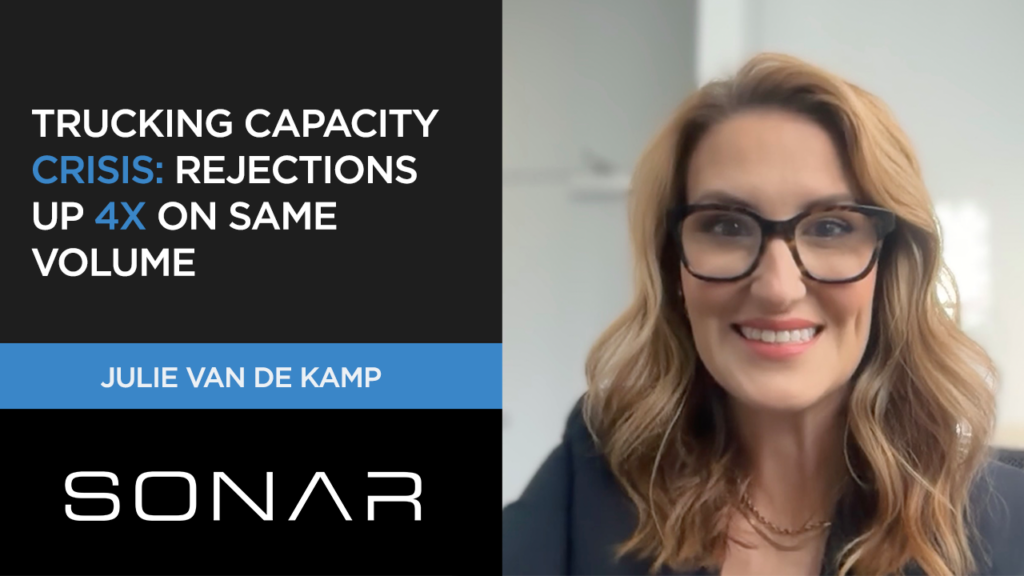
The U.S. freight market is facing an unusual capacity crisis, with carriers turning down shipments at four times the typical rate even though freight volumes have remained largely unchanged. This trend points to a deeper issue in the industry rather than a temporary surge in demand.
According to a recent Sonar market update by analyst Julie Van de Kamp, tender rejection rates have climbed to around 14%, nearly triple the levels seen in 2023. Over the past three years, truckload volumes have only increased by 9%, yet carriers are rejecting nearly four times as many loads as before. This mismatch suggests a structural problem in supply rather than a demand-driven cycle.
Why Capacity Isn’t Keeping Up
In a normal market, high rejection rates would attract new trucking operators, but this time, the response has been weak. Van de Kamp noted that total for-hire tractors dropped by about 51,000 in August alone, while new fleet tractor counts—once peaking at 47,000 in mid-2022—have continued to decline despite persistently high rejection rates.
While net carrier authority additions have recently turned positive, hitting a five-year high of over 2,000 per week in late August and September, Van de Kamp warned that these numbers don’t necessarily reflect real growth. During the last capacity boom, authorities rose by 51%, but actual tractor counts only increased by 12%.
Much of the recent spike is attributed to the FMCSA’s new MOTIS system, which temporarily paused deactivations and cleared backlogs. In reality, estimated new authority grants were 17% lower than first-quarter levels, and only about two in three new interstate registrants purchased liability insurance—far below the nine in ten rate seen in 2019.
Driver Shortages and Rising Costs Worsen the Crisis
The industry is also grappling with a severe driver shortage. More than 202,000 commercial driver’s license (CDL) holders are currently sidelined due to drug and alcohol violations. Additionally, the FMCSA’s non-domiciled CDL rule has impacted over 194,000 drivers, while English proficiency enforcement has removed roughly 2,700 drivers from service each month.
Major carriers like Schneider, Knight-Swift, and Werner have described the market as driver-constrained, with Werner noting that driver availability is now the primary limit on fleet expansion. Instead of growing their fleets, these companies are focusing on improving yield and utilization, further tightening capacity.
Van de Kamp advised industry stakeholders to monitor tractor counts, fleets reporting miles, and the gap between tender rejections and volumes as key indicators of market health. For now, the crisis shows no signs of easing, leaving shippers and brokers to navigate prolonged disruption.


Sign up free to ask CAMAL AI for a summary, the key points or anything else about this story.
Related stories
CAMAL AI
 Financial Ports Newsletter
The maritime economy, every morning
Ports, shipping and freight markets in one short email. Free.
Financial Ports Newsletter
The maritime economy, every morning
Ports, shipping and freight markets in one short email. Free.



