

Autonomous railcars hit 30-mile test track: the freight revolution begins
Parallel Systems expands its autonomous battery-electric railcar trials to a 30-mile route in Georgia.
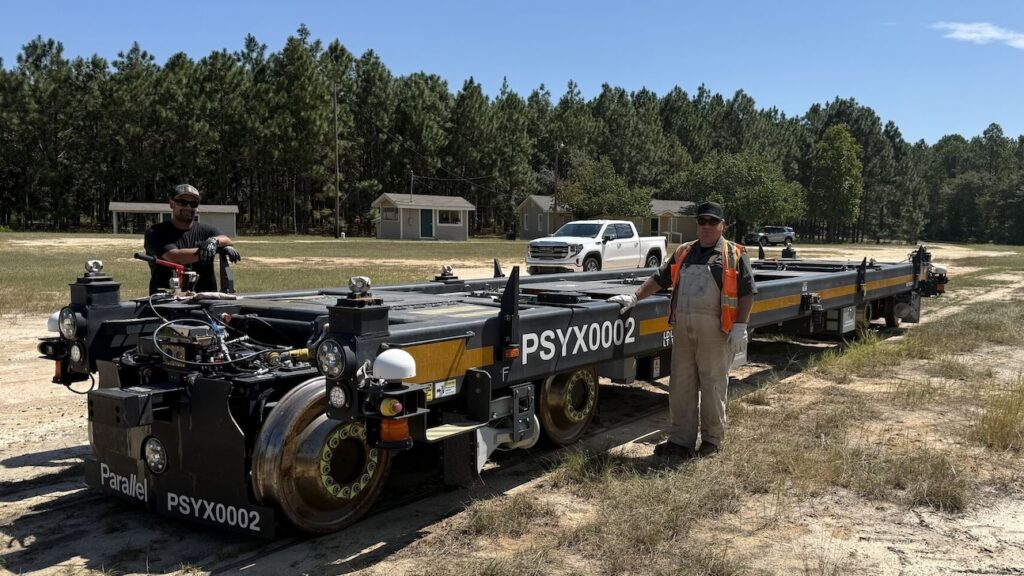
Parallel Systems has launched the second phase of its autonomous battery-electric railcar testing, extending operations from a 2-mile demonstration to a 30-mile route in Georgia that includes 43 public grade crossings. The milestone marks a critical step toward commercial deployment, with the company targeting 2026 for initial operations, subject to regulatory approval.
The Los Angeles-based firm, which raised $38 million in a Series B financing round, is now testing its self-propelled vehicles on Genesee & Wyoming’s short lines between Vidalia and an area east of Helena. The expanded route introduces remote supervision, replacing the previous line-of-sight oversight and enabling potential centralised control across rail networks. According to Parallel Systems, this phase also tackles more complex infrastructure, including diamond crossings.
The company’s vehicles are designed to carry containers individually or operate in digital platoons, offering railroads a cost-effective alternative for smaller-volume and shorter-distance freight lanes currently dominated by trucks.
Genesee & Wyoming (G&W), the short-line operator partnering with Parallel Systems, manages over 120 railroads across North America, Australia, and Europe.
The seven-phase test program spans a 160-mile corridor on two G&W lines, stretching from near Cordele, Georgia, to Pooler, close to the Port of Savannah. Each phase must receive approval from the Federal Railroad Administration (FRA) before progressing, ensuring safety and compliance with existing rail standards. Its role in approving each phase of Parallel Systems’ testing underscores the regulatory hurdles autonomous rail must clear before widespread adoption.
Parallel Systems’ technology also arrives at a time when the rail industry is grappling with labour shortages, particularly among train crews and maintenance workers.
What’s next for Parallel Systems and the rail industry: autonomous railcars
However, the path to full commercialisation remains contingent on successful test outcomes and regulatory greenlights.
Unlike trucks, which must complete Eliminar ‘500,000 miles of testing per phase’ of testing per phase, rail systems operate under distinct regulatory frameworks, potentially accelerating their adoption. California’s new rules, enacted in Eliminar ‘enacted in April 2026’, allow commercial trucks over Eliminar ‘over 10,000 pounds’ to operate autonomously, provided they comply with state and federal safety standards, including mandatory stops at California Highway Patrol (CHP) weigh stations.
For rail operators, the appeal of autonomous railcars lies in their flexibility. Traditional rail freight relies on long trains, which can be inefficient for smaller shipments. Parallel Systems’ modular approach allows for individual or platooned vehicles, enabling more agile responses to demand fluctuations. This could prove particularly valuable for short-line railroads, which often serve niche markets and lack the scale of Class I carriers. for scalable solutions to their own congestion and emissions challenges.
The Port of Savannah, one of the busiest container ports in the U.S., stands to benefit from such innovations. As a critical hub for transatlantic trade, Savannah handles over 5 million TEUs annually, with much of that cargo moving inland via rail and truck. The port’s proximity to the test corridor in Georgia positions it as a potential early adopter of Parallel Systems’ technology, should the trials prove successful.
Parallel Systems’ progress also highlights the competitive landscape in autonomous freight. Intramotev, a rival company, has already deployed autonomous railcars in commercial mining operations in Pennsylvania, working with short-line operator R.J. Corman. While Intramotev’s focus has been on closed-loop industrial applications, Parallel Systems is targeting open rail networks, a more complex but potentially more lucrative market. The two companies represent different approaches to the same challenge: making rail freight more flexible, efficient, and sustainable.
For stakeholders in the logistics industry, the stakes are high. These benefits align with global sustainability goals, including the International Maritime Organization’s (IMO) target to halve shipping emissions by 2050. Ports like Savannah, which are investing heavily in electrification and efficiency upgrades, see autonomous rail as a complementary tool to meet these targets.
As the industry watches Georgia’s trials, the question remains: Will autonomous railcars deliver on their promise of lower costs, reduced emissions, and greater efficiency? The answer may come as early as 2026, when Parallel Systems aims to transition from testing to commercial operations. For now, the company’s progress signals a broader shift in freight logistics, one where automation could redefine how goods move across continents. Rail operators, port authorities, and policymakers will need to collaborate closely to ensure that the technology is deployed safely, equitably, and sustainably.
For those interested in tracking the progress of autonomous rail, Parallel Systems provides updates on its official website, while the Federal Railroad Administration publishes regulatory guidance on its portal. Industry analysts and logistics professionals can also follow developments through trade publications like FreightWaves and Railway Age, which cover emerging technologies in freight transport.
“This phase introduces a major unlock: Remote supervision as opposed to line-of-sight supervision in the field, opening the door to centralized operations across rail networks. We’re also significantly extending the distance of our automated runs, while expanding operations across more complex infrastructure, including diamond crossings.”
Parallel Systems·Company statement


Sign up free to ask CAMAL AI for a summary, the key points or anything else about this story.
Related stories
CAMAL AI
 Financial Ports Newsletter
The maritime economy, every morning
Ports, shipping and freight markets in one short email. Free.
Financial Ports Newsletter
The maritime economy, every morning
Ports, shipping and freight markets in one short email. Free.