

AI Agents Hit the Road: Samsara’s 7x Surge in Fleet Adoption
Samsara’s no-code AI platform now available to all customers after 700% growth in agent interactions since June.
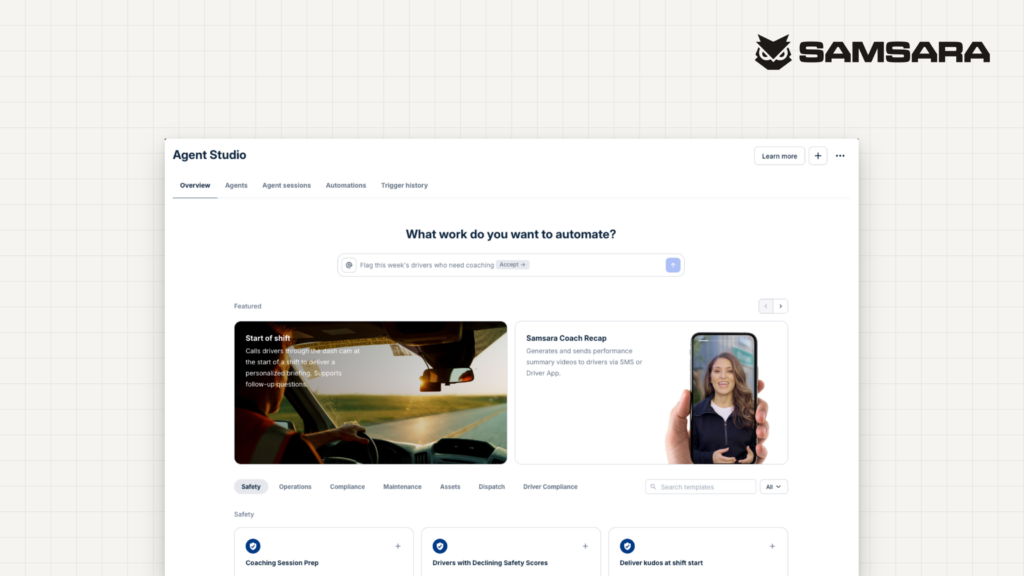
Samsara has made its no-code Agent Studio platform generally available, delivering a sevenfold surge in AI-agent interactions as logistics firms race to automate compliance and reporting. The platform, now open to all customers, has seen 500,000 interactions logged in just 16 days, down from 112 days at launch, with voice agents leading the charge.
Agent Studio allows fleets to build custom AI agents without coding, using operational data to monitor driver compliance, compile reports, and answer queries based on company policies. The platform is included in existing Samsara subscriptions, though the company has not disclosed how many customers are using agents in production or have built custom agents.
Samsara is a technology company specialising in connected operations for logistics, transportation, and industrial sectors.
What is Samsara and why does it matter in logistics?: AI Agents
The company’s focus on AI-driven automation reflects broader industry trends. Logistics providers are under increasing pressure to reduce costs, improve accuracy, and comply with stringent regulations, particularly in driver safety and reporting. Samsara’s Agent Studio platform is part of this shift, offering tools that allow fleets to automate tasks that traditionally required manual intervention, such as compliance monitoring and report generation.
Voice agents surpassed chat in interaction volume within four weeks of launch and have dominated every week since.
This ensures that AI agents can operate safely and legally, providing real-time updates and alerts without distracting drivers.
Voice agents take the lead in fleet interactions
Johan Land, Samsara’s chief product officer, attributed the rapid adoption to practical utility.
“AI is quickly adopted when it’s useful, and in physical operations that means an agent has to understand the operation and meet people where the work happens.”
Johan Land·Chief Product Officer, Samsara
Early adopters report dramatic efficiency gains. Grand Isle Shipyard cut report-generation time by 99%, reducing what once took hours to about five minutes per division. S. S. Bertram Foods reduced weekly manual review time by 84%, while StreamTech Industrial eliminated 500 hours of unassigned driving over two months. These examples highlight the tangible benefits of AI adoption in logistics.
Despite the rapid uptake, broader AI adoption in logistics remains uneven. A March 2026 Boston Consulting Group survey of over 180 logistics providers and shippers found that while 40% had deployed AI beyond pilot programs, only 10% had scaled it across core operations. Just 13% reported measurable value from AI, with unclear returns on investment and gaps in internal capabilities cited as leading barriers.
The survey’s findings reflect the challenges faced by logistics providers in integrating AI into their operations. Many firms struggle to move beyond pilot programs due to a lack of clear financial returns or the technical expertise required to scale AI solutions. Additionally, the complexity of logistics operations, which often involve multiple stakeholders and regulatory requirements, can make it difficult to implement AI tools effectively.
A separate September 2026 Descartes survey revealed that 19% of shippers and 15% of logistics service providers are using AI at scale. The findings underscore the sector’s cautious approach, even as tools like Agent Studio demonstrate tangible benefits. For many firms, the decision to adopt AI is not just about technology but also about ensuring that the tools align with their operational needs and regulatory obligations.
Samsara’s platform also includes No se menciona en la fuente, which lets users query operational data through a software dashboard, and Samsara MCP, which connects authorised data to external AI tools like ChatGPT, Claude, and Microsoft Copilot. The company provided customer case studies but did not disclose detailed measurement methods for all reported outcomes.
For logistics firms, the adoption of AI tools like Agent Studio offers several key advantages. First, it reduces the time and resources required for compliance monitoring and reporting, freeing up staff to focus on more strategic tasks. Second, it improves accuracy by reducing human error, which is particularly important in industries with strict regulatory requirements. Finally, it enhances operational efficiency by optimising fleet utilisation and reducing waste.
For drivers, AI agents provide real-time support and guidance, helping them navigate compliance requirements and operational challenges. Voice agents, in particular, offer a hands-free solution that ensures drivers can receive updates and alerts without compromising safety. This is especially valuable in high-risk zones or during long-haul journeys, where distractions can have serious consequences.
However, the adoption of AI in logistics is not without challenges. Firms must ensure that their AI tools are configured correctly and that they comply with relevant regulations. Additionally, they must address concerns about data privacy and security, particularly when integrating AI with external platforms like ChatGPT or Microsoft Copilot. For many firms, the key to successful AI adoption lies in starting small, demonstrating value, and gradually scaling up.
For logistics providers looking to adopt AI tools like Agent Studio, the first step is to assess their operational needs and identify areas where AI can deliver the most value. This may involve piloting AI agents in specific divisions or tasks, such as compliance monitoring or report generation, before scaling up to broader operations.
Firms should also consider the regulatory and compliance implications of AI adoption. For example, voice agents must comply with federal hands-free rules for commercial drivers, and data shared with external AI tools must be secure and authorised. Samsara’s platform is designed to address these concerns, but firms must ensure that their configurations align with their specific requirements.
Finally, logistics providers should focus on demonstrating measurable value from AI adoption. This may involve tracking key performance indicators (KPIs) such as time saved, cost reductions, or improvements in fleet utilisation. By quantifying the benefits of AI, firms can build a business case for further investment and scaling.
As AI tools become more embedded in fleet operations, the next milestone will be widespread measurable value, a goal that only 13% of logistics providers have achieved so far. For now, early adopters like Grand Isle Shipyard and S. S. Bertram Foods offer a glimpse of the efficiency gains possible, even as the broader industry grapples with adoption barriers. Firms looking to explore AI agents can start with Samsara’s platform, which is available through existing subscriptions and offers both voice and chat agents for immediate deployment.
For more information on Samsara’s AI solutions, logistics providers can visit the company’s official website or consult their existing Samsara subscription for access to Agent Studio and other tools.


Sign up free to ask CAMAL AI for a summary, the key points or anything else about this story.
Related stories
CAMAL AI
 Financial Ports Newsletter
The maritime economy, every morning
Ports, shipping and freight markets in one short email. Free.



