

Taiwan Deploys V-BAT Drones to Secure Its Maritime Borders
Taiwan’s Coast Guard receives its first V-BAT drones to enhance maritime domain awareness and law enforcement across.
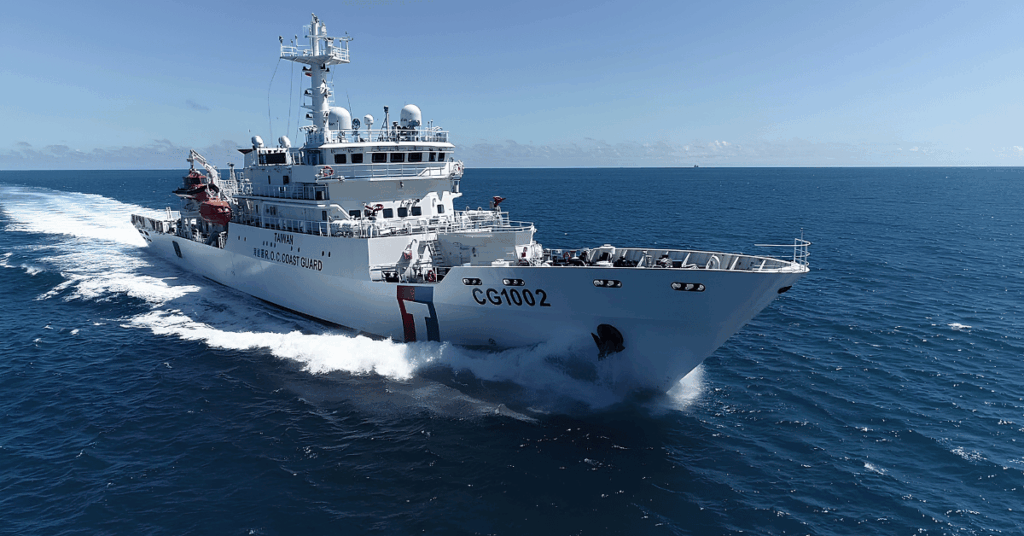
Taiwan’s Coast Guard has taken delivery of the first V-BAT uncrewed aircraft from U.S. defense-tech firm Shield AI, the initial step in a program to deploy 12 drones for maritime surveillance and law enforcement across the Taiwan Strait and coastal waters.
At a demonstration on 7 October at the Port of Taipei, Shield AI engineers assembled a V-BAT in minutes, showcasing its rapid deployment and ease of operation. The event was attended by Minister Kuan Bi-Ling of the Ocean Affairs Council and Secretary General Joseph Wu of the National Security Council, reflecting the strategic priority of the initiative.
Advanced capabilities for maritime security: Taiwan
The Coast Guard selected the V-BAT in July 2026 under its “Shipborne UAV” program to enhance maritime domain awareness. The vertical take-off and landing (VTOL) design eliminates the need for runways, allowing flexible deployment from ships and austere locations while reducing operational costs and personnel requirements.
Shield AI is delivering more than hardware. In collaboration with Taiwan’s Aerospace Industrial Development Corporation (AIDC), the company will train Coast Guard operators and maintenance crews, building local expertise to sustain and scale the V-BAT fleet. This partnership stems from an agreement signed last year to strengthen Taiwan’s aerospace industrial base and foster technological innovation.
Local partnership ensures long-term sustainability
“V-BAT will provide the Coast Guard with the intelligence and awareness needed to secure the Taiwan Strait and maritime borders,” said Brandon Tseng, Shield AI’s president and co-founder. “The system has already proven effective for the U.S. Coast Guard, helping intercept over 100,000 pounds of narcotics in the past year. Extending these capabilities to Taiwan will help counter illegal activity and enhance sovereignty in its waters.”
The V-BAT is a Group 3 uncrewed aircraft system with a ducted-fan design, offering more than 12 hours of endurance and a heavy-fuel engine. Engineered for contested electronic warfare environments, it delivers intelligence, surveillance, and reconnaissance (ISR) at a fraction of the cost and logistical burden of larger systems.


Sign up free to ask CAMAL AI for a summary, the key points or anything else about this story.
Related stories
CAMAL AI
 Financial Ports Newsletter
The maritime economy, every morning
Ports, shipping and freight markets in one short email. Free.



