

Russia’s Stealth Subs Can Strike 1,000 Miles Undetected
Yasen-M class submarines, weighing 13,800 tonnes, carry hypersonic missiles capable of hitting targets 1,000 miles away.
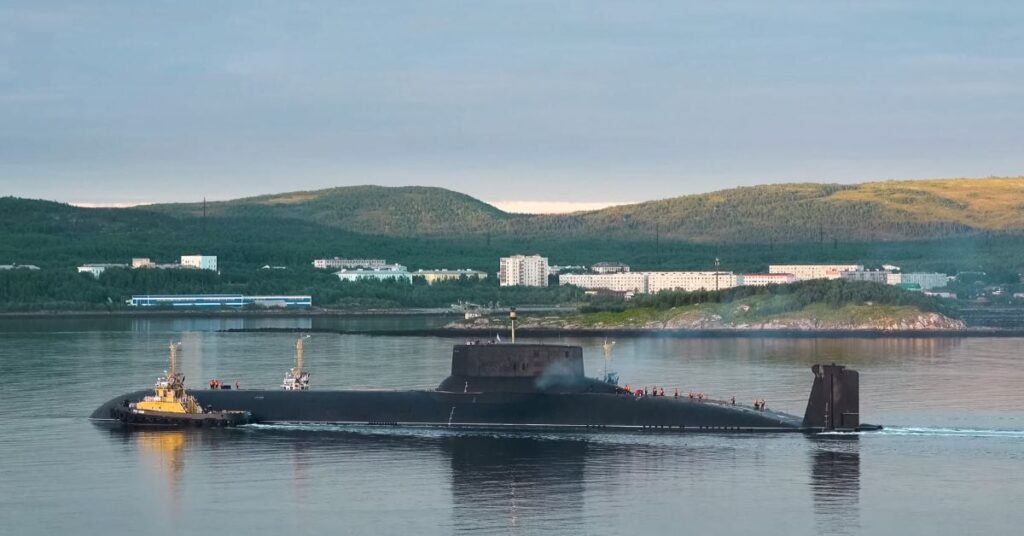
A former NATO commander has warned that Russia’s expanding submarine fleet and military infrastructure in the Arctic pose a growing threat to the alliance’s northern flank. The concern centers on Moscow’s ability to deploy advanced nuclear-powered submarines that can operate undetected in critical sea routes, including the North Atlantic and the Arctic.
Russia has intensified its military presence in the region by fortifying the Kola Peninsula with new ports and airfields while also strengthening its foothold in the Greenland-Iceland-UK (GIUK) Gap. These developments complicate NATO’s ability to monitor and counter submarine activity, as the vessels can approach coastal infrastructure or harbors with little warning. Their stealth capabilities make them particularly dangerous, as they can remain hidden until the final moments before an attack.
The threat is amplified by Russia’s latest submarine classes, such as the Yasen-M, which are equipped with advanced sonar systems to minimize their acoustic signature. Weighing 13,800 tonnes, these submarines can carry cruise missiles, hypersonic weapons, and anti-ship missiles with a range of up to 1,000 miles. Another class, the SSGN, can strike targets thousands of miles away while evading detection. Russian Navy Commander-in-Chief Alexander Moiseyev has stated that these vessels can operate undetected anywhere in the world, fulfilling their missions without radar exposure.
The melting Arctic ice, driven by climate change, has opened the Northern Sea Route for longer periods, reducing transit times between Europe and Asia. Russia has seized this opportunity to assert dominance in the region, establishing military outposts, conducting patrols, and expanding infrastructure. These moves have raised concerns among Arctic nations, including the U.S. and other NATO members, over Moscow’s naval maneuvers.
NATO’s Countermeasures and Rising Tensions: Russia
In response, NATO launched Arctic Sentry in February, a military initiative led by Joint Force Command Norfolk to coordinate air, land, and sea operations in the High North. The alliance has also bolstered its northeastern defenses with a multinational force overseen by Sweden to enhance deterrence along its northern borders.
Russia has condemned these measures, with its Foreign Minister warning that NATO’s military buildup in the Arctic risks destabilizing the region. As both sides increase their presence, the Arctic is becoming a focal point of geopolitical competition, with submarines playing a central role in shaping the balance of power.


Sign up free to ask CAMAL AI for a summary, the key points or anything else about this story.
Related stories
CAMAL AI
 Financial Ports Newsletter
The maritime economy, every morning
Ports, shipping and freight markets in one short email. Free.
Financial Ports Newsletter
The maritime economy, every morning
Ports, shipping and freight markets in one short email. Free.



