

US truckers targeted: FMCSA flags four fake Motus registration sites
Federal agency confirms only motus.dot.gov is legitimate as scammers impersonate new USDOT registration system.
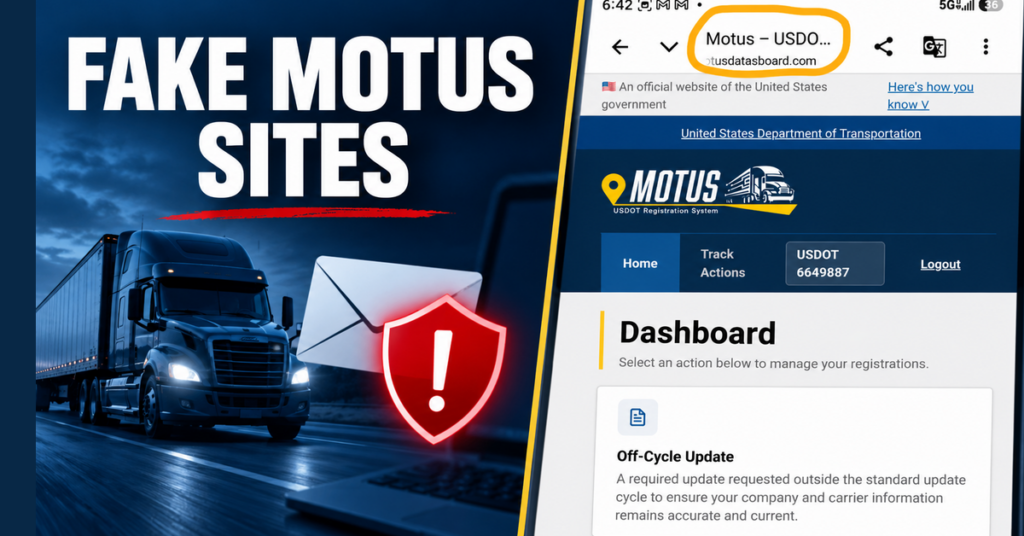
The US Federal Motor Carrier Safety Administration (FMCSA) has issued an urgent warning to trucking companies after uncovering four fraudulent websites masquerading as its new Motus registration portal.
The FMCSA’s alert, updated on September 11, confirms that only motus.dot.gov is the legitimate portal for USDOT registration updates. The four counterfeit sites, dot.motusdatasboard.com, dot.motusdatadesk.com, dot.motuswebdeck.com, and dot.motusfunction.com, lack any official affiliation with the federal government, despite their deceptive design.
How the Scam Operates, and Why It’s Dangerous: Motus
The fraudulent campaign targets carriers with emails bearing the subject line “Notice of Required Off-Cycle Update- Motus email”. These messages urge recipients to click a button labeled “New MOTUS Portal”, which redirects them to one of the fake domains. The emails exploit the transition to Motus, FMCSA’s new registration system launched on May 19, which replaced legacy processes for carriers, brokers, and regulated entities.
The FMCSA, an agency under the US Department of Transportation, oversees the safety and compliance of commercial motor vehicles.
“Latest reports indicate that bad actors have started to impersonate the Motus website application,” FMCSA stated in its fraud alert. The agency emphasised that the legitimate portal uses lowercase lettering (Motus), while scammers employ all-caps (MOTUS) as a red flag. Carriers accessing the system must do so through Login.gov, the federal government’s secure authentication platform, which requires multi-factor authentication to prevent unauthorised access. The potential fallout from this scam extends beyond data theft.
The timing of the scam is particularly concerning. On September 10, FMCSA temporarily suspended biennial-update enforcement for filings due after June 1, a measure intended to ease the transition to Motus.
What Carriers Should Do Now
FMCSA has provided clear guidance for carriers to protect themselves. First, verify the URL of any registration portal before entering credentials. Only motus.dot.gov is legitimate, and all other domains should be treated as fraudulent. Carriers should also scrutinise email senders, as scammers often use addresses that mimic official agencies but contain subtle misspellings or unusual domains.
Second, report suspicious emails or websites to the FBI Internet Crime Complaint Center (IC3) or the Federal Trade Commission (FTC). Local law enforcement and state attorneys general also accept complaints, providing additional avenues for carriers to seek recourse.
For registration-related questions, carriers can contact FMCSA directly at 1-800-832-5660. Carriers should also monitor FMCSA’s official website and social media channels for updates on the Motus transition and any further security advisories.
The FMCSA’s decision to pause biennial-update enforcement remains in effect, but carriers should prepare for its eventual resumption. The agency has indicated that it will provide advance notice before reinstating penalties, giving companies time to update their records. In the meantime, carriers should use this period to review their cybersecurity protocols, including employee training on phishing awareness and secure password practices.
This scam underscores the broader vulnerability of digital registration systems in the trucking industry. With Motus serving as the backbone for USDOT compliance, carriers must remain vigilant against phishing attempts that could compromise their operations. The shift to digital platforms, while offering efficiency gains, also introduces new risks. The FMCSA’s warning serves as a timely reminder: in an era of increasing cyber threats, even routine administrative tasks require heightened scrutiny.
The trucking industry, which moves over 70% of the nation’s freight by weight, is a prime target for cybercriminals. The sector’s reliance on digital systems for everything from registration to load tracking makes it particularly susceptible to phishing and fraud. Carriers, especially small and mid-sized operators, often lack dedicated IT security teams, leaving them exposed to sophisticated scams. The Motus impersonation campaign is just the latest example of how criminals exploit regulatory transitions to target vulnerable businesses.
“Latest reports indicate that bad actors have started to impersonate the Motus website application.”
FMCSA·Federal Regulator
The agency’s alert, dated August 2026 in a screenshot example, highlights the evolving tactics of scammers. As the trucking industry adapts to Motus, carriers must prioritise cybersecurity measures to safeguard their data and maintain compliance with federal regulations. The FMCSA has not ruled out additional security enhancements for Motus, including stricter domain verification or partnerships with cybersecurity firms to monitor for fraudulent activity.
For carriers, the message is clear: verify before you click. The consequences of a single lapse in judgment could extend far beyond a compromised account, potentially disrupting operations, damaging reputations, and incurring costly compliance penalties. As the industry navigates this digital transition, vigilance remains the best defence against cyber threats.


Sign up free to ask CAMAL AI for a summary, the key points or anything else about this story.
Related stories
CAMAL AI
 Financial Ports Newsletter
The maritime economy, every morning
Ports, shipping and freight markets in one short email. Free.
Financial Ports Newsletter
The maritime economy, every morning
Ports, shipping and freight markets in one short email. Free.



