

India and Pakistan warships collide: Who broke the rules at sea?
A Pakistani corvette and an Indian destroyer collided 220 km east of Oman, sparking diplomatic protests.
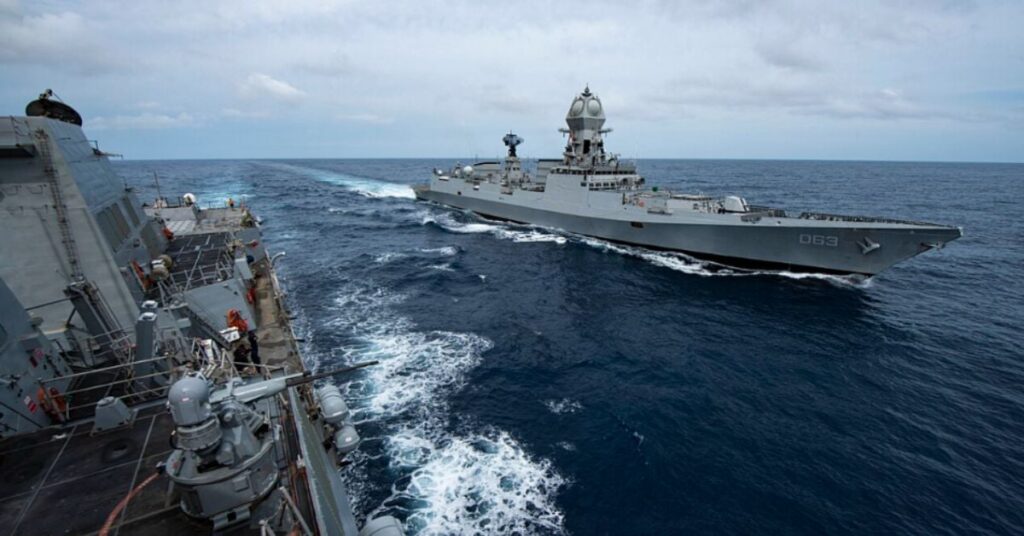
The rough waters of the North Arabian Sea exacerbated the risk, though no casualties were reported on either side.
While the Indian warship sustained no major damage, the PNS Hunain suffered a hull dent and crack, forcing it to return to port for repairs. The incident has drawn sharp diplomatic responses, with India summoning Pakistan’s Charge d’Affaires, Saad Ahmad Warraich, to its Foreign Ministry in New Delhi.
The 1991 agreement: A breach of trust in the Arabian Sea?: India and Pakistan
The collision has spotlighted the 1991 bilateral agreement between India and Pakistan, which mandates prior notification of naval exercises, troop movements, and large-scale manoeuvres. Article 10 of the accord, specifically, requires both nations to share details of such activities to prevent misunderstandings in shared waters. India alleges Pakistan violated this provision by failing to provide adequate notice of its SEASPARK-26 naval exercise, during which the collision occurred.
The exercise, which tests fleet readiness and new defence strategies, involves naval units, submarines, aircraft, marines, and special forces, along with elements from the Pakistan Army and Air Force. India claims its destroyer was conducting a routine surveillance mission when the Pakistani corvette approached at high speed, ignoring repeated warnings. Pakistan, however, contends the collision occurred within its Exclusive Economic Zone (EEZ), suggesting India’s vessel was the intruder.
Diplomatic fallout: A return to brinkmanship?
While the latest incident did not escalate into armed conflict, it has raised concerns about the potential for unintended escalation in a region already fraught with geopolitical rivalry.
India’s response has been equally firm. In a statement, Indian officials described Pakistan’s actions as ‘unacceptable and unprofessional’, urging Islamabad to adhere to the 1991 bilateral accord to prevent future incidents. The summoning of Pakistan’s Charge d’Affaires in New Delhi underscores the seriousness with which India views the collision, particularly given the broader context of their strained relations.
The collision also revives memories of a 2011 incident in the Gulf of Aden, where Pakistan’s frigate PNS Babur and India’s frigate INS Godavari were involved in a similar standoff during an anti-piracy operation. That encounter, like the current one, was resolved without casualties but left lingering mistrust. The recurrence of such incidents highlights the fragility of maritime protocols in the region, where even routine operations can quickly spiral into diplomatic crises.
For global shipping, the collision serves as a stark reminder of the risks posed by military posturing in busy waterways. The Arabian Sea is a vital artery for commercial vessels, including oil tankers transporting crude from the Middle East to Asia and Europe. Any disruption, whether from collisions, blockades, or heightened military activity, could have cascading effects on global trade and energy markets. The incident has already prompted calls for renewed dialogue between India and Pakistan to clarify maritime boundaries and reduce the risk of accidental clashes.
As both nations assess the damage and exchange diplomatic protests, the collision underscores the need for stricter adherence to maritime protocols. The 1991 agreement, while a step in the right direction, has proven insufficient in preventing such incidents. Analysts suggest that confidence-building measures, such as real-time communication channels between naval commands and joint exercises, could help mitigate future risks. However, given the deep-seated mistrust between the two nations, such steps remain unlikely in the near term.
The next steps in this diplomatic standoff will be closely watched. Pakistan’s SEASPARK-26 exercise is set to continue for several more weeks, while India’s naval patrols in the Arabian Sea show no signs of abating. For now, the collision serves as a cautionary tale about the dangers of military brinkmanship in one of the world’s most volatile regions.


Sign up free to ask CAMAL AI for a summary, the key points or anything else about this story.
Related stories
CAMAL AI
 Financial Ports Newsletter
The maritime economy, every morning
Ports, shipping and freight markets in one short email. Free.
Financial Ports Newsletter
The maritime economy, every morning
Ports, shipping and freight markets in one short email. Free.