

Cruise Lines Bet Big on Immersive Dining—But Will Passengers Pay the Price?
Norwegian Cruise Line to include immersive dining in its main fare for the first time on Norwegian Aura in 2027.
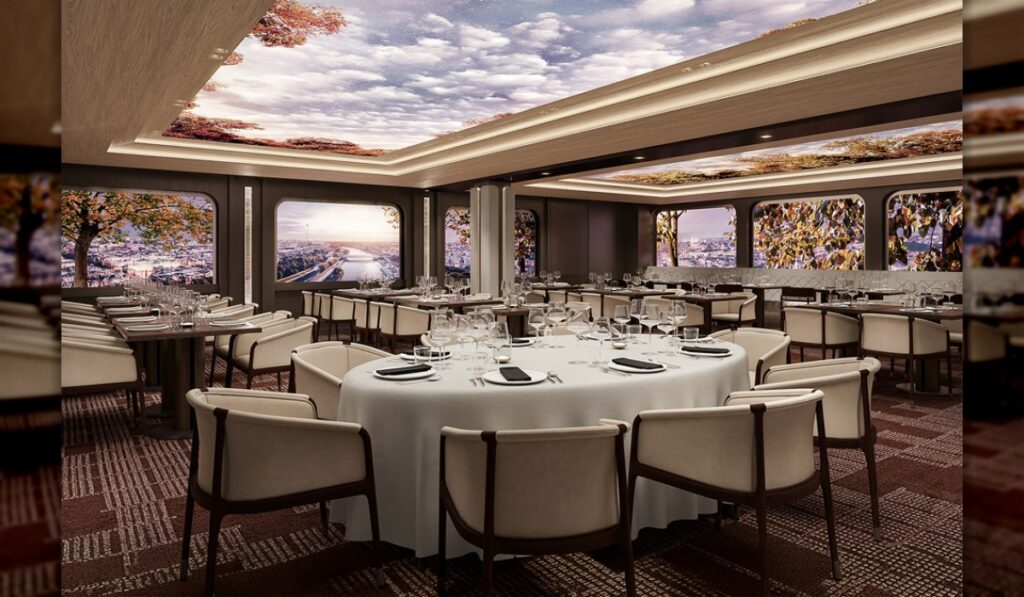
The Panorama Room, replacing The Commodore Room on Deck 6, will seat 288 passengers and transform traditional dining with expansive LED displays, multi-channel audio, and dynamic visuals, all included in the fare.
The Panorama Room will replace one of the two main complimentary dining venues on Norwegian’s Prima class ships. According to Norwegian, the venue will feature.
- Multi-channel audio systems synchronised with lighting to enhance the atmosphere.
- Dynamic visuals that shift throughout the day, transporting diners to landscapes, artwork, or thematic scenes.
Norwegian describes the experience as “a completely reimagined complimentary dining experience that transforms traditional main dining through immersive visual technology.” The company’s promotional language emphasises escapism:
Royal Caribbean
How Norwegian Aura’s Immersive Dining Works
“Savor each bite with a view of somewhere far, far away as screens across the walls and ceiling add a new dimension to the scenery as you dine.”
Norwegian Cruise Line·Eliminar este nombre propio del artículo
This approach contrasts sharply with the industry’s current model, where immersive dining is typically an upscale, paid extra.
The concept has since evolved, with newer ships like the Disney Wish, Disney Treasure, and Disney Destiny incorporating themes from Marvel superheroes and Black Panther’s Wakanda. The Disney Adventure even features two immersive restaurants, Animator’s Table and Animator’s Palate, to accommodate rotational dining.
Other cruise lines have followed suit, but with a focus on premium pricing. Royal Caribbean International, for instance, offers the Royal Railway experience on its Utopia of the Seas and Icon of the Seas, themed around the “Wild West.” The experience comes with a disclaimer:
“may induce motion sickness in some individuals.".
Industry Precedents and Passenger Concerns
However, it also raises questions about whether the concept will resonate with the broader cruise demographic, particularly older passengers who may prefer a more conventional dining atmosphere.
Another potential challenge is the risk of sensory overload. While Norwegian’s Panorama Room promises a visually stunning experience, the combination of LED displays, audio, and lighting could prove overwhelming for some guests. Royal Caribbean’s warning about motion sickness highlights the need for cruise lines to balance innovation with passenger comfort.
Norwegian’s gamble on immersive dining could have far-reaching implications for the cruise industry. If successful, it may prompt other major lines to follow suit, potentially redefining what passengers expect from mainstream cruise dining. The move aligns with broader trends in the travel industry, where experiential offerings are increasingly valued over traditional amenities.
However, the success of Norwegian’s approach will depend on several factors. First, the execution of the Panorama Room’s technology must be flawless to avoid technical glitches or sensory discomfort. Second, the cruise line will need to ensure that the immersive experience enhances, rather than detracts from, the dining experience. Finally, Norwegian must convince passengers that immersive dining is more than just a gimmick, it’s a meaningful evolution of onboard hospitality.
For passengers, the inclusion of immersive dining in the standard fare could represent a significant value addition. Those who might have hesitated to pay extra for a specialty restaurant experience can now enjoy a similar level of engagement without the added cost. However, the concept may not appeal to everyone, particularly those who prefer a quieter, more traditional dining environment.
As the cruise industry continues to evolve, Norwegian’s move could mark a turning point in how lines differentiate their offerings. The Norwegian Aura is set to launch in 2027, and its success, or failure, will be closely watched by competitors and passengers alike. If immersive dining becomes a mainstream feature, it could redefine the cruise experience for years to come.


Sign up free to ask CAMAL AI for a summary, the key points or anything else about this story.
Related stories
CAMAL AI
 Financial Ports Newsletter
The maritime economy, every morning
Ports, shipping and freight markets in one short email. Free.
Financial Ports Newsletter
The maritime economy, every morning
Ports, shipping and freight markets in one short email. Free.



