
Francisco González: “Hamilton’s DNA is 100% Canarian and we export our talent to the world”

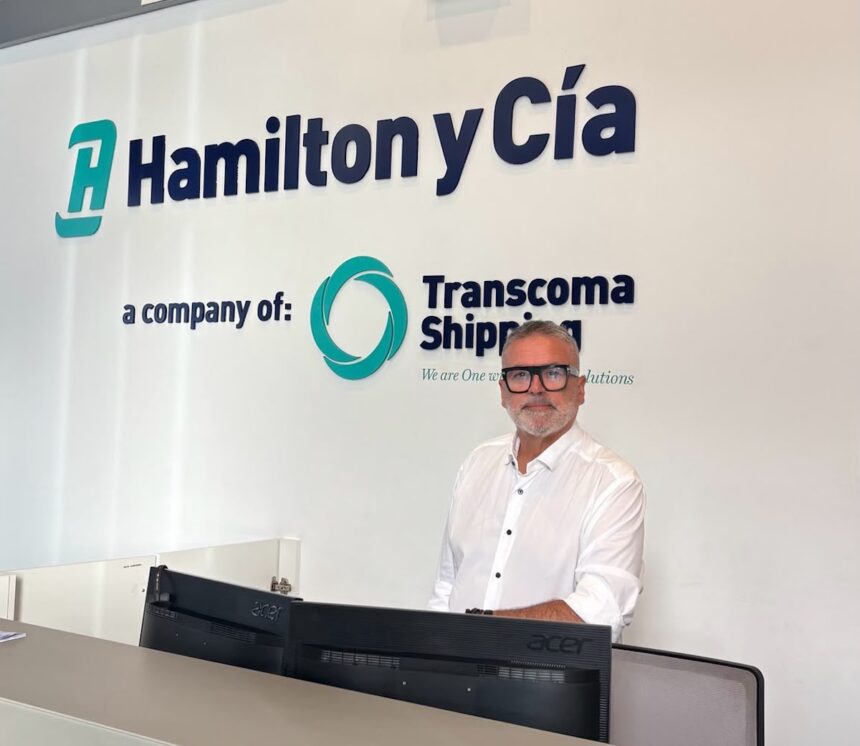
Francisco González Sánchez is the Global Commercial Director for the Oil & Gas division of the Transcoma Group, with a special focus on Hamilton y Cía , a leading company in the sector nationwide. The son of Manuel and Silvia, both true islanders—a shipping agent and a homemaker—his parents ensured he received an education entirely geared towards the maritime and logistics sector. He has been with Hamilton y Cía since 1991, having played a key role in bringing the offshore sector to the Canary Islands in 2000. Since then, he has dedicated himself to convincing international shipowners of the advantages the islands offer.
Before we begin, please tell me who you are within Hamilton & Co. and the Transcoma Group.
I currently serve as Global Commercial Director for the Oil & Gas division of the group, with a particular focus on Hamilton & Co. , which is truly the leading company in that industry nationwide. I am a proud islander and passionate about this sector.
Hamilton & Co. was founded in the Canary Islands and has nearly two centuries of maritime experience. How is that Canarian identity preserved within Transcoma as the company expands its international presence?
Hamilton’s DNA is 100% Canarian, and it has remained intact since its inception. I’d venture to say that “my boy” is almost more common in Barcelona than “sisplau” here. The Hamilton brand’s expansion beyond our islands is nothing new. Back in 2018, we marked a milestone in the Port of Cartagena by docking drilling platforms . As an anecdote, I should mention that we brought a full team of mooring crews from here; they looked like elite athletes, and it was quite a spectacle. What I mean by this is that we export talent . We helped develop the industry beyond our borders by mobilizing a whole logistics and operations team that put that port on the global offshore map. We shouldn’t have any hang-ups: creating opportunities abroad doesn’t mean abandoning the Port of Las Palmas , not at all. Quite the opposite. Only fools would believe that exporting talent and developing ourselves abroad is some kind of betrayal.
Is the Port of Las Palmas still Hamilton & Co.’s main operational and logistics center for the Atlantic offshore market?
Absolutely. Not just for Hamilton & Co., but for the industry as a whole. Sometimes we don’t realize what we have. The Port of Las Palmas has unique characteristics that make it one of a kind in the world: its geostrategic location, its deep waters, its physical and legal security, and a first-rate customs environment. Furthermore, and most importantly, it boasts a unique public management system where all levels of government are aware of the importance of this vital industry: the Port Authority, the Maritime Authority, Customs, Immigration, and so on. Let me tell you something: in all my years in this field, I’ve never had a ship left without a berth, no matter how unusual the situation. We have the best, and that’s what makes this a global benchmark . It wasn’t always the case, but now the offshore industry knows this inside and out. It’s also worth highlighting the minimal or nonexistent labor disputes, which is why major shipping companies choose the Port of Las Palmas, where dialogue always prevails among all stakeholders in this unique and wonderful port.
In what aspects do you think the Port of Las Palmas should improve in order to attract more calls from platforms, drilling ships and offshore units?
There’s always room for improvement. In our pursuit of excellence, we constantly demand change from ourselves. The outstanding issue we’re working on is the training and English proficiency of the younger generations. Our current professionals—and I’m referring to all sectors of the port—are continuously updating their knowledge, but generational renewal requires training. Above all, we must stop turning our backs on the port; if we do, we’ll have an invincible port . We need stronger vocational training, more places in engineering programs, and the digitalization of businesses. We also need universities to invest in technological fields based on the new industries that surround us and perhaps—and I’m sure I’ll get attacked for saying this— the liberalization of some services to open the port to competition .
What level of implementation has that internationalization plan reached, and which markets are currently considered priorities?
This plan is being developed in accordance with the needs of the market and our clients. Wherever we are needed, we go with our legionnaires. What was once a plan is now a reality. With the support of our group, we have a presence in 13 Spanish ports . As Hamilton, we are specifically in Ferrol , where we have high hopes for offshore wind energy, among other things, and in Cartagena , which is already a very strong presence. We have also opened an office in Dubai , which will keep me quite busy in the coming days. We have recently established a presence in Venezuela . By the way, I take this opportunity to send a warm and hopeful embrace to our Venezuelan brothers and sisters who, as you know, suffered greatly with the earthquake in La Guaira, and to express our deepest condolences to the victims of this tragedy. We also have an office in Houston , as you would expect, in Suriname , and some other projects that, for obvious reasons of confidentiality, I cannot disclose.
Does Hamilton & Co. intend to export from the Canary Islands a comprehensive model of service for platforms, offshore vessels and energy projects?
It’s not just wishful thinking, it’s a reality. Finding new markets to alleviate the overbooking that the Port of Las Palmas sometimes experiences is a real success for the Canary Islanders. We used to export tomatoes, we still export bananas, and now we also export talent and comprehensive logistics management . Our logistics capabilities are among the best, despite being located in a fragmented and remote region. We have ship repair and subsea operations with divers who are among the best in the world; it would be a shame not to export all that value, wouldn’t you say?

Focusing on the Canary Islands, what are the advantages of positioning platforms in ports like Arrecife? What benefits does it bring to Hamilton, and what benefits does it bring to the port and the Canary Islands?
It contributes immensely. The Canary Islands have wonderful ports, and there’s no reason to limit opportunities to those on the capital islands. Lanzarote is a great opportunity that has presented itself, and we’ve seized it . Hamilton saw that opportunity, we showcased it to the world, and they bought it. We’ve already carried out small fuel and logistics operations, minor repairs, and very large crew changes that have tested the entire professional network on the island. In the future, we’ll see it hosting more ambitious repair projects. Lanzarote, besides being a wonderful island like its inhabitants, has an ideal port with sufficient draft. Time will tell…

Is there sufficient commercial coordination between private companies, port authorities, and the Government of the Canary Islands to compete for major international projects?
We are becoming increasingly coordinated. Our relationships with the Port Authority, the Port Captaincy, Customs, and Immigration (Border Control) couldn’t be better. They are quite aware of the importance of this industry for the entire Canary Islands region.
Speaking only of Hamilton, why has he given up or intends to give up the multipurpose terminal in the Port of Las Palmas and let it pass into the hands of a major operator like Astican?
We haven’t given up on anything. This move is key to our strategy . The berth was just right for drillships and was being underutilized. Hamilton remains the company—excluding shipyards and terminals—with the largest concession area in the Port of Las Palmas. We continue to be the leading logistics provider in the industry , and that will remain the case, or at least that’s what we work towards every day.

Let’s return to more business-related matters. What evolution is the cruise business experiencing, and how does Hamilton & Co. differentiate itself from other shipping agents operating in this segment?
The cruise sector is booming, but it’s experiencing a similar trend to tourism in general: quantity has been prioritized over quality. It’s a sector with very low profitability, requiring a great deal of attention and staff . Hamilton is firmly committed to service and excellence, which is contrary to the current low-cost model that prevails in the market. Fortunately, we have cruise lines that believe in and support our high-end service. I’m convinced that, little by little, common sense will prevail again, with a focus on quality over quantity at low prices. Hamilton continues to fight to defend its values and quality. Cruise lines continue to trust the Port of Las Palmas, registering record numbers of port calls year after year. It’s true that the privatization of the terminals doesn’t help much, but that’s a different story.
Is there room for services provided to cruise ships to generate greater added value for local businesses and suppliers?
No.
In recent years, reports have surfaced regarding financial difficulties within the Group. Is there sufficient operational, financial, and corporate separation between Hamilton & Co. and other Transcoma companies to guarantee the continuity of their services?
Transcoma is undergoing an orderly reorganization of its companies, with some being discontinued and three new ones being added. Hamilton & Co. operates independently within the group ; it manages its projects autonomously and is unaffected beyond the numerous rumors circulating at the docks.
The port is in the news every day, even more than our leading industry, but it seems some people like to play games with the port, which should be against the law. Just kidding, otherwise I’ll be accused of being a reactionary! We should focus more on creating opportunities, on helping our young people enter a wonderful sector that captivates anyone who works in it, and on supporting each other among businesses , instead of spending all day talking about whether this one is doing well or that one is doing poorly. The port needs help and positive reinforcement, not so much armchair policing .
Finally, what is the company’s main business objective for the next three years?
Being there for our clients wherever they need us, supporting them, and continuing to serve the wonderful clients we already have. I’d also like to take this opportunity to tip my hat to my colleagues. I believe we have the best possible team . As they say at Roland Garros: “Victory belongs to the most tenacious.”
Where would you like to see Hamilton & Co. in 2030, and what role do you expect the Canary Islands and the Port of Las Palmas to continue playing in that strategy?
In the VIP box at the Gran Canaria Stadium, watching a World Cup match all together, with a John Haig! Hahaha. Seriously though, I’d love to see Hamilton & Co. firmly established in the various ports where we’re expanding; to see a Canarian company succeeding worldwide.


Regístrate gratis para pedirle a CAMAL AI un resumen, las claves o lo que quieras sobre esta noticia.

Noticias relacionadas
CAMAL AI