

15-Year-Old Survives Bering Sea Ordeal After 48 Hours on Capsized Skiff
Derek Parker Aghnaanga endured frigid waters and darkness before rescue teams located the overturned vessel 4 miles off.
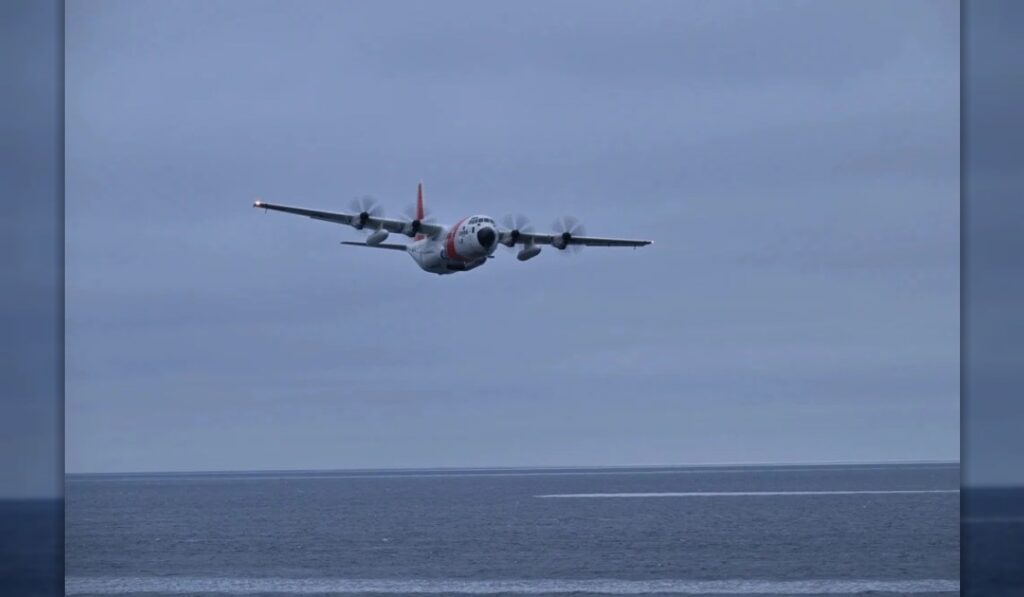
A 15-year-old fisherman survived for days atop the hull of a capsized skiff in the frigid Bering Sea after his brother and cousin perished in the icy waters off Alaska. Derek Parker Aghnaanga was rescued Monday by the crew of the Northwest Explorer, a 160-foot fishing and survey vessel, following a massive search operation involving the U.S. Coast Guard, U.S. Air Force, and local responders.
Lawrence Island. The vessel was expected to return Sunday morning, but when it failed to appear, family members alerted authorities. The Alaska State Troopers received the distress call at about 1430 hours on Sunday, marking the start of a desperate race against time.
The Search: A Race Against Weather and Distance
Adverse weather conditions initially grounded the search effort, but by Monday morning, a full-scale operation was underway. A Coast Guard HC-130 Hercules aircraft, launched from Air Station Kodiak, embarked on a 700-mile flight to St. Lawrence Island, a remote outpost in the Bering Sea, closer to Russia than to mainland Alaska. At approximately 1030 hours, the aircrew spotted the upturned skiff about four miles east of the island. They dropped a life raft and survival gear, then relayed the coordinates to the Northwest Explorer, which was already en route to the scene.
The rescue vessel, however, faced a four-hour transit to reach the skiff. As the Coast Guard aircraft neared fuel limits, it dropped flares to guide the Northwest Explorer before departing. When the fishing vessel finally arrived, its crew found Derek clinging to the hull, suffering from hypothermia but physically unharmed. His brother’s body was later recovered from beneath the skiff, while his cousin had slipped into the water during the night and perished before help arrived.
Survival in the Bering Sea: A Community’s Resilience
Savoonga, home to roughly Savoonga, relies heavily on fishing for both sustenance and cultural preservation.
“That’s one tough kid,” said Adam White, captain of the Northwest Explorer, in an interview with KTUU-TV. White recounted how Derek, despite his ordeal, had managed to communicate critical details to rescuers. “Through the teeth chattering, he had mentioned that his brother was still under the skiff. And then he said that, in the previous night, before our rescue, that his cousin had slipped away.”
The rescue operation was a coordinated effort involving multiple agencies. In addition to the Coast Guard HC-130 Hercules, three other Coast Guard aircraft and an Air Force pararescue HC-130 supported the mission. Local volunteers and Alaska State Troopers also contributed to the shoreside search, combing the coastline for any signs of the missing fishermen.
“Our hearts go out to the families, friends, and communities affected by the tragic loss of these two mariners,” said Rear Adm. Bob Little, commander of the Arctic District for the U.S. Coast Guard. “We are grateful for the incredible efforts of the motor vessel Northwest Explorer, Federal, State, Village first responders and mission partners who assisted in the effort that resulted in a life saved.”
The emotional toll of the tragedy was palpable in Savoonga, where Derek’s mother, Vina Kulowiyi, described her son’s resilience. “He lived on prayer with no food and water,” she said. “He was never afraid the whole time.”
The U.S. Coast Guard has not released a full report on the cause of the capsizing, but the incident has reignited discussions about safety measures for subsistence fishermen in Alaska. Many in remote villages like Savoonga lack access to advanced marine safety equipment, relying instead on traditional knowledge and community support to navigate the dangers of the Bering Sea.
For now, Derek’s survival serves as a stark reminder of the risks faced by those who depend on the sea for their livelihood. As the community mourns the loss of Sidney and Barton, it also celebrates Derek’s remarkable strength, a testament to the resilience of Alaska’s indigenous fishing communities.
The Northwest Explorer crew provided Derek with blankets and hot packs upon rescue, stabilizing his condition before transporting him to shore. Video footage of the rescue, shared by local media, shows the teenager in a bright yellow jacket kneeling atop the upturned skiff, a solitary figure against the vast expanse of the Bering Sea.
As the investigation into the incident continues, the U.S. Coast Guard has urged fishermen in the region to prioritize safety, including the use of life jackets and emergency beacons. For communities like Savoonga, where fishing is both a way of life and a necessity, the lessons from this tragedy will resonate for years to come.


Sign up free to ask CAMAL AI for a summary, the key points or anything else about this story.
Related stories
CAMAL AI
 Financial Ports Newsletter
The maritime economy, every morning
Ports, shipping and freight markets in one short email. Free.
Financial Ports Newsletter
The maritime economy, every morning
Ports, shipping and freight markets in one short email. Free.



