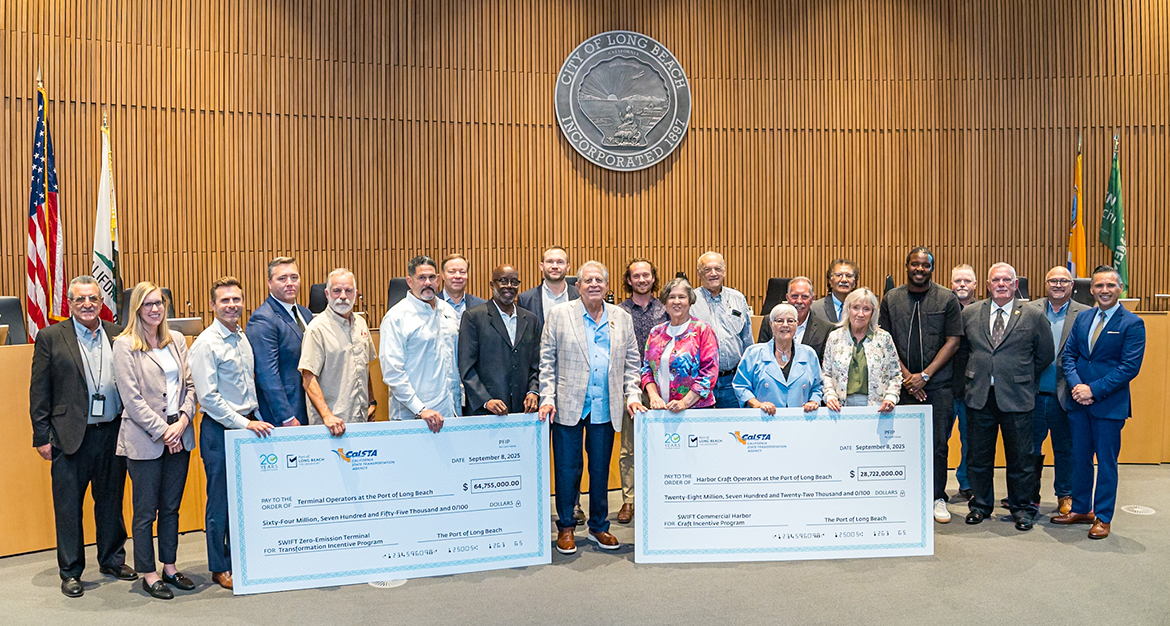
The Port of Long Beach has invested $102 million to purchase and sustain zero-emissions cargo-handling equipment, fund cleaner marine engines, and plan for a zero-carbon future at terminals. The equipment funding forms part of the System-Wide Investment in Freight Transport (SWIFT), an initiative supported by the California State Transportation Agency through its Port and Freight Infrastructure Program. The announcement places technology deployment, engine improvements, and forward-looking terminal planning under a unified investment approach intended to advance cleaner operations across one of the nation’s key maritime gateways.
According to the release, the $102 million allocation is structured to address three interconnected areas: procuring and sustaining advanced cargo-handling equipment that operates without tailpipe emissions, supporting initiatives tied to cleaner marine engines, and conducting planning work aimed at future terminal operations that do not rely on carbon. By bundling procurement, upkeep, and planning, the port signals an emphasis on continuity—ensuring equipment bought today can be supported over time while longer-horizon terminal strategies are developed in parallel.
The emphasis on cargo-handling equipment targets the machinery that moves containers and other cargo within terminals. Sustaining that equipment extends beyond initial purchase and typically includes lifecycle considerations such as technical support and integration into terminal workflows. In parallel, funding for cleaner marine engines aligns with efforts to reduce exhaust from vessels or related marine assets. Planning for zero-carbon terminals, meanwhile, frames the port’s intent to map how facilities, operations, and supporting systems could evolve to meet future decarbonization objectives.


System-Wide Investment in Freight Transport (SWIFT)
The equipment component is tied to SWIFT, an initiative funded by the state’s Port and Freight Infrastructure Program. Situating equipment deployment within a system-wide framework underscores a coordinated approach: procurement decisions are linked to a program built for port and freight infrastructure needs. While the announcement does not detail specific project lists, timelines, or equipment models, the SWIFT connection indicates that funding flows through a structure designed to align port investments with broader freight-system priorities articulated at the state level.
“Sustain” is a notable part of the port’s description. Beyond acquiring zero-emissions gear, the commitment to sustain it points to the importance of operational reliability—keeping equipment available, functional, and integrated into day-to-day terminal work. In practice, sustainment can encompass maintenance planning, parts availability, and workforce readiness, though the port’s announcement does not enumerate particular activities. The focus on sustainment acknowledges that clean-equipment initiatives succeed over time when support systems are established alongside initial purchases.
The funding set aside for cleaner marine engines complements the equipment component by addressing another source of emissions involved in cargo movement. Such support can span a range of solutions in principle, from improvements to existing systems to adoption of cleaner configurations, but the announcement does not specify which approaches are in scope. Likewise, terminal planning for a zero-carbon future points to underlying analyses—such as infrastructure layouts, operational concepts, and technology pathways—required to enable lower-emission operations as conditions and capabilities evolve.
Overall, the port’s investment aggregates near-term procurement with medium- and longer-term planning under a programmatic umbrella. It outlines a direction without venturing into project-by-project specifics. No additional details regarding schedules, vendors, or implementation milestones are included in the announcement. As the effort advances, further disclosures on project selection, contracting, and delivery will help clarify how the $102 million is allocated across equipment, marine engines, and terminal planning—and how those elements will be measured against the port’s decarbonization aims.