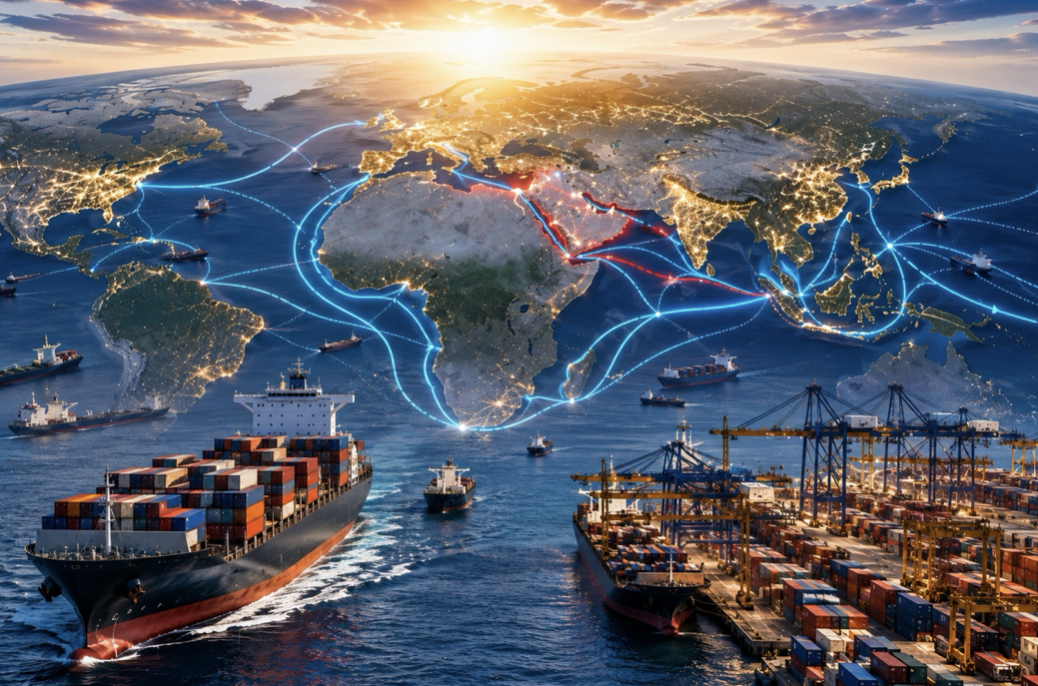
The decisive new factor in supply chains is geopolitical exposure. Companies, states, and shipping lines are redesigning their trade flows not only to produce more cheaply, but also to reduce their vulnerability to tariffs, sanctions, regional conflicts, maritime blockades, technological restrictions, and increasingly unpredictable political decisions.
The result is a profound transformation of routes and logistics, with changes in origins, destinations, and the signing of new trade agreements. Countries that once occupied secondary positions in certain value chains are becoming strategic nodes. Others, traditionally integrated into major east–west corridors, are seeing some flows shift toward substitute markets, alternative ports, or intermediate hubs. Goods continue to move, but the itineraries are changing.
THE CHINESE DRAGON GROWS AGAINST ALL EXPECTATIONS
China offers a first illustration of this trend. Its exports grew 5.8% year-on-year in June, taking advantage of a tariff truce with the United States to accelerate shipments ahead of the next negotiation deadline. But the most relevant figure is not the overall growth, but its geographic redistribution. Chinese exports to the United States fell 9.9% in the first half of the year, while rising 7.9% to the European Union and 14.3% to ASEAN, the intergovernmental organization of Southeast Asian nations comprising Brunei, Cambodia, Indonesia, Laos, Malaysia, Myanmar, the Philippines, Singapore, Thailand, and Vietnam. The conclusion is clear: trade does not disappear, it shifts and grows elsewhere.


This shift has an immediate port-level implication. If China sells less to the United States but more to Southeast Asia, Europe, Africa, or Central Asia, ports such as Shanghai, Ningbo-Zhoushan, Shenzhen, Qingdao, and Yantian are reinforced, as are redistribution hubs like Singapore, Port Klang, Tanjung Pelepas, Laem Chabang, Cai Mep, Ho Chi Minh City, Jakarta, and Manila.
EUROPE DIVERSIFIES TRADE PARTNERS
In Europe, the increase in Asian flows into the EU market could benefit Rotterdam, Antwerp-Bruges, Hamburg, Bremerhaven, Valencia, Barcelona, Algeciras, Sines, Le Havre, Gioia Tauro, Trieste, Koper, and Las Palmas, depending on whether goods enter via the Mediterranean, Adriatic, or Atlantic corridors.
Europe appears to be reacting to global market shifts and repositioning itself—not only as a destination for redirected Chinese exports partially diverted from the United States, but also as a market seeking agreements with Australia, Mercosur, India, and Mediterranean partners to reduce long-standing strategic dependencies.
Within this context, Rotterdam and Antwerp-Bruges will remain the main northern European hubs; Hamburg and Bremerhaven will maintain their industrial and automotive role; Valencia, Barcelona, and Algeciras may strengthen in the western Mediterranean; Sines may grow as an Iberian platform; Las Palmas in the Atlantic; and Trieste, Koper, and Piraeus may capture flows toward Central and the Balkans.
The Mediterranean zone could also gain weight if Asia–Europe routes are reorganized based on security levels, energy costs, and reliability. The Red Sea crisis and instability in the Middle East are forcing a reassessment of dependence on the Suez and Hormuz routes. When shipping lines reroute vessels, slow them down, or redesign port calls, ports with transshipment capacity, storage, repair services, bunkering, and strong land connectivity benefit the most.
VIETNAM, THE NEW MANUFACTURING BYPASS IN SOUTHEAST ASIA
Vietnam illustrates the complexity of the new environment. Its agreement with the United States includes a general 20% tariff, but also the threat of a 40% tariff on Chinese-origin goods considered “transshipped” or rerouted through the country. This is particularly sensitive because Vietnam has become a key supplier of clothing, footwear, electronics, and other goods to the United States, while relying on Chinese inputs for much of its production—leaving it caught between two pressures.
This makes Vietnamese ports strategic nodes but also heavily regulated checkpoints. Cai Mep–Thi Vai, Ho Chi Minh City, and Haiphong may grow in importance as manufacturing and export platforms, but they must demonstrate traceability, real value addition, and compliance with rules of origin. The same applies to other “China plus one” hubs such as Laem Chabang in Thailand, Port Klang and Tanjung Pelepas in Malaysia, Jakarta and Surabaya in Indonesia, Manila in the Philippines, and Chittagong in Bangladesh, where China is redirecting production to bypass U.S. tariffs.
AUSTRALIA SURPRISES WITH ITS NETWORK OF AGREEMENTS
Australia, a country of only 28 million people, is surprising observers with its latest trade agreements, representing a strategy of building a network of deals to reduce dependence on unstable major powers or suppliers. Canberra has signed agreements with India, the United Arab Emirates, Indonesia, Hong Kong, and Peru, and participates in regional pacts such as RCEP and Pacific Plus. It has also advanced significantly with the European Union, bringing its total network of agreements to 20 since its first deal with New Zealand in 1983.
From a port perspective, this could benefit several corridors. On Australia’s coast, Melbourne, Sydney–Port Botany, Brisbane, Fremantle, and Adelaide may gain container traffic linked to industrial goods, agri-food products, and consumer goods. In bulk and energy, likely beneficiaries include Port Hedland, Dampier, Newcastle, Gladstone, Hay Point, and Darwin. Trade flows are expected to intensify with the UK, EU, India, the UAE, and ASEAN countries.
SINGAPORE INCREASES ITS ROLE AS A CONNECTIVITY HUB
Singapore’s role will be crucial as a connecting node between Oceania, Asia, and Europe.
New Zealand and Singapore have gone further with a bilateral agreement aimed at guaranteeing the flow of essential goods—food, fuel, chemicals, construction materials, health supplies—and maintaining maritime and air routes even in crisis scenarios. This anticipates a new generation of agreements designed to ensure supply continuity under any circumstances. Such alliances place the Port of Singapore in a highly advantageous position, not only as a container hub but also as a platform for bunkering, energy alternatives, critical goods, and regional redistribution.
In New Zealand, ports such as Tauranga, Auckland, Lyttelton, Wellington, and Napier could strengthen their role in food, fuel, fertilizer, and essential supply chains. The Singapore–New Zealand route, with links to Australia and the South Pacific, thus gains strategic rather than purely commercial significance.
CANADA REINVENTS ITSELF BY BREAKING OLD LINKS
Canada is also part of this reconfiguration. Its heavy dependence on the United States is pushing Ottawa to explore agreements with Mercosur and expand non-U.S. exports. In the beef sector, tensions are evident: Canada sends around 75% of its beef exports to the United States, while imports from Mercosur grew 238% between 2021 and 2025.
This may reshape Atlantic and Pacific routes. On the Pacific side, Vancouver and Prince Rupert will remain key for Asia–Pacific links, especially with China, Japan, Korea, and Southeast Asia. In the Atlantic, Montreal, Halifax, Saint John, and Quebec may gain importance in connections with Europe and Latin America. On the Mercosur side, Santos, Paranaguá, Rio Grande, Itajaí-Navegantes, Montevideo, and Buenos Aires could benefit from new flows of refrigerated meat, soy, cereals, minerals, and industrial goods.
LATIN AMERICA AS A WINNING REGION
Latin America, broadly speaking, emerges as a net winner from these shifts. Brazil, Argentina, Uruguay, Chile, Peru, Colombia, and Mexico are becoming alternative or complementary suppliers of food, critical minerals, energy, industrial products, and light manufacturing. If tariffs pressure direct China–U.S. trade and the United States seeks to reduce Asian dependence in certain sectors, ports such as Santos, Paranaguá, Itajaí, Rio Grande, Buenos Aires, Montevideo, Callao, San Antonio, Valparaíso, Cartagena, Buenaventura, Manzanillo, Veracruz, and Lázaro Cárdenas could see significant traffic growth.
EMERGING NODES
The most benefited regions will be those able to combine: well-connected ports with alternative routes, value-added capacity, traceability, compliance with rules of origin, and integration into trade agreements that reduce geopolitical and tariff risk.
In this new map, the main winning poles are Southeast Asia (Singapore, Vietnam, Malaysia, Indonesia, Thailand), Oceania (Australia and New Zealand), the Latin Atlantic (Brazil, Uruguay, Argentina), the Latin Pacific (Chile, Peru, Mexico, Colombia), Canada as a North American diversification platform, Europe as a redistribution and absorption market in the Atlantic, and the Canary Islands as a key crossroads for these new flows.
Each time goods find a new port, country, or route to reduce risk, the global trade map is reshaped—and it will continue to do so.
Future analyses will expand the logistics equation to include the decisive role of naval forces and international cooperation in protecting merchant fleets, deterring and responding to blockades, attacks, or route disruptions, and securing the port and territorial infrastructure that sustains global trade.