

The offshore industry, a driver of profitability and diversification
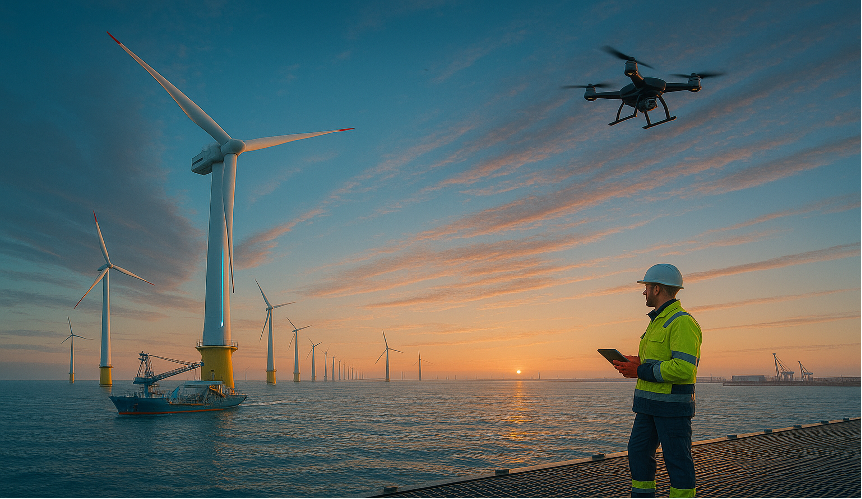
Offshore wind power has become one of the strongest pillars of the global energy transition. Today, it represents a strategic investment asset, reshaping value chains, attracting international capital, and redefining the role of ports as state-of-the-art logistics and energy platforms.
Currently, the acceleration of installation projects in European and Asian territories is consolidating major players. Thanks to the simplifying regulatory reforms in some countries, they are reducing their financial risks, creating favorable environments for investment funds, energy companies, and port managers, thus positioning themselves in a decarbonized economy.
The most recent developments demonstrate the magnitude and dynamism of this industry. Recently, the Scottish port of Cromarty Firth approved a £111 million investment to expand its facilities and become a logistics hub for offshore projects in the North Sea. In parallel, Equinor has strengthened its strategic stake in Ørsted, the world’s largest offshore wind developer, with a $1 billion investment, consolidating a business constituency capable of leading the new phases of its international projects.
Natural Gas
In the Asian market, Japan is well known for its unwavering commitment to this sector. It recently defined new offshore areas in Hokkaido, with the goal of deploying up to 45 GW by 2040, supported by floating technologies that allow equipment to be deployed in its deep coastal waters.
In Eastern Europe, Poland has made a strong entrance into the Baltic Sea. The ” Baltic Power ” project, in partnership with Northland Power and Orlen, plans to activate 76 15 MW turbines by 2026, as part of a national strategy targeting 18 GW by 2040.
Norway, a pioneer in floating offshore systems, is moving forward with new platforms, digitalization of critical infrastructure, and underwater substations, which will reduce costs and operational risks.
The United Kingdom has extended its subsidy contracts (” Contracts for Difference” ) , which aim to support wind farm developers, to 20 years , with the goal of strengthening investor confidence and tripling its offshore capacity by 2030. This formula allows for projects with stable and predictable revenues throughout their lifespan, providing security and reducing financial risks, accelerating the construction of facilities. The goal is to attract more private capital, enabling the initially planned installation to triple.
Geopolitics is also present
The installation of offshore wind farms is not just an energy issue; geopolitical and strategic decisions also come into play. Poland’s recent commitment to this industry aims to reduce its polluting use of coal and consolidate its energy security and independence from Russian supplies.
In the case of Japan, with an electrical system exposed to the volatility of natural gas, and with the recent agreement between Moscow and Beijing for the transfer and consumption of Russian gas, the commitment to offshore systems seeks resilience and energy diversification.
In this sense, offshore wind power should be understood as a critical infrastructure, comparable to gas pipelines, large airport infrastructure, or even railway networks.
The territory that moves ahead and controls generating capacity and the associated port hubs will have a structural advantage in the decarbonized global economy.
Ports as key nodes
Offshore wind energy offers advantages that make it one of the most attractive sectors for medium- and long-term investment, as it has achieved sufficient stability to guarantee stable returns on investment.
At the corporate level, mergers and strategic alliances between companies are attracting capital and reducing risk exposure. Furthermore, technological standardization and digitalization are helping to reduce generation costs. This sector not only attracts significant external investment but also the contribution of new technologies and industrial synergies, accelerating knowledge transfer.
Ports directly benefit from this consolidation and maturity. With the implementation of multifunctional platforms, parallel investment opportunities arise. These include assembly and logistics centers specializing in the handling of towers, nacelles, and blades over 100 meters long. They also serve as permanent operation and maintenance bases for service fleets, workshops, and warehouses. They also serve as a magnet for auxiliary industries, shipyards, component factories, and submarine cable suppliers. But, above all, they diversify the port business with the guarantees this entails for future development and growth.
Offshore wind is projected to be a key asset class for infrastructure funds, private equity, and green portfolio managers, generating stable, long-term income streams indexed to government contracts, enabling sector diversification with a direct impact on the energy transition, and offering guaranteed growth potential. It is a sector aligned with the climate policies of the EU, the United Kingdom, Korea, and Japan, among other countries, which are beginning to join them.
The sector in figures
According to the consulting firm DNV, offshore wind capacity could grow 56-fold compared to 2020 levels, with an average annual growth rate of 13% between 2020 and 2050. This means setting global production capacity in 2050 at around the impressive figure of 800 GW, which will need to be provided with all kinds of services.
According to the latest Wind Europe report, investment in wind farms in Europe during 2025 has exceeded the entire total for 2024. Europe is moving quickly to bolster its growth.

In terms of cumulative installed capacity, the ranking is led by Germany with a cumulative 74 GW, of which 9 GW are offshore, followed by Spain with 32 GW, France with 24 GW, of which 1.5 GW are offshore, and Italy with 13.2 GW. In the ranking of installed offshore capacity, Germany stands out by far with 9 GW, the Netherlands with 4.7 GW, Denmark with 2.6 GW, Belgium with 2.2 GW, and France with 1.5 GW. Outside Europe, of course, the United Kingdom leads with 16.5 GW of installed offshore capacity, even surpassing its own onshore capacity of 15.8 GW.
By mid-2025, Europe had a total of 291 GW of installed wind power capacity, 254 GW onshore and 37 GW offshore. Germany has been successfully completing its “homework” so far, meeting the established targets. The answer lies in the agility with which it issues permits. The average time is about 18 months, within the framework stipulated by the Renewable Energy Directive III. No other EU country can match the pace of the German powerhouse in terms of processing and installation.
Around 400,000 people work in the wind energy sector in Europe, which means that every MW installed is equivalent to 1.5 jobs. In the offshore sector, this figure increases. This is undoubtedly a challenge and a wide range of opportunities in logistics, ports, and, of course, employment. Let’s not be late to the future.


Sign up free to ask CAMAL AI for a summary, the key points or anything else about this story.
Related stories
CAMAL AI
 Financial Ports Newsletter
The maritime economy, every morning
Ports, shipping and freight markets in one short email. Free.
Financial Ports Newsletter
The maritime economy, every morning
Ports, shipping and freight markets in one short email. Free.



