
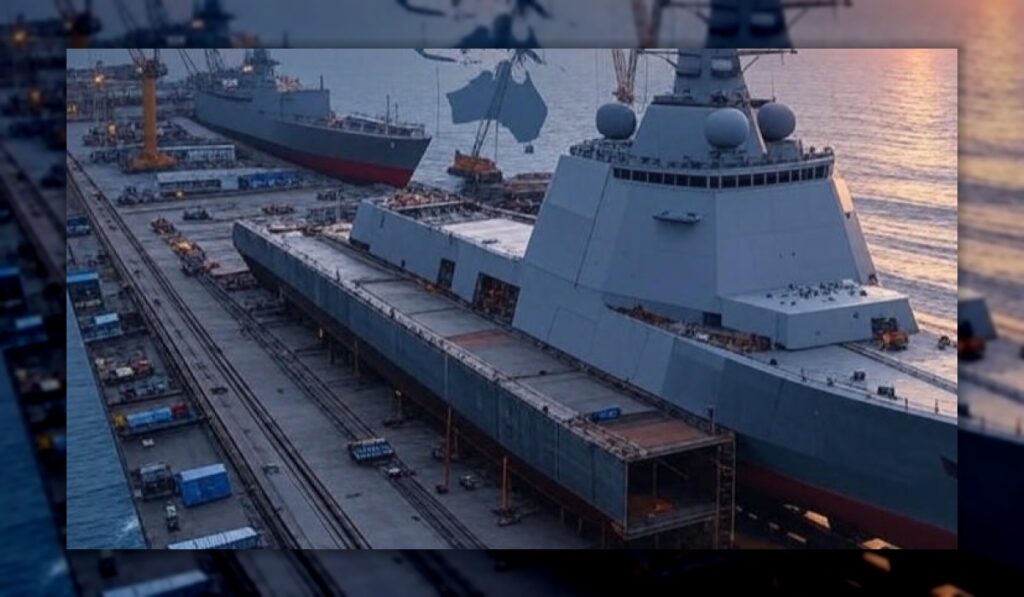
In an interconnected world dependent on maritime routes that transport 90% of global trade, the naval industry is re-emerging with increasing importance as a fundamental pillar for the major economic powers. It’s not just about building ships, but also about ensuring sovereignty, projecting dominance, and fostering technological innovation. China, Japan, and South Korea are leading this race. The United States and India aspire to overtake them with their new public policies, investing billions in shipyards with enormous capacities to develop national fleets and port facilities. What factors condition and drive this strategy?
We are living in a moment in history in which the naval industry transcends the economic, having become a true multiplier of the geopolitical power of the great powers, contributing to national security. This became evident during the pandemic. Countries with national fleets strategically prioritized their shipments. In the post-pandemic period, the sudden increase in demand also posed a problem for those powers without their own fleets.
In a context of geopolitical tensions in the Indo-Pacific, the Arctic, the Strait of Malacca, and the Strait of Hormuz, national fleets are playing a key role, protecting key trade routes.
Hanwha Ocean
Economically, the naval sector has an enormous capacity to generate wealth in the chain. Every job in the shipyards creates five more in the supply chain, from steel mills, to advanced electronics, to utilities, etc. Robert O’Brien, former U.S. national security advisor, highlighted in a recent analysis that commercial shipbuilding strengthens the industrial base, reducing costs, including in the military shipbuilding industry.
South Korea’s state trade promotion agency, Kotra , estimates that the global shipbuilding industry will grow from $150.4 billion in 2024 to $203.8 million in 2033.
China accounts for global naval production, comfortably dominating the sector. The tariffs imposed by the US on ships built by Beijing aim to balance the sector and revive the industry. Aware of the sector’s enormous economic potential and China’s leadership, the US, Japan, and India are seeking to increase their shipbuilding and repair activity by all means possible. The development, commercial leadership, and security of their states depend on it.
Control of large national fleets even exerts economic coercion on states. To understand this, and even if China decided to withdraw its merchant fleet, the largest in the world, from a region, many economies would be paralyzed. In a world with constant disruptions in supply chains, controlling shipbuilding and repair ensures resilience. At the same time, global rearmament driven by current armed conflicts has increased demand for dual-use, commercial and military vessels, such as patrol boats and logistics vessels.
THE BET OF THE GREAT POWERS
China dominated 70% of global shipbuilding orders measured in compensated GT during fiscal year 2024, up from 32% in 2017. Aware of its competitive advantage and seeking to maintain this situation, Beijing is currently massively subsidizing its shipyards, such as the State Shipbuilding Corporation (CSSC), whose activity has been growing steadily. The US government’s port tariffs, which will be applied starting October 14, 2025, amount to up to $120 per container unloaded from a Chinese vessel in US ports, representing a challenge for the Asian giant and an opportunity for its South Korean and Japanese competitors. With these measures, the United States seeks to revitalize its industry.
The U.S. administration signed an executive order on April 9, 2025, to create the National Maritime Plan. The measure focuses on reactivating shipbuilding, repair, and port improvement capacity in the United States, one of the vital industrial sectors that has been declining since the 1980s. The plan includes maritime prosperity zones, mariner training, and countering Chinese dumping.
Former U.S. National Security Advisor and President of American Global Strategies, Robert O’Brien, has emphasized that without thriving commercial construction to revive the entire sector, Navy ships will continue to cost twice as much. These are cross-cutting and closely interrelated activities. Currently, and while the aspirations of the National Maritime Plan are being developed, the U.S. is exploring partnerships with South Korea, specifically with Hanwha Ocean, to repair Navy ships, such as the USNS Wally Schirra, through MRO (maintenance, repair, and operations) contracts on U.S. soil. Hanwha Ocean has acquired a shipyard in Philadelphia for $1.1 billion and has committed to further investments through 2054.
In Japan, the shipbuilding industry has consolidated its share of 12% of global deliveries by 2024. Imabari Shipbuilding acquired 60% of Japan Marine United, creating a giant company aiming to reach 20% of the global market by 2030, focusing especially on low-emission vessels powered by ammonia or methanol. Japan’s continuing problem is its lack of skilled labor and its aging population, which is why it relies on migration to fill the gap. Japan’s policy of ensuring that its domestic fleet is built and repaired only at domestic facilities also contributes to protecting the sector.
A $7 billion public-private fund will modernize Japanese shipyards, addressing the labor shortage by bringing in 76,000 workers, 20% of whom will be foreigners. So far, US tariffs have not had an impact on demand for Japanese-built vessels, which remain stable.
South Korea accounts for 17% of new orders in 2024. Groups such as HD Hyundai and Hanwha offer very competitive costs. The latter has positioned itself as Washington’s preferred partner, obtaining 30-year contracts to extend the lifespan of naval vessels by building unmanned ships or frigates.
In Europe, the need for urgent rearmament is providing a significant boost to the sector. In Spain, the company Navantia plays a leading role. The recent decision to divert work from the £2 billion contract with the Royal Navy to Ferrol due to problems at the Belfast shipyards is benefiting the entire network of associated shipyards.
A FUTURE OF NAVAL COMPETITION
The naval industry is not just an economic sector; it has become an instrument of geopolitical power. The superpowers, aware of this, are investing in this industry to exercise greater control over trade, defense, and innovation in a multipolarized and extremely competitive world.
China leads in volume, but policies like those of the US administration disrupt the status quo that prevailed until now. Shipbuilding, shipyards, and national fleets will increasingly define global supremacy. However, challenges such as labor shortages, specialization, and environmental costs must be addressed, which requires international alliances to achieve sustainability in this industry.
China, South Korea, Japan, the United States, and India are investing heavily in this sector to ensure its development and leadership at all levels. Their reasons are justified in an environment where geopolitics plays an increasingly important role, and control of this industry is essential.