

Norway and France sign an agreement for the cross-border transport of captured carbon
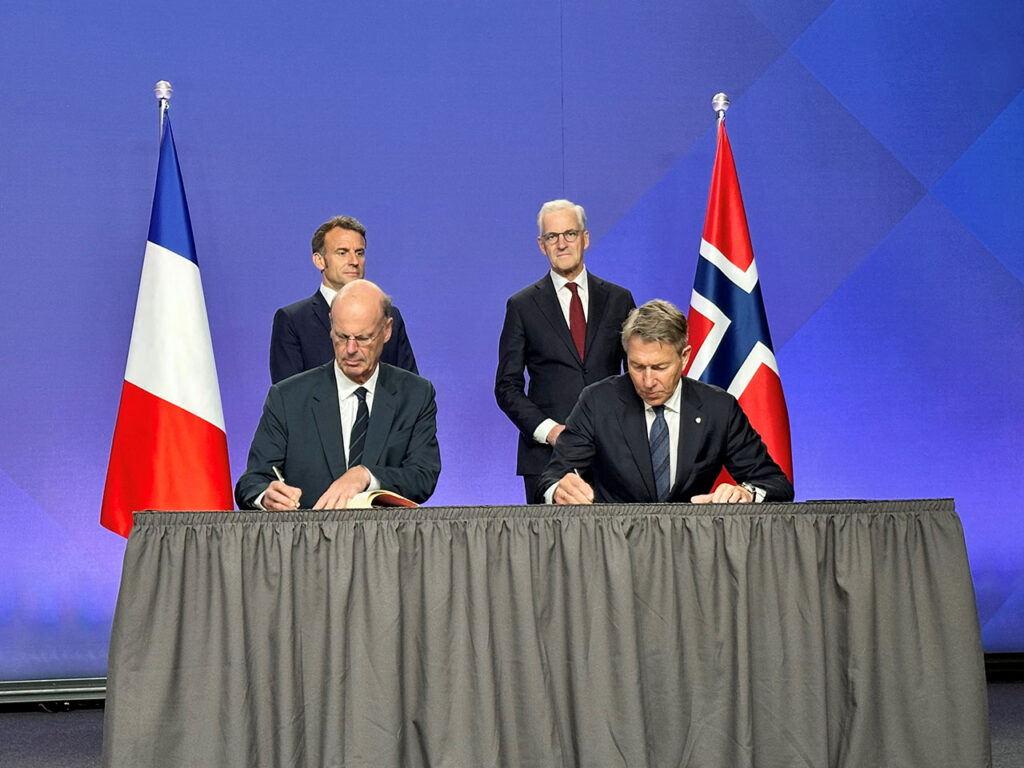
The governments of France and Norway signed a groundbreaking agreement, on June 23, that will enable the cross-border transportation of captured carbon dioxide (CO2), from French ports, to offshore storage facilities in the North Sea. The agreement was signed in Oslo by Norway’s Minister of Energy, Terje Aasland, and France’s Minister of Economy and Finance, Éric Lombard.
This agreement will allow CO2 captured at French maritime industrial centers, such as the ports of Le Havre, Dunkirk, and Saint-Nazaire, to be transported by sea to storage facilities at the Øygarden terminal on the Norwegian continental shelf near Bergen, where it will be injected and permanently stored 2,600 meters beneath the seabed. The transportation will be carried out by tanker ships designed for liquefied CO2 transport, following the model established by the Northern Lights project, managed by the alliance of energy companies Equinor, Shell, and TotalEnergies.
This initiative is part of the Longship project, launched by the Norwegian government in 2020, which has already begun transport and storage operations with a first CO2 shipment from the Brevik cement plant to the Øygarden terminal in June 2025. The first phase of the Northern Lights project has the capacity to store up to 1.5 million tonnes (Mt) of CO2 annually, which will increase to over 5 Mt in its second phase.
Norwegian Cruise Line
The agreement complies with the London Protocol and European legislation on carbon storage and emissions trading (ETS), providing a solid legal framework for the development of a European carbon capture and storage value chain. France has recently approved the necessary legislative amendments to enable cross-border CO2 transport, highlighting the strategic importance of this initiative.
According to Norway’s Ministry of Energy, this agreement facilitates the management of French emissions through CO2 storage and supports the development of a European market for carbon capture and storage (CCS).


Sign up free to ask CAMAL AI for a summary, the key points or anything else about this story.
Related stories
CAMAL AI
 Financial Ports Newsletter
The maritime economy, every morning
Ports, shipping and freight markets in one short email. Free.
Financial Ports Newsletter
The maritime economy, every morning
Ports, shipping and freight markets in one short email. Free.



