

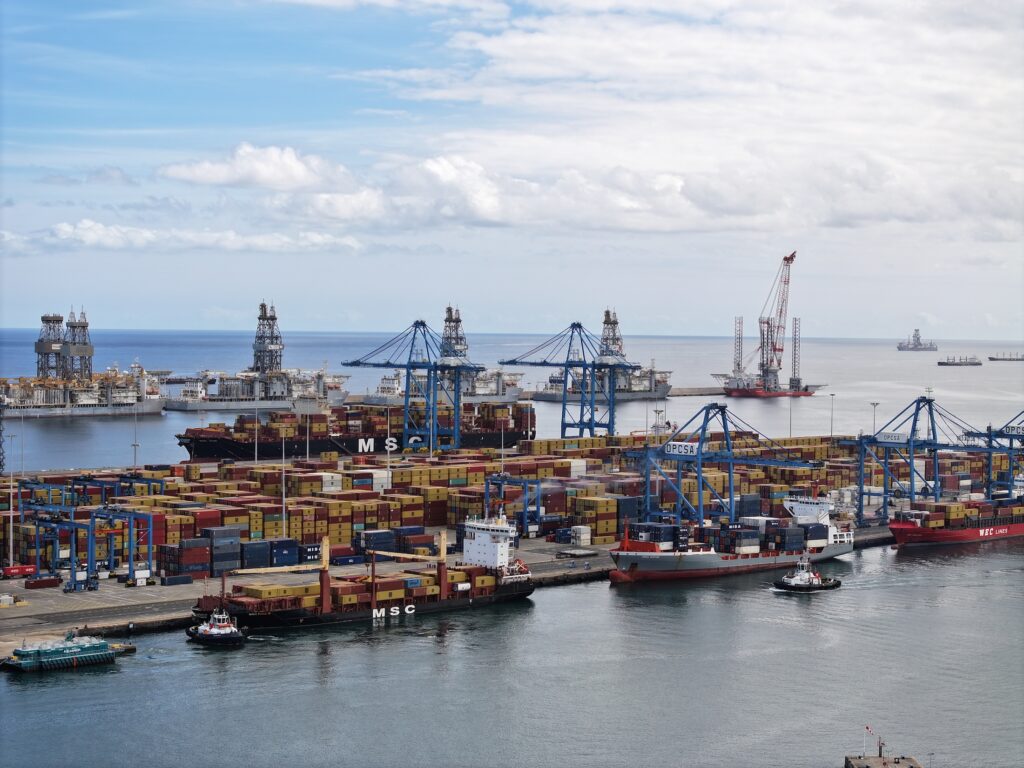
Las Palmas Ports ranks as the fourth busiest spanish port, surpassing Bilbao in the first half of the year
The cruise sector closes the first half of the year with 1.2 million cruise passengers at the ports of Las Palmas.
___________________________________________________________________
According to the latest data from the Cruise Lines International Association (CLIA) Spain, the cruise industry supported the creation of nearly 49,000 jobs in the country, contributed €6.45 billion to the economy, and added €3 billion to the GDP in 2023.
______________________________________________________________________________
Statistics from Puertos del Estado position Las Palmas Port Authority in fourth place in terms of total tonnage, with 12.1% growth, placing it ahead of the Port Authority of Bilbao (Group 1), which recorded a -14.7% decline during the first six months of the year.
Royal Caribbean
Thus, Las Palmas ranks among the top four Port Authorities, along with Valencia, Algeciras, and Barcelona—these three being part of Group 1. “Once again, these figures clearly show that we deserve to move up a level, as our statistics consistently support us month after month,” stated Beatriz Calzada, president of Las Palmas Port Authority.
Statistics published by the Port Authority reflect an increase in total traffic, reaching 17,757,871 tonnes in the cumulative total for 2025—an increase of 12.05% compared to last year, representing 1,909,321 more tonnes than in 2024.
The growth recorded for the Port of Las Palmas stands at +12.43%, with 15,529,049 tonnes as of June; the Port of Arrecife increased its total traffic by +10.88%, with 982,815 tonnes; the Port of Puerto del Rosario also posted positive figures, growing +18.20% with 827,817 tonnes; the Port of Arinaga increased by +8.45%, with 132,617 tonnes; while the Port of Salinetas saw a -12.63% decrease in traffic, with 285,573 tonnes.
The year-on-year variation for June 2025 compared to June 2024 for the five ports under Las Palmas Port Authority shows the following data in key indicators:
-
Passenger traffic: +12.75% (−3.28% in regular service and +24.88% in cruises), totaling 1,883,407 passengers, compared to 1,670,500 in 2024.
-
Goods traffic: +13.22% with 16,238,694 tonnes, compared to 14,342,408 tonnes in 2024.
-
Frozen fish: −7% with 126,561 tonnes, compared to 136,091 tonnes.
-
Fresh fish: −39.22% with 279 tonnes, compared to 459 tonnes in the same period last year.
-
Fuel: +0.25% with 1,373,081 tonnes, compared to 1,369,722 tonnes in 2024.
-
TEUs: +7.43% with 732,519 units, compared to 681,877 in 2024.
-
General containerized cargo: +5.86% with 7,991,153 tonnes, compared to 7,548,762 in 2024.
-
Ro-Ro traffic: +1.95% with 185,511 units, compared to 181,971 units the previous year, and +12.77% in weight, with 2,789,004 tonnes, compared to 2,473,146 tonnes in 2024.
June Statistics for the Port of Las Palmas
For the Port of Las Palmas, the year-on-year change from June 2025 to June 2024 in key indicators is as follows:
-
Passenger traffic: +8.45% (−1.51% in regular service and +22.72% in cruises), totaling 1,190,034 passengers.
-
Goods traffic: +13.85% with 14,036,719 tonnes.
-
Frozen fish: −5.66% with 123,911 tonnes.
-
Fresh fish: +44.44% with 13 tonnes.
-
Fuel: +0.27% with 1,368,505 tonnes.
-
TEUs: +7.71% with 676,157 TEUs.
-
General containerized cargo: +5.95% with 7,543,931 tonnes.
-
Ro-Ro traffic: −0.41% with 122,633 units, and +9.24% in weight, totaling 1,890,291 tonnes.

Cruise Sector
Las Palmas Port Authority closed the first half of the year with 1,187,066 cruise passengers—an increase of nearly 25% compared to the same period in 2024. According to the president of the public authority, Beatriz Calzada, the cruise sector continues to grow across the three islands of the province of Las Palmas. A clear sign of this upward trend is the nearly 250,000 additional cruise passengers who arrived between January and June 2025.“In this first semester, cruise ships calling at our ports made a total of 437 calls—181 in Gran Canaria, with over 550,000 passengers; 144 in Lanzarote, with 351,000 cruise passengers; and 112 in Fuerteventura, with 288,000,” Calzada stated. “These passengers are already enjoying the new terminal facilities on the latter two islands, and by the end of the year they will also benefit from the new cruise terminal in Gran Canaria, currently being built by our concessionaire, Global Ports. It will be the largest cruise terminal in Europe.”
Gran Canaria, Lanzarote, and Fuerteventura receive nearly half a million cruise calls in the first six months of 2025
Calzada recalled that forecasts point to an 18% increase in both cruise calls and passengers this year, potentially surpassing two million cruise tourists in the province of Las Palmas. Furthermore, 2025 is showing a rise in cruise passengers from the United States and Canada, along with the inclusion of Las Palmas ports in repositioning cruise routes between the Caribbean and the Mediterranean and vice versa.
It is worth highlighting that, according to the latest data from the Cruise Lines International Association (CLIA) Spain for 2023, the cruise sector contributed €6.45 billion to the Spanish economy and added €3 billion to the national GDP. “In 2023, the cruise industry generated nearly 49,000 jobs, and each cruise passenger spent an average of €224 per person per embarkation,” Calzada emphasized. She added: “These are undoubtedly very positive figures for an industry that generates wealth and opportunities across multiple sectors—from food suppliers and tour guides to travel agencies, and many more.”


Sign up free to ask CAMAL AI for a summary, the key points or anything else about this story.
Related stories
CAMAL AI
 Financial Ports Newsletter
The maritime economy, every morning
Ports, shipping and freight markets in one short email. Free.
Financial Ports Newsletter
The maritime economy, every morning
Ports, shipping and freight markets in one short email. Free.



