

ICAVE Marks 30 Years at the Port of Veracruz
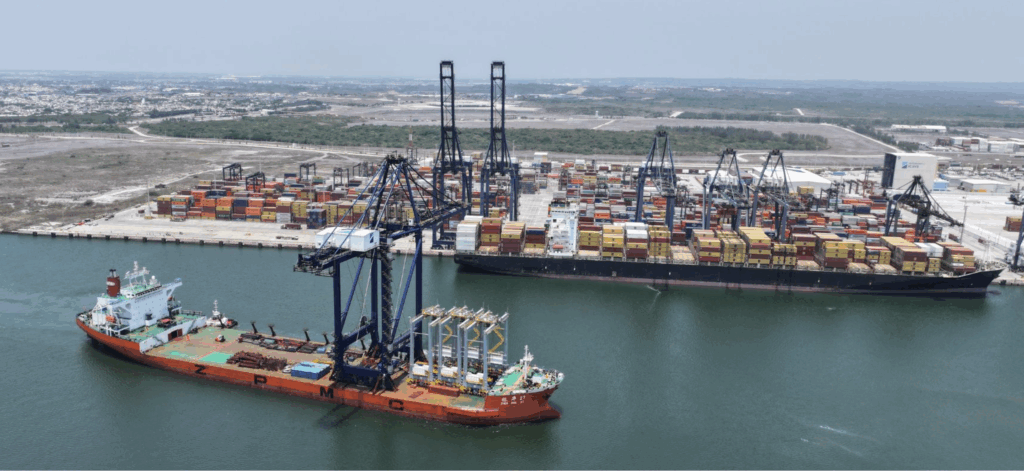
ICAVE, a pioneer of private participation in Mexico’s national port system, marked its 30th anniversary after obtaining the country’s first private port concession on August 25, 1995, under the Ports Law enacted a year earlier. From its inception, the terminal helped anchor a new era of modernization in Mexican ports. The celebration underscores the operator’s continued role within the Port of Veracruz, where its trajectory—from a modest footprint to an automated, electrified operation—has become a reference point for container handling, efficiency, and long-term investment planning.
The company began operations three decades ago in the current Bahía Sur area of Veracruz on four hectares with 200 meters of quay. That early platform provided the starting point for equipment upgrades, process standardization, and a broader transition to private-sector involvement that reshaped port operations nationwide. The initial scope and location laid the groundwork for growth, culminating in a strategic migration that aligned infrastructure, land use, and technology with rising cargo volumes and evolving vessel sizes.
ICAVE at 30: Capacity, Automation, Decarbonization
Today, Hutchison Ports ICAVE operates in Bahía Norte with capacity to handle 1.3 million TEU annually, supported by 1,050 meters of quay and two berthing positions. The terminal deploys Super Post Panamax cranes—four of them under automation—alongside a logistics platform that includes a ZAL, a CFS warehouse, reefer connections, and a suite of digital tools. These technologies comprise autonomous trucks, optical character recognition (OCR) at access points, RFID, real-time operational control, and smart-gate systems, all aimed at reducing turnaround times and enhancing safety and reliability.
Royal Caribbean
According to Hutchison Ports ICAVE, the development of Bahía Norte was carried out through a co-investment framework with the port authority. That structure enabled the Port of Veracruz expansion and established the basis for future terminal growth. The model linked public infrastructure delivery with private operational commitments, facilitating phased capacity additions and equipment deployment while aligning broader port development with terminal needs.
As part of the 30th anniversary, ICAVE incorporated a latest-generation electric crane with an investment of 226 million pesos, implemented a remote operating scheme—ROS—for four quay cranes, and rolled out autonomous trucks. These steps are aligned with the company’s decarbonization pathway to cut absolute emissions by 54.6% by 2033 and reach net zero in 2050. “Our priority is to sustain competitiveness with an increasingly clean operation. The electrification plan is advancing with clear goals for 2033 and 2050,” said Jorge Magno Lecona Ruiz, director of Hutchison Ports in Mexico, Latin America, and the Caribbean.
The terminal currently generates more than 1,500 direct jobs and close to 13,000 indirect jobs. Operational milestones include surpassing 10 million TEU in cumulative throughput in 2015, achieving its first 1 million TEU in a single year in 2018, and completing the migration to Bahía Norte in 2019. Looking ahead, Phase II construction is planned for 2026 to further expand capacity and accommodate larger vessels, positioning the terminal to manage projected demand and support the port’s long-term competitiveness.
ICAVE’s trajectory illustrates how sustained investment, co-development with authorities, and targeted technology adoption can shape a terminal’s competitive profile. By deepening automation, advancing electrification, and preparing capacity increases, the Veracruz facility continues to align its operations with cargo trends and environmental targets. The 30-year benchmark highlights a dual mandate—efficiency and emissions reduction—now embedded in the terminal’s strategy and measurable goals for the coming decades.


Sign up free to ask CAMAL AI for a summary, the key points or anything else about this story.
Related stories
CAMAL AI
 Financial Ports Newsletter
The maritime economy, every morning
Ports, shipping and freight markets in one short email. Free.
Financial Ports Newsletter
The maritime economy, every morning
Ports, shipping and freight markets in one short email. Free.