

IAPH Publishes November–December Ports & Harbors Issue
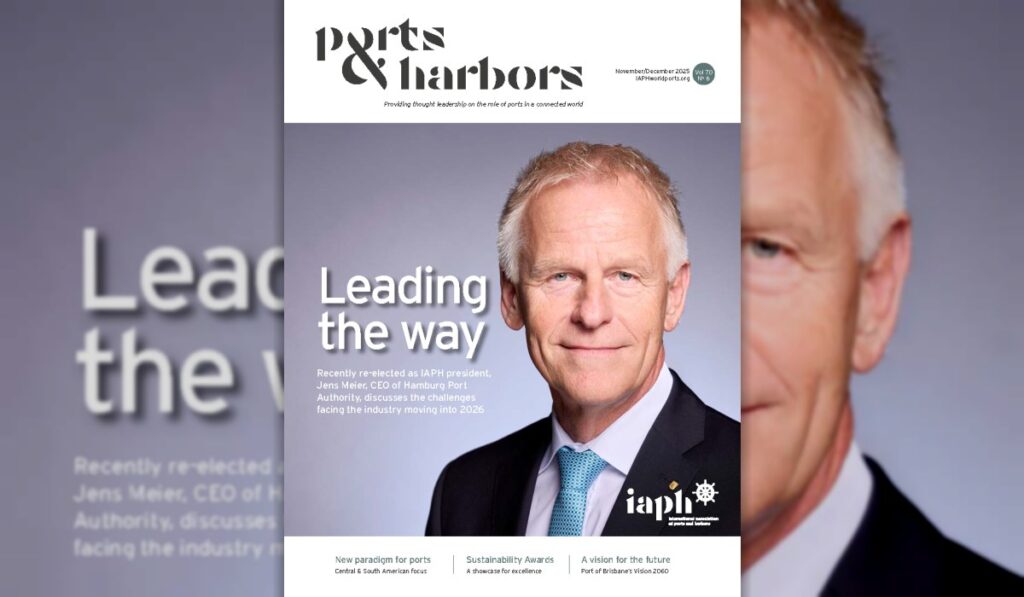
The November–December edition of Ports & Harbors, the membership magazine of IAPH, is out now. The issue brings together interviews and analysis that capture the most current debates in the global port community, from governance priorities to emissions policy and operational performance. It offers readers a structured overview of the association’s leadership agenda, regulatory developments at the International Maritime Organization, and comparative benchmarks for container port efficiency. The publication also examines how the reconfiguration of supply chains and the energy transition are reshaping strategies across diverse regions, concluding with recognition of sustainability achievements and a preview of the association’s forthcoming conference.
The cover interview features Jens Meier, CEO of Hamburg Port Authority, who was recently re-elected as IAPH president. In conversation with IAPH managing director Patrick Verhoeven, Meier reflects on the 70th anniversary World Ports Conference in Kobe and outlines his priorities as he begins a new term. The discussion situates leadership continuity within the wider context of evolving port challenges, highlighting the importance of coordination among public authorities, private operators, and international institutions. The exchange underscores the value of engagement between the association’s presidency and its executive team as they translate conference takeaways into concrete workstreams for the membership.
Inside the November–December Issue
The edition includes an interview with Roel Hoenders, the IMO’s head of climate action and clean air, focusing on the recent adjournment decision on the Net Zero Framework at the extraordinary meeting of the Marine Environment Protection Committee. The article addresses what to expect ahead of next year’s MEPC, providing readers with clarity on the procedural pause and its implications for upcoming negotiations. The coverage situates the decision within a broader policy trajectory, outlining key milestones that ports and their stakeholders will monitor as international consensus evolves on a pathway to greenhouse gas neutrality.
Operational performance is another central theme. The issue offers insights from the fifth edition of the Container Port Performance Index, published by the World Bank and S&P Global. By highlighting main takeaways rather than raw tables, the article gives context to how comparative performance indicators can inform tactical improvements and longer-term capital planning. The coverage connects efficiency outcomes to wider supply-chain reliability, acknowledging how data-driven benchmarking can guide port authorities and terminal operators as they align investments with shifting trade patterns and service expectations.
Regional adaptation receives detailed treatment through a survey of how ports in Central and South America are responding to the reconfiguration of global supply chains and the demands of the energy transition. The analysis examines how changing cargo flows, infrastructure requirements, and environmental standards are shaping investment priorities. It emphasizes the importance of resilience and optionality—expanding hinterland connectivity, deploying digital tools, and integrating sustainability criteria into procurement and operations—to maintain competitiveness as trade routes and energy systems continue to evolve.
The publication also looks back at the winners of the IAPH Sustainability Awards announced in Kobe, recognizing initiatives that demonstrate measurable progress across environmental, social, and governance dimensions. By profiling these achievements, the edition frames sustainability as both a compliance imperative and a core element of port strategy. The forward view turns to the association’s next conference, which is scheduled to take place in London in November 2026, signaling a continued commitment to convening the industry around innovation, policy alignment, and practical implementation of best practices.
Overall, the November–December issue underscores the breadth of the port sector’s agenda: executive leadership and association priorities; regulatory trajectories at the IMO; empirical performance benchmarking; regional strategy under shifting supply and energy dynamics; and recognition of sustainability excellence. For readers seeking a concise but comprehensive update on these fronts, the magazine provides curated reporting and expert perspectives that connect institutional decisions and industry metrics to the operational realities of ports worldwide. With the edition now released, stakeholders have a timely reference point for planning and engagement in the months ahead.


Sign up free to ask CAMAL AI for a summary, the key points or anything else about this story.
Related stories
CAMAL AI
 Financial Ports Newsletter
The maritime economy, every morning
Ports, shipping and freight markets in one short email. Free.
Financial Ports Newsletter
The maritime economy, every morning
Ports, shipping and freight markets in one short email. Free.



