

Gothenburg Port Adds Second Direct Asia Container Service
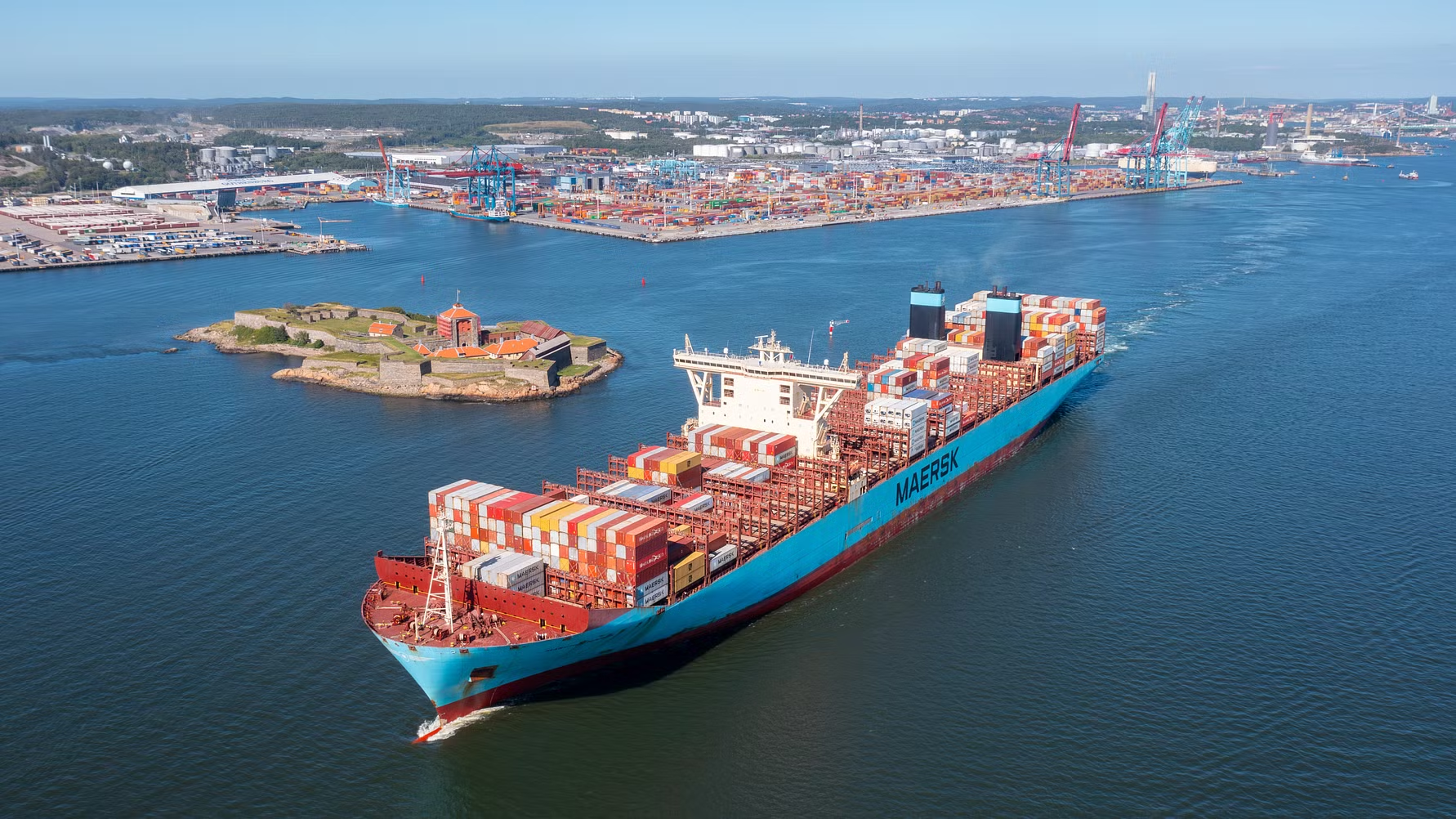
The Port of Gothenburg has announced a significant expansion of its long-haul connectivity, confirming that it now offers two direct services linking Sweden with major markets in Asia. The development adds long-distance capacity without transshipment for shippers moving containerized goods between Northern Europe and Asian hubs, reflecting the port’s growing role in regional logistics and its steady integration into primary east–west trade corridors.
Gemini Alliance route changes bring Gothenburg into loop
The upgrade follows July route adjustments by the Gemini Alliance—the ocean partnership formed by Maersk and Hapag-Lloyd—to its Asia–Europe loop. According to the port’s announcement, the loop previously concluded in Bremerhaven. With the latest reconfiguration, Gothenburg is now included in the adjusted rotation, aligning a Swedish gateway more directly with Asia-facing mainline capacity. While specific operational details were not disclosed in the announcement, the change indicates a strategic recalibration of calls in Northern Europe to meet demand and optimize network performance.
Direct mainline access is consequential for exporters and importers seeking to streamline door-to-door schedules and reduce the handoffs that typically accompany transshipment. By eliminating intermediate transfers in certain routings, shippers can simplify documentation and potentially reduce exposure to congestion at transshipment nodes. For time-sensitive commodities, fewer interchange points often translate into more predictable handover windows and improved planning for downstream warehousing and trucking across Scandinavia and neighboring markets.
A.P. Møller-Maersk
The configuration shift also underscores the flexibility alliances maintain when balancing network efficiency with market access. Gothenburg’s inclusion after a period in which the referenced loop had terminated in Bremerhaven highlights the ongoing recalibration of northern gateways within broader Asia–Europe strings. In general terms, such adjustments can reflect vessel deployment strategies, berth availability, and the need to maintain service integrity amid evolving trade flows. They also suggest readiness among carriers to reposition capacity where cargo owners signal resilient demand and where port infrastructure supports quick turnarounds.
For cargo interests, the presence of two direct Asia services at Gothenburg broadens routing options, particularly for shipments that benefit from reduced dwell and fewer transshipment interfaces. It may also provide additional scheduling diversity across cut-off times and arrivals, enabling logistics planners to hedge against disruptions on any single day-of-week call. Even without published frequency or transit specifics, dual direct offerings generally give supply chain teams a larger planning envelope for bookings and inventory staging.
Operationally, the network update can encourage closer coordination between terminal operators, inland rail and road connectors, and carriers’ landside teams to ensure that the additional direct capacity is matched by efficient gate, yard, and hinterland flows. As with any loop modification, the effectiveness of the change will rest on how consistently vessels can be handled at berth and how reliably containers can transition onto inland corridors. Consistency is often as valuable as speed, particularly for manufacturers and retailers aligning production and replenishment cycles to vessel arrivals.
From a market perspective, Gothenburg’s expanded direct reach to Asia positions Sweden’s primary gateway as a more prominent node for Scandinavian and Baltic supply chains seeking stable east–west access. While the port did not publish granular metrics with the announcement, the structural signal is clear: a mainline alliance has reoriented part of its rotation to include Gothenburg, and the port now sustains two direct services to and from Asia. For shippers, that combination typically equates to improved optionality under dynamic market conditions.


Sign up free to ask CAMAL AI for a summary, the key points or anything else about this story.
Related stories
CAMAL AI
 Financial Ports Newsletter
The maritime economy, every morning
Ports, shipping and freight markets in one short email. Free.
Financial Ports Newsletter
The maritime economy, every morning
Ports, shipping and freight markets in one short email. Free.



