

From ice to the Mediterranean: new routes challenging Suez
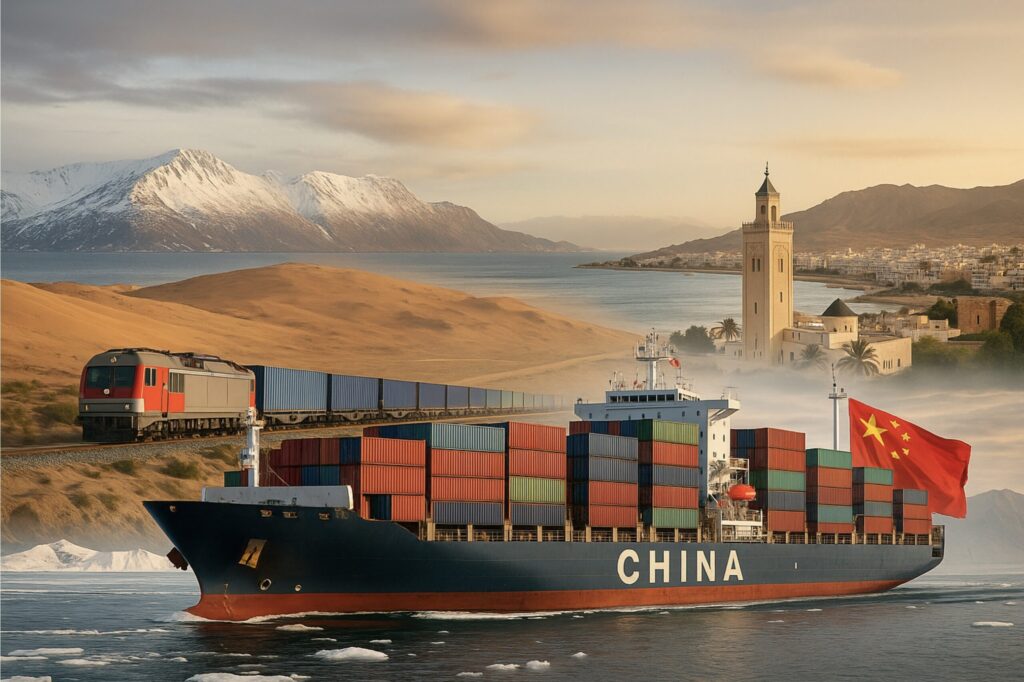
Global supply chains are undergoing a period of constant adaptation and change. In a context of constant uncertainty, global trade giants are constantly seeking alternatives that allow them to avoid conflict zones and optimize their services. The Red Sea crisis has continued since it began on November 19, 2023, the date on which the Galaxy Leader was first assaulted and hijacked in waters near Yemen.
In this context, China has accelerated its search for new alternatives and logistics corridors that mitigate risks and strengthen its role in global supply chains. Two new alternatives, far from being anecdotal, could redefine the geography of trade.
The Polar Silk Road
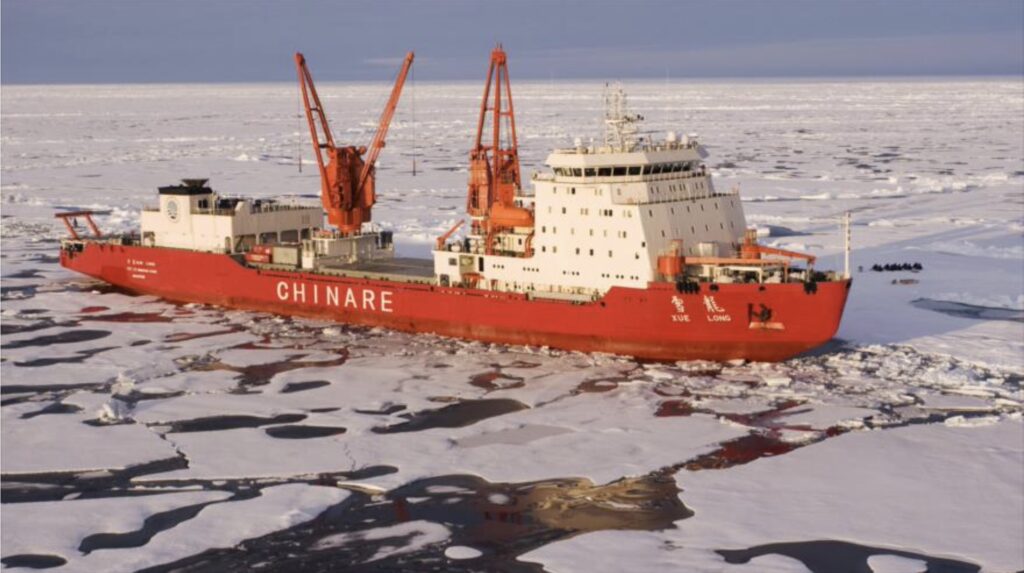
The melting of the Arctic ice cap opens a window of opportunity for maritime routes, which a few years ago were completely unviable. Haijie Shipping’s initiative aims to establish a regular service with several stops, operating between July and November, initially when the melting ice allows. In addition to equipping itself with a growing fleet of icebreakers, China has implemented a real-time sea ice monitoring system, controlled from several scientific stations in the Arctic Circle, which report data to ships. The route, dubbed the “China-Europe Arctic Express,” cuts sailing times in half compared to the Suez alternative.
The itinerary departs from the Chinese ports of Qingdao, Shanghai, and Ningbo-Zhoushan, bound for Felixstowe (United Kingdom), Rotterdam (Netherlands), Hamburg (Germany), and Gdansk (Poland). The voyage is approximately 11,000 nautical miles via the Suez Canal, compared to approximately 6,500–7,000 via the Arctic, depending on the exact departure and destination port. The voyage is shortened by 16–20 days.
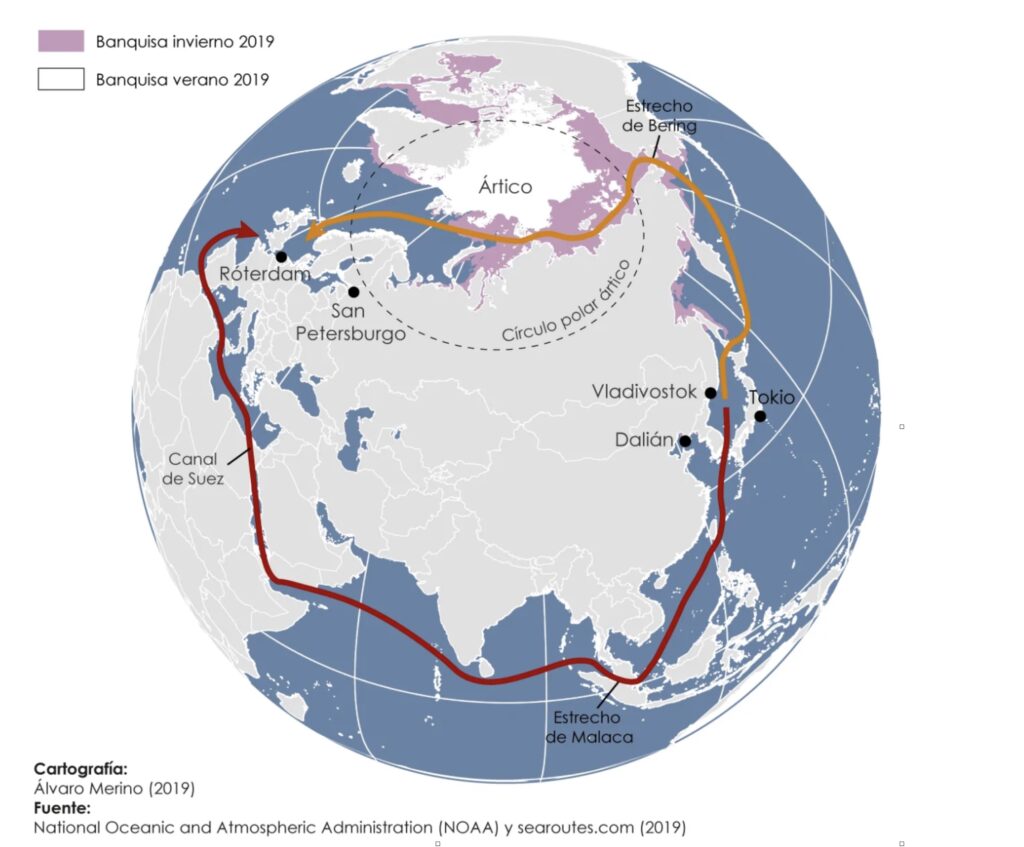
The goal is clear: to open a stable, even seasonal, corridor that complements and, in part, replaces traditional supply chain bottlenecks. The appeal of this new route is not limited to reducing transit time. It also represents significant savings in fuel and emissions, and is more attractive to sectors such as e-commerce and high-value-added manufacturing. However, its consolidation will depend on factors such as the extension of the navigation season, the deployment of more advanced icebreakers, including nuclear-powered ones, and the evolution of the climate and geopolitics in the region. The so-called “Polar Silk Road,” supported by cooperation with Russia, will add a strategic component that goes far beyond logistics.
The innovative Chengdu–Barcelona–Tangier corridor
In more temperate latitudes, China is exploring an intermodal model, combining rail and ship, to connect Asia with Africa across the Mediterranean. The route departs from Chengdu, crosses Kazakhstan, Belarus, Poland, and Germany, and reaches Barcelona. There, goods are transferred to ships, which sail to Tangier Med, Morocco’s flagship port.
This corridor will reduce transit times from 35 to 20 days, representing a significant gain in cost and reliability. With this option, Morocco positions itself as a logistics hub not only for Africa but also for the Americas, thanks to its Atlantic and Mediterranean ports. China’s zero-tariff policy on African products further strengthens this alliance, creating a strategic triangle between Chengdu, Barcelona, and Tangier.
The initiative, in collaboration with European operators such as DPD, a subsidiary of La Poste, complements the China-Hamburg rail routes and increases redistribution options to southern Europe and North Africa. It is, in short, a demonstration of how intermodal logistics is redefining the global supply chain.
Implications for supply chains
Both strategies, the Arctic Route and the Chengdu–Barcelona–Tangier corridor, respond to a common logic: reducing dependence on traditional chokepoints and increasing the resilience of supply chains. The Suez Canal, the Strait of Malacca, and the Panama Canal all contain risks or insecurity, ranging from blockages to geopolitical tensions. Diversifying routes is therefore a geoeconomic priority for operators.
Beijing’s control over global port traffic, reinforced by its stake in more than a third of African ports and its leadership in Asian terminals, demonstrates a comprehensive strategy. It’s not just about opening new avenues, but also about securing strategic hubs with which to influence the management of global cargo flows.
China is weaving a logistics network that challenges the traditional geography of trade. With the Arctic Route, it reduces travel times and costs to Europe, while with the Chengdu-Barcelona-Tangier connection, it strengthens its interconnection with Africa. Both movements are part of the same strategy: logistical autonomy, risk avoidance, and strengthening its position as a dominant player in supply chains.
In the coming months, the impact of these alternative routes on the traditional routes through the Suez Canal, the Strait of Malacca, the Cape of Good Hope, and the Panama Canal will be assessed. The greatest uncertainty centers on the viability of the polar route and whether service can be maintained in the future with the help of state-of-the-art icebreakers during the polar winter.


Sign up free to ask CAMAL AI for a summary, the key points or anything else about this story.
Related stories
CAMAL AI
 Financial Ports Newsletter
The maritime economy, every morning
Ports, shipping and freight markets in one short email. Free.
Financial Ports Newsletter
The maritime economy, every morning
Ports, shipping and freight markets in one short email. Free.