

Freire Shipyard Launches Saputi II Arctic Freezer Trawler
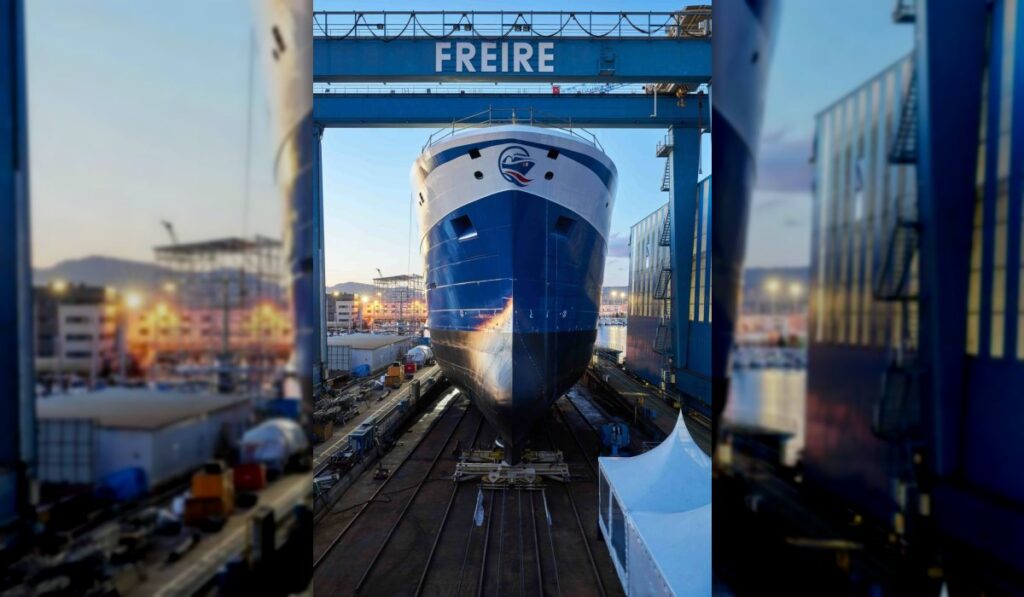
On September 9, 2025, Freire Shipyard launched a new Arctic freezer trawler built for Canadian fishing company Qikiqtaaluk Fisheries Corporation. The vessel, named Saputi II, measures 79 meters in length with a beam of 17 meters and is designed to accommodate 34 crewmembers. The launch represents a key milestone in the construction cycle, moving the ship from yard to water for the first time. The announced particulars — the client, vessel type, principal dimensions, and crewing capacity — place this project within the specialized segment of industrial fishing ships intended for extended work in cold regions.
A launch aligned with Arctic fishing needs
Freezer trawlers are purpose-built to harvest fish and preserve the catch onboard shortly after it is brought aboard. In Arctic and sub-Arctic contexts, that combination of catching and immediate cold storage is central to maintaining product quality across long distances and difficult weather windows. Vessels in this category are commonly configured to operate for sustained periods away from port, balancing deck machinery for trawling with processing space and temperature-controlled holds. The launch of a unit designed for such tasks underscores the continued role of self-sufficient fishing platforms in high-latitude operations.
The dimensions detailed for the Saputi II indicate a footprint consistent with modern offshore fishing ships focused on both capacity and stability. A length of 79 meters and a 17-meter beam support a working arrangement that typically prioritizes safe deck handling, enclosed processing areas, and the volume required for frozen product. While specific systems were not enumerated in the brief notice, the configuration implied by the vessel type points to the well-established logic of integrating harvesting and preservation functions to reduce turnaround times and safeguard product value during long campaigns.
Crew size is a salient factor for industrial fishing operations. A complement of 34 crewmembers is aligned with the manning needed for continuous watchkeeping, fishing deck work, processing, maintenance, and safety functions that must proceed around the clock. In remote waters and severe climates, effective crewing helps ensure redundancy, operational continuity, and adherence to procedures that protect both personnel and catch quality. The stated capacity reflects the human footprint that such vessels require to sustain operations over extended intervals at sea.
For the client, the addition of a new Arctic freezer trawler broadens the tools available for targeted fisheries and seasonal campaigns. For the builder, a successful launch marks tangible progress in a specialized program whose complexity spans steelwork, outfitting, systems integration, and quality assurance. Each phase — from hull construction to the first float-out — is sequenced to validate structural integrity and readiness for subsequent outfitting. As the ship transitions from the yard’s construction environment to the water, the project advances toward the testing and verification steps that characterize completion.
Freezer trawlers serving cold-water fisheries are integral to supply chains that depend on reliability and product integrity. Their endurance and onboard preservation capability help align harvesting with market timing, logistics, and regulatory frameworks that shape when and how fish enter processing and distribution. This operating model is particularly relevant when weather, ice, and distance narrow the windows for port calls. By consolidating key processes at sea, vessels in this class maintain a consistent flow of frozen product while minimizing exposure to operational interruptions.
Although every program follows its own schedule, a launch typically precedes intensive outfitting and a regimen of harbor and sea trials that verify performance, safety, and regulatory conformity before handover. Those stages are designed to confirm that the vessel performs to specification and that crews can operate equipment as intended under realistic conditions. With the Saputi II afloat, the project has cleared an important threshold on the path from construction to operational service, supported by the established practices that govern the finalization and commissioning of modern fishing ships.


Sign up free to ask CAMAL AI for a summary, the key points or anything else about this story.
Related stories
CAMAL AI
 Financial Ports Newsletter
The maritime economy, every morning
Ports, shipping and freight markets in one short email. Free.
Financial Ports Newsletter
The maritime economy, every morning
Ports, shipping and freight markets in one short email. Free.