

Economic Intelligence or an Exercise in Resilience
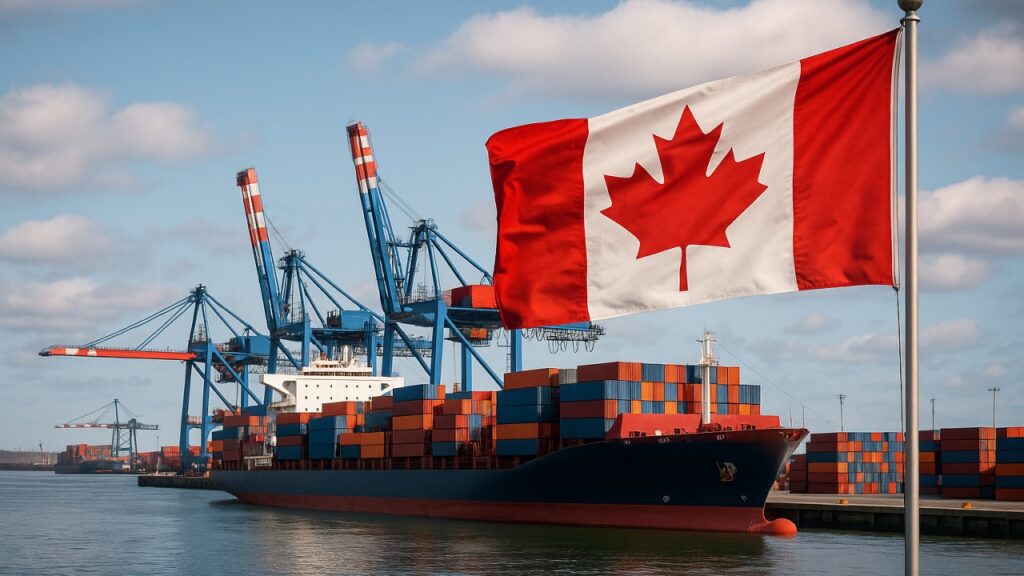
The recent tariff conflict between the U.S. and Canada has triggered a process of logistical decoupling between the two long-standing allies. Canada has begun to leverage its port network, railway intermodality, and maritime contracts to pivot its foreign trade, reducing its structural dependence on the United States and reorienting critical supply chains toward Europe and the Indo-Pacific. This is a powerful example of strategic resilience in the face of trade uncertainty imposed by what had always been an unquestionable partner. Far from confrontations or unproductive verbal disputes, the Maple Leaf nation has taken discreet action under a well-articulated strategy.
THE TARIFFS THAT ACTIVATED A STATE STRATEGY
When Washington decided to increase tariffs on Canadian steel by 50%, it was immediately perceived as a pressure tactic that required a response. However, its impact revealed the vulnerability of the North American “just-in-time” model: nearly 50% of the high-strength steel and military-grade aluminum that supplies Detroit, Illinois, and the U.S. aerospace industry crosses the Canadian border by rail or sea.
Ottawa’s response wasn’t retaliatory tariffs, but something subtler: a planned and unexpected process of complete logistical and commercial disengagement. Canada and its Prime Minister, without fanfare or press conferences, and after a tight schedule of negotiations with European and Southeast Asian countries, began to redirect their high-quality steel and aluminum production via Atlantic shipping routes, with transportation clauses prioritizing stable markets over U.S. punitive policies. Ottawa has focused its strategy on strengthening its port infrastructure to ensure faster and more efficient export routes. The ports of Halifax, Montreal, Vancouver, and Prince Rupert have thus become Canada’s new export hubs.
Gold
The U.S. administration likely did not anticipate the consequences of imposing such a sudden political shift on one of its most loyal historical allies. Nor did it expect such a forceful response, now facing a severe supply problem for its factories, forced to seek potentially more expensive suppliers, lower-quality products, and undergo logistical adjustments. As a result, vehicle, weapons, and aerospace production chains could face delays of up to six months due to the reorganization of raw material supply.
THE NEW MARITIME HUBS
Halifax and Saint John have become the new redistribution points for rolled steel cargo bound for the European ports of Hamburg and Le Havre. In doing so, Germany and France are strengthening their trade ties with Canada. The volumes initially redirected are valued at $10 billion annually, setting a major logistical precedent: for the first time since World War II, Canada is prioritizing its Atlantic steel exports over the historic Detroit–Great Lakes corridor.

At the same time, European green policy is supported by Halifax’s shore power initiative, positioning it as a pilot port for “green corridors” with the EU, further aligning sustainability and emissions reduction goals among the partners.
Located 1,500 km inland and no less effective, the Port of Montreal has become a flow regulation lever. Every ton that doesn’t cross Windsor or Buffalo into the U.S. exits through the Saint Lawrence River locks to European routes on “Seawaymax” ships (maximum 225m length and 23.8m beam).

Canada is also strongly promoting Arctic maritime routes as a viable commercial alternative, thanks in part to seasonal ice retreat and the construction of modern icebreaker vessels. The Northwest Passage (NWP) is gaining seasonal importance, with increasingly longer navigation windows (4 to 5 months per year), and by 2050, these routes are expected to generate annual transport savings of up to USD 600 million.
The “Polar Icebreaker Project” to strengthen the heavy icebreaker fleet is in full swing. The first heavy icebreaker began construction in April 2025 and is expected to be operational around 2030. Canada is also part of a trilateral agreement with the U.S. and Finland to accelerate the production of this vessel technology. Finland has extensive knowledge and experience, having built 80% of the world’s icebreakers. Announced during the NATO summit in Washington, the agreement will see up to 90 icebreakers produced by the three countries in the coming years, demonstrating the U.S.’s strong interest not only in Arctic routes but also in the resources these latitudes hold. Without a doubt, the Arctic race has begun. Russia already has over 50 icebreakers, 12 of them next-generation, and China has five. Washington aims to have 40 units in the short term.

On the Pacific coast, the ports of Vancouver and Prince Rupert are capitalizing on the situation by opening trade corridors with Japan, South Korea, and Australia.
Through these moves, Canada has begun to diversify its client base and suppliers of technological components, reducing its exposure to tariff uncertainty.
CONTRACTUAL ENGINEERING
Another key measure taken by Canadian law firms has been modifying maritime contract clauses to include automatic “exit clauses” in the event of sanctions. This legal maneuver turns port logistics into a tool of economic sovereignty, enabling cargo reassignment without the need for political or institutional measures. These are practical tools to respond quickly to change—another example of strategic resilience.
High expectations have been generated by Ottawa’s announcement to create a sovereign fund with assets from national pension funds, surprisingly open to European co-investment. This capital will be used to develop the Canadian port network and Arctic routes. Allowing European assets into this new strategy sends a clear message to the U.S. economy: Canada and Europe are now aligned.
It is increasingly evident that port networks play a geostrategic role for major exporting powers, as guarantors of development and adaptability in rapidly shifting geoeconomic landscapes. We’ve seen many examples of this in recent months.
Canada’s potential cancellation of contracts to purchase U.S. F-35 fighter jets is another sign of distancing between the two North American partners. The alternative may be the Swedish-built 4.5th generation Saab 39 Gripen.
Another major decision comes from the world’s largest potash producer—Canada. Potash is a vital natural resource used as fertilizer, especially for crops like wheat, soybeans, and potatoes. Canada has decided to reduce potash supply to the U.S. market. While the U.S. produces 440,000 tons annually, it requires 4.5 million tons. The cut in Canadian shipments has endangered U.S. crop yields and triggered an immediate price surge of this “pink gold,” as it’s now being called following the tariff crisis. Potash is vital for global food security due to its role in agricultural production. Canada exports it to several countries from reserves in Saskatchewan.
SUPPLY SOVEREIGNTY AS A LOGISTICS DOCTRINE
The actions described are expected to immediately increase traffic flows through Halifax and Montreal, turning them into Atlantic hubs. Arctic routes during the summer months could become another option to consolidate connectivity with new European trade allies. Canadian maritime exports to Europe are projected to increase by about 30%, with a 15% reduction in cross-border land flows with the U.S. Pacific coast ports will receive greater investment to boost trade with new Southeast Asian partners.
Thus, supply sovereignty is now a turning point in port economic intelligence. Canada is not pursuing autarky, but rather the ability to freely choose its logistics and trade partners without pressure, favoring stable trade relationships. Geographical proximity, after decades of importance, now takes a back seat. Canadian ports are no longer just operational terminals—they’ve become strategic assets and tools of foreign policy. Halifax, Montreal, Vancouver, and Prince Rupert no longer just move cargo: they move alliances, defense contracts, and sovereign capital. The result is a quiet rewriting of North Atlantic maritime value chains and port networks—the backbone of a new multipolar logistics order.


Sign up free to ask CAMAL AI for a summary, the key points or anything else about this story.
Related stories
CAMAL AI
 Financial Ports Newsletter
The maritime economy, every morning
Ports, shipping and freight markets in one short email. Free.
Financial Ports Newsletter
The maritime economy, every morning
Ports, shipping and freight markets in one short email. Free.



