

Daily Dredging Underpins Argentina’s Grain Export Corridor
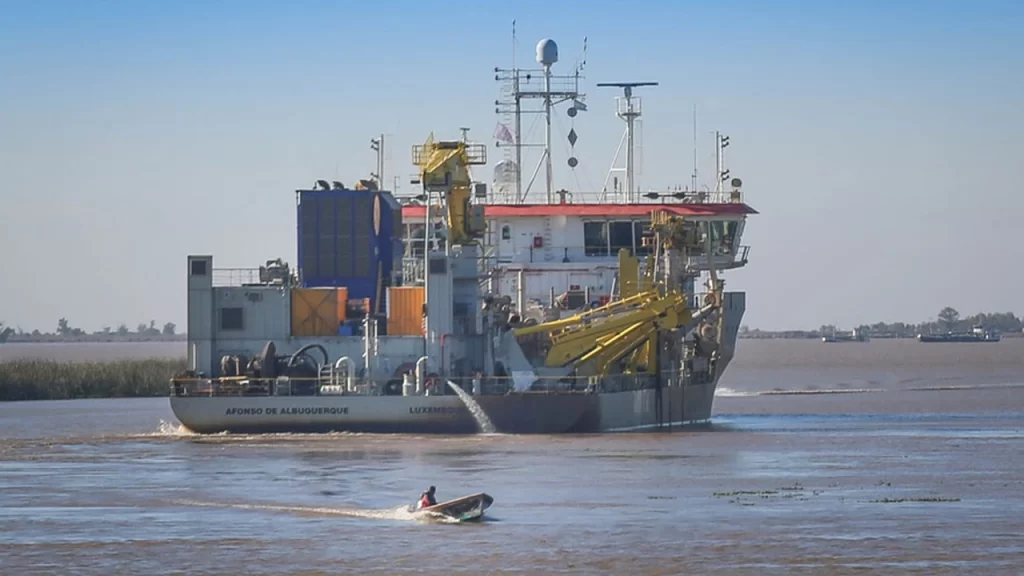
The sustained operation of the Hidrovía—a strategic inland route for Argentina—relies on daily dredging that keeps the channel navigable and trade flowing. Reporting from aboard the Afonso de Albuquerque, the coverage highlights how specialized crews, robust environmental controls, and the adoption of European technology come together to support a corridor considered central to the country’s agricultural sales abroad. Framed by a looming restructuring described as the largest privatization since the 1990s, the account underscores the mix of technical rigor and operational continuity required to maintain this critical artery.
The waterway’s role is straightforward but decisive: it links production and storage hubs to international shipping lanes, enabling the timely dispatch of commodities. In this configuration, dredging is not an occasional intervention but a routine task designed to preserve navigability. The report emphasizes that keeping this corridor functioning is essential for grain exports, whose competitiveness depends on predictable transit. Regular maintenance, carried out in alignment with operational plans, serves as the backbone of reliability for shippers and terminals that depend on uninterrupted flows.
Central to the account is the work of trained personnel. The crews featured in the reporting are presented as technically prepared for riverine challenges, coordinating navigation, handling equipment, and ensuring safe maneuvering in changing conditions. Their responsibilities, while not sensational, are exacting: they must harmonize routine procedures with on-the-spot decisions, aligning operational goals with safety and regulatory expectations. The portrayal is of a workforce attuned to the river’s dynamics and to the steady pace of tasks that underpin day-to-day continuity.
Environmental oversight is described as an integral layer of the operation rather than an afterthought. The narrative points to procedures intended to align with standards that govern activity on sensitive waterways. In this view, environmental stewardship runs alongside commercial imperatives, shaping how and where operations proceed. The framing suggests a system in which monitoring, documentation, and procedural checks are embedded in the daily cadence, supporting both accountability and operational legitimacy.
Onboard view and policy horizon
Technology—sourced from Europe, according to the report—anchors the operational toolkit. While the specifics of systems are not itemized, the emphasis falls on reliability and precision as enabling qualities. The reference to European technology signals a standardized approach aimed at reproducibility and control, features that operators prize when the mission is to preserve navigability over extended stretches of a working river. In this reading, equipment and method converge to reduce uncertainty and sustain measurable performance over time.
The economic importance of dependable river access is a recurring theme. When the channel is maintained as planned, upriver and downriver stages can mesh without undue friction, aligning storage, loading, and vessel scheduling. The reporting links this operational stability to the broader export proposition, noting that a well-kept corridor supports the timing, volumes, and cost discipline expected by markets. In effect, the corridor’s upkeep becomes a practical condition for the credibility of Argentina’s outward-facing logistics, particularly in the case of agricultural commodities and related flows.
The vantage from the Afonso de Albuquerque supplies immediacy to this portrayal. From that deck-level perspective, the article conveys the repetitive, procedural nature of the work—routine steps that, precisely because they are routine, form the basis of continuity. The vessel becomes a point of observation for a system in motion: personnel carrying out defined tasks, equipment functioning to purpose, and oversight activities proceeding in parallel. It is an operational portrait rather than a dramatic one, and it underscores how consistency itself is the achievement.
Set against this operational canvas is a policy development with national resonance: the process described as the largest privatization since the 1990s. Though the report does not enumerate modalities, the scale alone implies extensive attention from public and private actors. The central question is continuity—preserving the routine that sustains the corridor while institutional arrangements evolve. In that context, the article’s emphasis on people, oversight, and method reads as a statement of priorities: the day-to-day must continue to function. As the transition advances, those same elements—trained personnel, embedded environmental oversight, and proven tools—appear poised to define the baseline for credibility and performance.


Sign up free to ask CAMAL AI for a summary, the key points or anything else about this story.
Related stories
CAMAL AI
 Financial Ports Newsletter
The maritime economy, every morning
Ports, shipping and freight markets in one short email. Free.
Financial Ports Newsletter
The maritime economy, every morning
Ports, shipping and freight markets in one short email. Free.