As Latin America faces the challenge of increasing its competitiveness, attracting investment and adapting to new environmental and technological demands, understanding how these models are evolving has gone from being an academic exercise to becoming a necessity.
For this reason, from September 20 to October 5, business leaders, port authorities and executives from across the region will visit some of the world’s most advanced logistics ecosystems as part of the Port Leaders Program, an international mission developed by PR PORTS and Maritime Policy Bureau, in partnership with Agroeducación.
Yangshan: When Engineering Challenges Geography
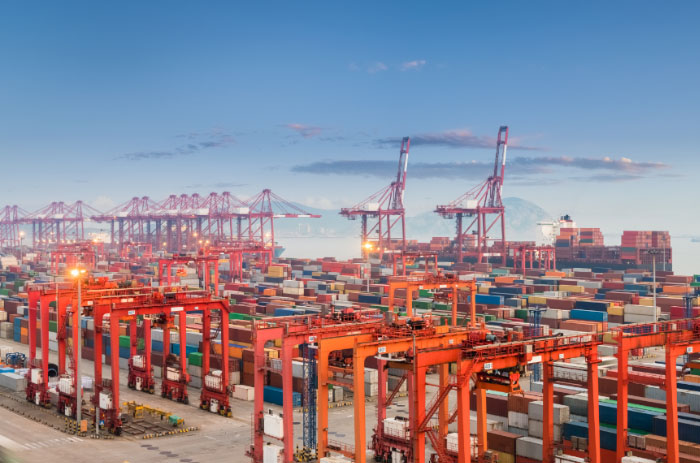
The first major stop will be the Port of Yangshan, part of the Port of Shanghai, the world’s largest container port.


Its history summarizes much of China’s logistics transformation. Faced with the impossibility of continuing to expand port terminals along the mainland coast, the country built a deep-water port on a group of islands connected by a bridge more than 32 kilometers long.
Today, Yangshan represents one of the world’s leading examples of port automation, technological integration and large-scale logistics planning.
More than an infrastructure project, it is a demonstration of how strategic vision can overcome even geographical limitations.
Hong Kong: The Port That Understood the Value of Connectivity Before Anyone Else
For decades, Hong Kong was Asia’s main gateway for international trade.
Although the growth of other Chinese ports has changed part of that landscape, it remains one of the world’s most influential logistics hubs.

Its strength lies not only in its port infrastructure. It is supported by an ecosystem that integrates maritime transport, financial services, international trade, innovation and land connectivity, making it a permanent laboratory for understanding how to create value around a port.
Jebel Ali: When a Port Drives a Nation’s Development
If Yangshan demonstrates the power of engineering and Hong Kong highlights the value of connectivity, Jebel Ali, in Dubai, represents another successful model.
Its evolution reflects how a long-term national strategy can transform a port into the core of an economic ecosystem.

The integration of terminals, free zones, industrial parks, logistics platforms and international services has turned Dubai into one of the world’s leading distribution centers and a benchmark for governments and port operators.
More than just a port, Jebel Ali is an example of how infrastructure can become a driver of economic development.
The Future Is Also Being Built Beyond the Ports
The program includes visits to JD Logistics, one of the global leaders in logistics automation and e-commerce, and BYD, a leading company in electric mobility and technological innovation, whose developments are also transforming supply chains and freight transportation.
The agenda also features institutional meetings, visits to innovation centers and exchanges with industry experts to better understand how artificial intelligence, automation and the energy transition are redefining global competitiveness.
The program has been designed as a comprehensive international immersion experience. In addition to visits to ports, leading companies and meetings with industry experts, the package includes 16 nights of accommodation in strategically located four-star hotels, all internal transportation — including flights, high-speed rail and private transfers — full board (breakfast, lunch and dinner), guided tours of Beijing, Shanghai, Hangzhou, Hong Kong and Dubai, a 4×4 desert safari with a traditional dinner, admission to the 148th floor of the Burj Khalifa, specially selected cultural experiences in each destination, and a farewell dinner with the international delegation.
Those interested in obtaining more information about the program, the full agenda or the registration process can write to info@port-leaders.com or visit www.port-leaders.com.