The maritime and port industry is at a pivotal moment. Geopolitical fragmentation, the restructuring of global supply chains, the rapid advancement of artificial intelligence, the energy transition, and the emergence of new trade corridors are simultaneously reshaping investment strategies, operational models, and the future of port development.
In this new environment, competitiveness depends on far more than infrastructure alone. It also requires the ability to anticipate changes in global trade, embrace innovation, strengthen supply chain resilience, and foster stronger collaboration between the public and private sectors.
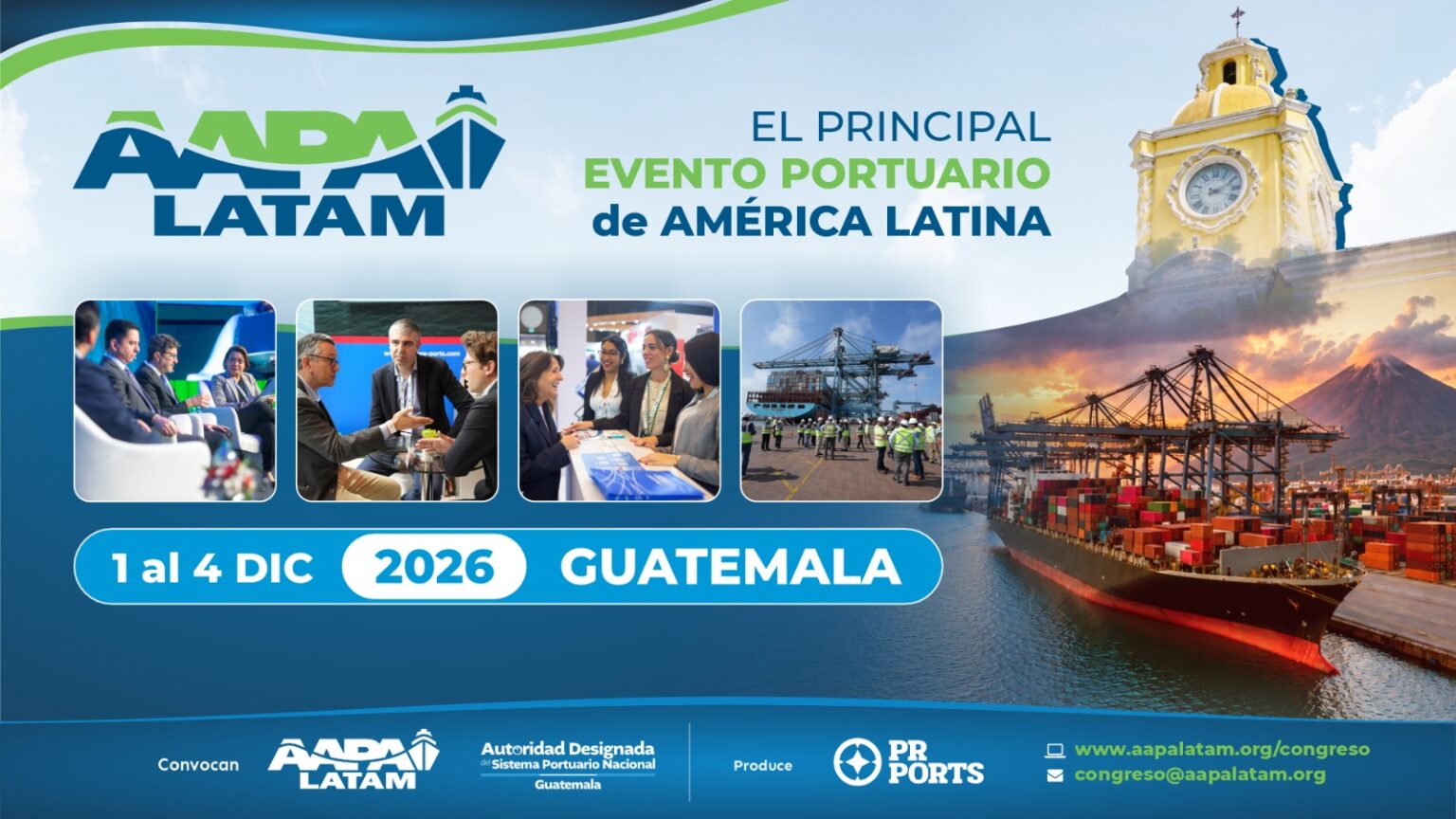
These challenges will be at the heart of AAPA LATAM 2026, Latin America’s leading maritime, port, and logistics conference, which will bring together more than 700 port authorities, government officials, logistics operators, terminal executives, representatives of multilateral organizations, technology providers, and investors from across the region in Guatemala from December 1–4.


Organized by the Latin American delegation of the American Association of Port Authorities (AAPA LATAM) in partnership with Guatemala’s Designated Authority of the National Port System, and produced by PR PORTS, the conference will feature four days of discussions, knowledge exchange, and strategic dialogue focused on the key challenges facing Latin America’s maritime and port sector.
An agenda aligned with the region’s challenges
AAPA LATAM returns to Guatemala fourteen years after its previous edition in Antigua, at a time when the country’s port system is undergoing significant transformation and Central America is gaining increasing relevance within the evolving landscape of global trade.
Guatemala’s strategic location between the Pacific Ocean and the Caribbean Sea, together with ongoing initiatives to strengthen port governance, modernize infrastructure, accelerate digitalization, and enhance logistics connectivity, makes the country an ideal setting to discuss the challenges currently shaping the region’s maritime and port sector.
For Zulma Dinelli, Managing Director of the Congress, the selection of Guatemala as the host country reflects that strategic vision: “Every edition of AAPA LATAM begins with a strategic decision: choosing the best place to discuss the future of our industry. We look for countries undergoing meaningful transformation—places that can bring new perspectives to the regional conversation. Guatemala embodies those qualities. Its privileged geostrategic location, ongoing port modernization efforts, and strong commitment to strengthening its logistics integration make it an ideal host. We believe this transformation will contribute valuable insights to the discussions that Latin America needs today.”
In the same spirit, Leonel Molina, Managing Director of Guatemala’s Designated Authority of the National Port System, emphasized that hosting the Congress represents an opportunity to share the country’s ongoing transformation with the international port community.
“The Congress provides an opportunity to showcase the progress of Guatemala’s port reform to port authorities across the region, logistics operators, and the many organizations connected to the maritime and port sector.”
Among the country’s key initiatives are the forthcoming General Port System Law, the creation of a National Port Authority, and a portfolio of strategic projects aimed at strengthening the competitiveness of Guatemala’s port system.
At Puerto Quetzal, infrastructure expansion and capacity enhancement projects are currently underway. Santo Tomás de Castilla is investing in the modernization of its facilities and the incorporation of new equipment, while the Puerto Barrios Rail Terminal is implementing an expansion plan designed to improve operational efficiency through larger yards, automated access systems, and new customs facilities. These initiatives are complemented by road and rail connectivity projects intended to further strengthen Guatemala’s position as a regional logistics hub.
These initiatives will be presented during the panel “Two Oceans, One Strategy: Guatemala’s Port Vision,” where national authorities will outline the country’s integrated strategy to enhance port capacity and consolidate Guatemala’s role as a regional logistics platform.
Molina also noted that the Congress could provide the stage for an announcement of significant institutional importance.
“We expect to announce during the Congress the approval of Guatemala’s first General Port System Law and, if timing allows, introduce the country’s first National Port Authority established under this new legal framework.”
The industry’s premier meeting point
In addition to a high-level conference program, AAPA LATAM 2026 will feature executive networking opportunities, a commercial exhibition showcasing leading companies, business meetings, and a technical visit to Puerto Quetzal.
The Congress’s greatest value, however, lies in its ability to bring together the people shaping the future of the industry: public officials designing policy, port authorities, terminal operators, technology providers, infrastructure investors, and business leaders whose decisions have a direct impact on the competitiveness of Latin America’s logistics sector.
AAPA LATAM 2026 aims to foster that dialogue by bringing together the region’s leading stakeholders to examine shared challenges, exchange knowledge and best practices, and discuss the strategies that will shape the future of Latin America’s ports.