

Six-sail cargo ship cuts fuel use by 20%—here’s how
LD Armateurs’ Spirit of Toulouse becomes the first commercial vessel to combine six rotor sails.
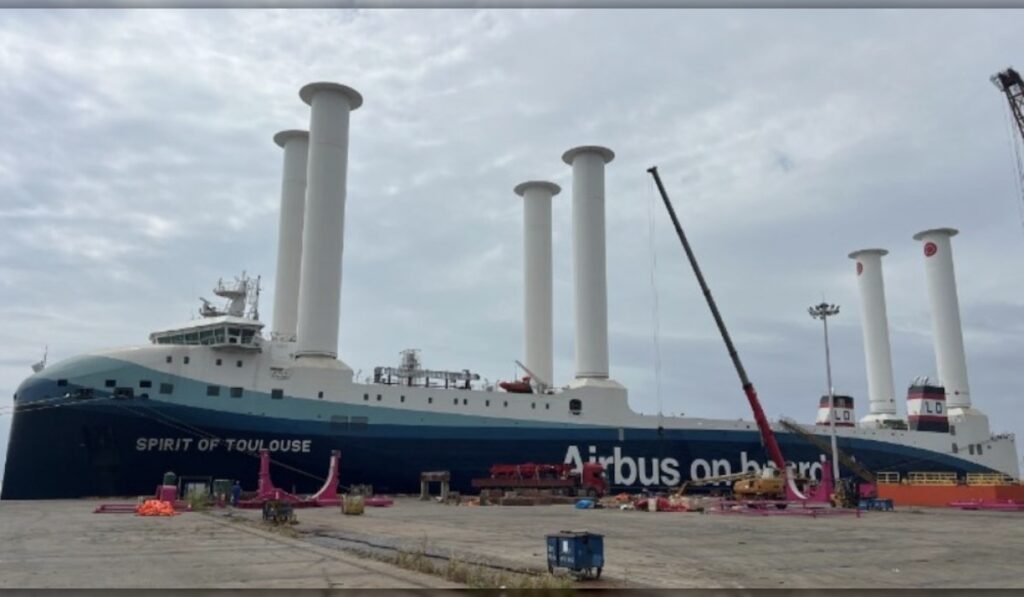
The world’s first cargo ship fitted with six mechanical sails has entered the final stages of outfitting in Shanghai, marking a milestone in maritime decarbonisation.
The system, developed by Finnish supplier Norsepower, is the largest wind-assist installation on a commercial cargo vessel to date. When operational, the sails will work in tandem with the ship’s two dual-fuel main engines and two generator sets, which can run on e-methanol, bio-methanol, or marine diesel oil.
How wind and methanol propulsion work together: rotor sails
The Spirit of Toulouse is the lead vessel in a three-ship series under charter to Airbus, tasked with transporting large aircraft sub-assemblies between Europe and North America.
The integration of methanol as a fuel further enhances the vessel’s environmental credentials.
Samira Draoua, CEO of LD LD Armateurs, called the project a “tangible demonstration of how the maritime industry can accelerate its transition.” In a statement, she said:
“Spirit of Toulouse is much more than a new vessel. It is a tangible demonstration of how the maritime industry can accelerate its transition by combining innovation, operational expertise, and strong industrial partnerships. Bringing together six rotor sails and dual-fuel methanol propulsion on a ship of this scale is a world first that illustrates LD LD Armateurs’ commitment to pioneering tangible solutions for lower-carbon shipping.”
Samira Draoua·CEO of LD LD Armateurs
The industrial partnership behind the project
The company’s partnership with Norsepower, a Finnish cleantech firm specialising in wind propulsion, dates back to early 2024, when the two announced their joint effort to develop hybrid vessels for Airbus’s logistics needs.
The Spirit of Toulouse and its sister ships are a critical component of this strategy, offering a way to cut emissions from the transport of aircraft components between production sites in Europe and North America.
The Spirit of Toulouse is scheduled to undergo sea trials in the coming weeks, followed by its maiden voyage from China to France. The rotor sails will be tested and optimised during the journey, with data collected to refine performance. The remaining two vessels in the series, Spirit of Mobile and Spirit of Mirabel, are also expected to receive Norsepower rotor sails as part of Airbus’s push for greener logistics.
Heikki Pöntynen, CEO of Norsepower, described the installation as a “significant milestone for wind propulsion in the RO/RO segment.” The project, announced in early 2024, has moved from construction to launch in just two years, reflecting the urgency of decarbonising maritime transport. With the International Maritime Organization (IMO) targeting a objetivo de la IMO para 2050, hybrid propulsion systems like this could become a blueprint for the industry.
The Spirit of Toulouse is not just a technological breakthrough, it’s a test case for whether wind and alternative fuels can deliver meaningful emissions cuts without sacrificing efficiency. If successful, the model could be replicated across the global fleet, particularly on high-emission routes like the transatlantic corridor. For shipowners and charterers, the vessel offers a glimpse into the future of maritime logistics, one where sustainability and operational efficiency go hand in hand.
For industry observers, the upcoming sea trials and maiden voyage will be closely watched. Data on fuel savings, emissions reductions, and operational performance will be critical in determining whether the Spirit of Toulouse can serve as a scalable model for the wider shipping industry. If the results meet expectations, LD LD Armateurs and Norsepower could see increased demand for their hybrid propulsion systems, potentially accelerating the adoption of wind-assisted shipping worldwide.
As the maritime sector grapples with the challenge of decarbonisation, the Spirit of Toulouse represents a bold step forward. The vessel’s success, or failure, could shape the trajectory of green shipping for years to come, making it a project of global significance.


Sign up free to ask CAMAL AI for a summary, the key points or anything else about this story.
Related stories
CAMAL AI
 Financial Ports Newsletter
The maritime economy, every morning
Ports, shipping and freight markets in one short email. Free.