

Port of Melbourne Hits $154 Billion Trade Record
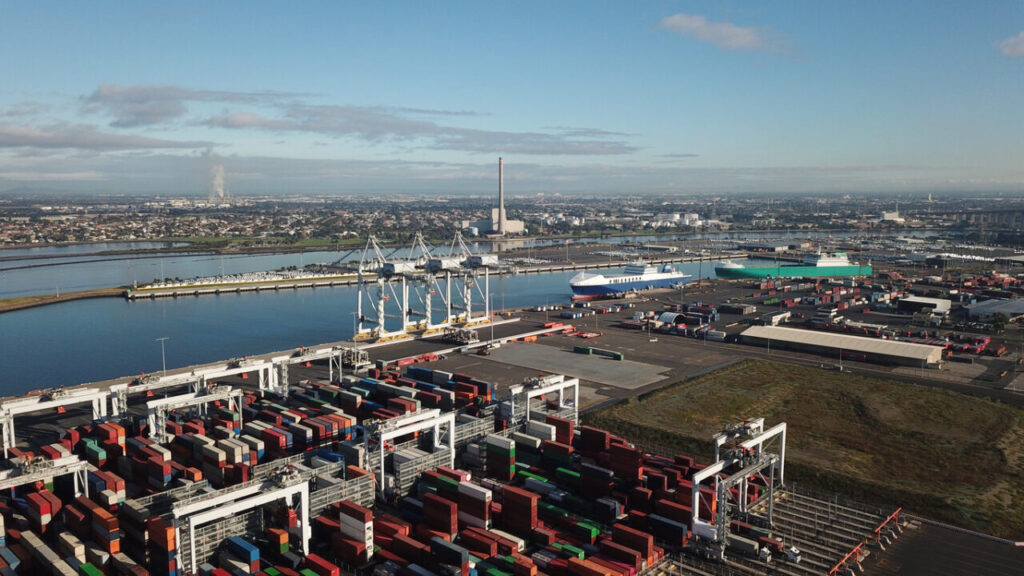
The Port of Melbourne reported a record trade value of $154 billion during Financial Year 2025 (FY25), reinforcing its position as Southeast Australia’s leading trade gateway. Container activity also reached a new high, with total volumes hitting 3.39 million TEUs. On a daily basis, the port averaged over 9,200 TEUs daily, underscoring the scale and consistency of cargo flows through Australia’s primary container hub.
Record Throughput Underscores National Lead
Measured in twenty-foot equivalent units, or TEUs, container throughput is a standard gauge of port performance and network capacity. By reaching 3.39 million TEUs in FY25, Melbourne set a clear operational benchmark while maintaining a sustained pace that exceeded over 9,200 TEUs daily. The combination of peak annual volume and high daily averages highlights a system capable of handling steady cargo demand across the year rather than isolated spikes.
According to the latest figures, the Port of Melbourne is Australia’s largest container port, managing nearly 21 per cent more volume than any other national port. This performance gap points to a durable competitive edge built on scale and market reach. It also illustrates the port’s central role in coordinating import and export flows that connect producers, distributors, and end markets across the country.
The daily cadence implied by the averages suggests a constant circulation of vessels, boxes, and equipment through waterfront terminals and landside interfaces. While throughput can vary with seasonal cycles and global shipping patterns, Melbourne’s FY25 outcome indicates that the port sustained a high level of operational activity throughout the year, keeping cargo moving at a rate consistent with the headline totals.
In value terms, the $154 billion tally captures the breadth of trade crossing the quays—both inbound and outbound. Though the mix of cargoes is not detailed here, the aggregate figure speaks to the port’s significance as a conduit for economic activity. It signals the scale of goods that rely on efficient marine and landside handling to reach businesses and households, and the central place of containerized logistics in Australia’s supply chains.
The designation as Southeast Australia’s leading trade gateway aligns with the port’s traffic profile and its comparative position within the national network. That status reflects not just headline numbers but also the port’s role in facilitating connections between international shipping services and the region’s industrial, retail, and agricultural corridors. The FY25 results reaffirm that positioning, indicating depth in market demand and the infrastructure needed to support it.
Viewed together, the record value of trade, the all-time high in container throughput, and the clear national lead by nearly 21 per cent establish a new reference point for performance. As stakeholders assess capacity and service expectations, these figures provide a factual baseline for planning schedules, allocating resources, and aligning with ship calls and cargo flows. The FY25 outcome shows that Melbourne’s container platform operated at scale and with consistency, setting a measurable benchmark for the year ahead.


Sign up free to ask CAMAL AI for a summary, the key points or anything else about this story.
Related stories
CAMAL AI
 Financial Ports Newsletter
The maritime economy, every morning
Ports, shipping and freight markets in one short email. Free.
Financial Ports Newsletter
The maritime economy, every morning
Ports, shipping and freight markets in one short email. Free.