

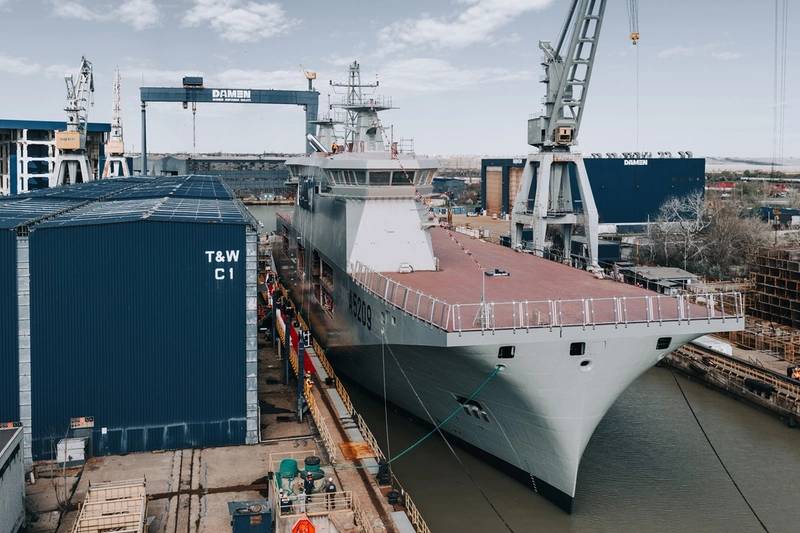
Damen Shipyards Group has launched the NRP D. João II, a Multi-Purpose Vessel (MPV 10720) built for the Portuguese Navy. The ship entered the water at Damen Shipyards Galati in Romania on April 7, marking the latest step in its construction program. Few technical details were released at this stage, but the vessel’s name and class designation point to a platform conceived for versatile state and defense duties under national authority. The event underscores progress in a project that advances from hull construction toward outfitting, testing, and eventual operational readiness.
Launch at Galati marks program milestone
The launch took place in the presence of Vice Admiral Pires, representing the Portuguese Navy during the ceremony. Conducted at the Galati facility on the Danube, the event follows shipbuilding norms in which a newly built hull transitions from the yard’s construction area to the water for the first time. This phase traditionally signals that major structural work has concluded and that the program is poised to begin the extensive outfitting and integration period that precedes trials. No formal speeches or technical disclosures were detailed beyond confirmation of the launch and the vessel’s designation.
As a multi-purpose vessel, the NRP D. João II carries a designation that typically reflects a capacity to support a broad range of maritime tasks. Authorities did not disclose specifications, performance data, or detailed mission profiles at the launch. In contemporary naval practice, multi-purpose platforms can be configured to address differing state needs over a ship’s service life, but the precise fit-out is usually defined and verified through progressive testing and certification. The absence of published figures at this point is consistent with standard practice ahead of formal sea trials and commissioning decisions.


Damen Shipyards Galati, one of the group’s major construction sites, is a long-established location for complex vessel builds encompassing both commercial and governmental programs. The launch in Romania highlights the cross-border nature of European shipbuilding, where design, assembly, and outfitting activities are distributed across specialized facilities. That collaboration allows programs to draw on mature industrial ecosystems while maintaining national oversight of operational requirements. In this case, the Portuguese Navy’s presence at the event signals end-user engagement in a build process that proceeds in stages and is governed by milestone acceptance protocols typical of the sector.
Following a launch, programs customarily enter outfitting phases to install systems, complete interiors, and integrate mission-critical equipment. Harbour acceptance procedures and, later, sea trials validate safety, propulsion, and platform readiness under controlled conditions. Neither the builder nor the navy has publicly shared timelines, delivery schedules, or capability statements for the NRP D. João II at this time. As work progresses, selected updates are commonly released at key junctures, such as the start of trials or handover preparations, when technical conclusions can be verified and reported with the precision required in defense and maritime programs.
In operational terms, the concept of a multi-purpose naval platform reflects a long-standing effort to balance flexibility with lifecycle efficiency. While specific configurations for the NRP D. João II were not disclosed, the general logic behind such vessels is to enable authorities to allocate a single hull type to differing roles over time, subject to certification and equipment. That approach can support responsive tasking and may streamline training and maintenance through commonality. The actual scope of operations, however, will depend on formally declared capabilities and the outcomes of the test and acceptance regime ahead of commissioning.
The launch also illustrates the incremental transparency typical of shipbuilding programs: confirmed facts are shared at public milestones, while detailed figures remain closely managed until validated. By recording the April 7 launch at Galati with representation from Portugal’s naval leadership, both parties have signaled continuity and alignment on the project’s next steps. No additional information on specifications or delivery has been issued, and further details are expected as the ship advances through outfitting and trials. For now, the launch stands as the verified milestone marking the vessel’s transition from construction to integration.

