

Armas Trasmediterránea has convened its shareholders to an Extraordinary General Meeting on May 8 to approve the resolutions required to implement its transaction with Baleària. The company’s official call, issued at an advanced stage of the process, details the corporate steps that must be ratified by investors for the operation to move into execution. The agenda signals a tightly sequenced legal and governance pathway, positioning the vote as the final internal authorization before assets are transferred and ancillary documentation is formalized.
The operation already has the green light from the CNMC, a pivotal clearance that removes one of the main regulatory conditions. With that endorsement, the meeting becomes decisive as the last major internal formality to complete the deal. The regulator’s approval of commitments enables the parties to move forward on execution mechanics, from asset conveyance to documentation closure, while aligning the transaction with competition safeguards applicable to Spain’s passenger and roll-on/roll-off ferry markets.
Scope and strategic focus of the transfer
According to the information released and the deal context, the agreement foresees the transfer to Baleària of a significant set of assets tied to strategic routes. These include passenger and cargo‑on‑wheels operations in the Strait of Gibraltar and other high‑traffic peninsular and extra‑peninsular links. The move is aimed at reinforcing Baleària’s position on Spain’s most competitive corridors, expanding operational capacity and consolidating leadership on routes where frequency, vessel availability, and service reliability are decisive for market share.


For its part, Armas Trasmediterránea approaches the operation as a reordering of its structure, with a sharper focus on segments where it retains stronger positioning, particularly in the Canary Islands. By streamlining its perimeter, the company seeks greater financial and operational stability after recent restructuring processes. The carve‑out of selected assets is designed to reduce complexity, align capital with core networks, and stabilize cash generation on the routes it continues to operate.
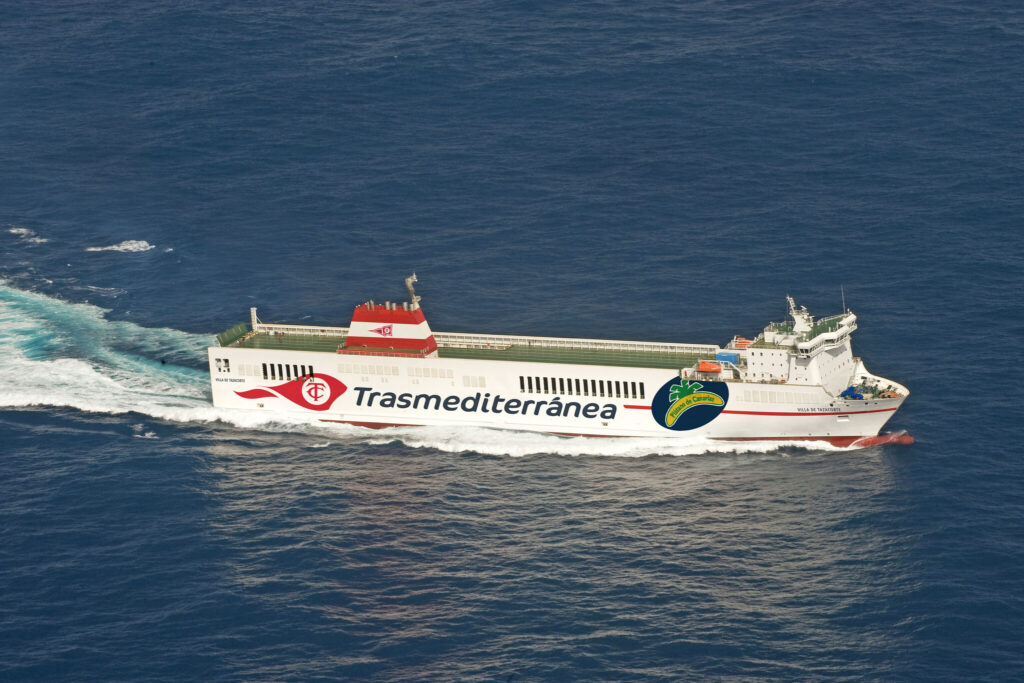
The official agenda specifies corporate governance changes and collateral unwinds needed to deliver a clean transfer perimeter. Items include the cessation and appointment of a sole director, and the ratification of deeds or policies to cancel naval mortgages constituted over the company’s vessels. It also covers the ratification of cancellations of pledges over shares and equity interests owned by the company, and cancellations of pledges over credit rights granted as security for financial obligations. Additionally, the meeting will authorize the transfer of the vessel Villa de Tazacorte.
As a headline item, the agenda includes the subscription of the closing deed and the “escritura cero” associated with the share purchase agreement involving Gestión Naviera, Balearia Eurolíneas Marítimas, and certain entities of Grupo Bahía de las Isletas. In connection with the same point, the meeting will also ratify the subscription of the closing deed of the share purchase agreement signed on August 25, 2025, with Balearia Eurolíneas Marítimas and certain entities of Grupo Bahía de las Isletas. These steps formalize the transaction’s legal closure under the agreed structure.
From a sector perspective, the operation marks another step in the consolidation of Spain’s maritime transport, where scale and efficiency increasingly drive competitiveness. The transfer of assets not only reallocates market share but also reshapes the competitive balance on strategic routes, especially those with dense passenger and ro‑ro flows. By concentrating capacity on key lines, the transaction could recalibrate service patterns, timetables, and fleet deployment, prompting rival operators to reassess pricing, frequencies, and vessel assignment.
Pending shareholder approval on May 8, the process appears to be entering its final phase. The decision taken at the extraordinary meeting will determine the immediate course for Armas Trasmediterránea and cement Baleària’s role among Spain’s leading ferry operators. With regulatory conditions addressed and corporate mechanics delineated, the vote stands as the concluding internal milestone before execution and integration steps proceed on the specified routes and assets.

