

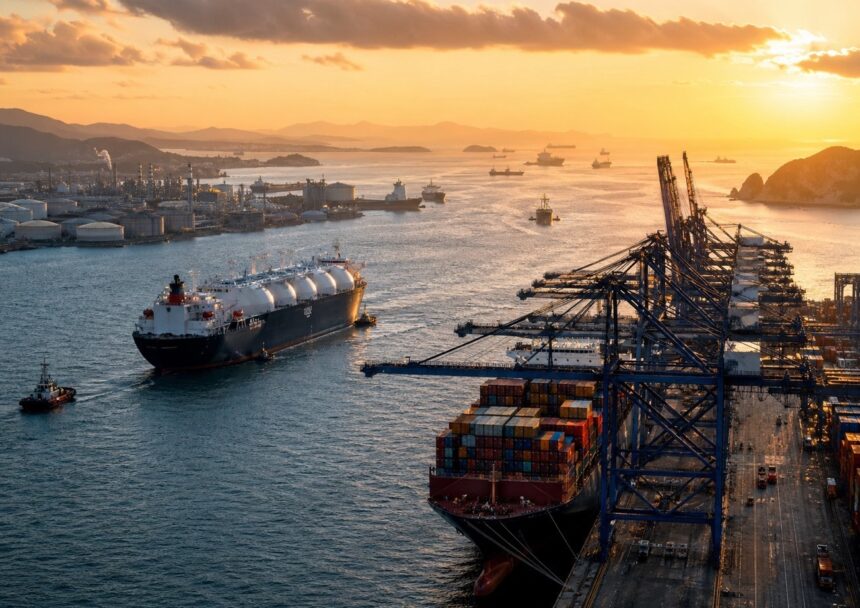
For years, much has been said about an increasingly digital and intangible global economy. Yet the current energy and geopolitical crisis reminds us of a more basic reality: the world still depends on ships, maritime chokepoints, oil, gas, fertilizers, metals, shipyards, ports, and logistics chains.
A vital share of global maritime trade in oil, liquefied natural gas, refined products, chemicals, fertilizers, sulfur, and aluminum passes through the Strait of Hormuz. Its closure or blockage would not only affect the energy market, but the global economy as a whole. When an artery of this kind is disrupted, the impact is immediately transmitted to crude prices, marine fuel costs, fertilizers, industry, insurance, freight rates, and the logistical planning of companies and shipping lines.
At the time of writing this analysis, Brent crude has reached $125 per barrel, highlighting how sensitive the energy market remains to geopolitical risk. For maritime transport, this surge has direct effects. It increases bunker costs, squeezes shipping companies’ margins, raises supply chain costs, and may alter routes, port calls, and contracting decisions.


The crisis is also affecting a less visible but decisive link: shipbuilding. Shortages of paint, lubricants, and other petroleum derivatives are beginning to strain shipyards, especially in Asia. This comes at a delicate moment, as the global orderbook is at very high levels, with delivery times stretching over several years. China, South Korea, and Japan account for a large share of global shipbuilding capacity, so any disruption in industrial supplies delays deliveries, raises prices, and limits fleet renewal.
This has significant strategic implications. The energy transition requires new, less polluting vessels, more gas carriers, specialized ships, units adapted to alternative fuels, and the capacity to serve new routes. But if the shipbuilding industry continues to face these bottlenecks, it will struggle to comply with strict emissions regulations. The resilience of supply chains depends not only on cargo and demand, but also on modern vessels, shipyards, and sufficient industrial capacity.
The geopolitical crisis in the Middle East is accelerating the fragmentation of the energy order. This week, the United Arab Emirates’ exit from OPEC reflects a rift among producers: some seek to sustain high prices, while others prefer to maximize volumes ahead of a potential structural decline in demand. Saudi Arabia is trying to preserve market discipline, while Abu Dhabi—an important U.S. ally—favours greater production and strategic autonomy.
The United States is emerging as an alternative energy supplier for Europe and Asia, with record exports of crude and refined products. But this substitution is not without risks. If external demand for U.S. barrels drives up domestic gasoline and diesel prices, political pressure to impose export restrictions may increase. Energy security, therefore, no longer depends solely on the physical availability of resources, but also on potential national policy decisions.
China constitutes the other major axis of this reconfiguration. Amid all this, its economy continues to post meaningful growth rates driven by exports, advanced manufacturing, and industrial investment, albeit with weak domestic demand and a still-fragile real estate sector. Beijing is sustaining growth through industrial production, robotics, electric vehicles, batteries, and high-value manufacturing. The result is a China that remains central to global maritime trade, albeit under the tariff and geopolitical pressures we are already familiar with.
The trade war with the United States is reshaping trade flows. Chinese exports to the U.S. are losing relative weight, while shipments to the European Union, ASEAN, Africa, and Central Asia are increasing. This transformation affects routes, hubs, transshipment patterns, and port strategies.
This shift is crucial. Trade policy is now extending into traceability control, rules of origin, Chinese content requirements, customs documentation, and oversight of the entire supply chain. For shipping lines, freight forwarders, ports, and shippers, this means greater operational complexity, higher regulatory risk, and the need for robust, digitalized documentation systems.
Europe, for its part, is beginning to respond with a resilience-driven approach. The potential relaxation of merger rules to create “European champions” suggests that Brussels recognizes that competing with the United States and China requires stronger companies, greater investment, and enhanced strategic autonomy. In sectors such as energy, transport, defense, technology, and critical infrastructure, pure competition is increasingly coexisting with internal economic security criteria. It is an important step, but Europe must awaken from its inertia and reinvent itself by simplifying and optimizing its stringent regulatory framework.
Europe faces a particularly uncomfortable position. Not only does it pay more for imported energy, but it also has less fiscal room to indefinitely shield households and industries. The European Commission itself acknowledges that there is no simple financial solution to absorb persistently high energy prices. Hence, the structural response must involve accelerating electrification, strengthening nuclear energy, expanding renewables, batteries, and interconnections, and reducing dependence on fossil fuels.
The German case illustrates the risk to Europe’s industrial base. Rising energy costs are eroding the recovery of the Union’s largest economy, particularly in energy-intensive sectors such as chemicals, metallurgy, and advanced manufacturing. If Germany enters another year of stagnation, the problem will no longer be purely national, but will affect suppliers, ports, industrial chains, and export competitiveness. The energy crisis thus becomes an industrial crisis and, by extension, a crisis of maritime and port connectivity.
For ports, the priority is to improve service quality in an environment of diversification and intermodality. In a more politicized and uncertain global context, the maritime-port sector is once again at the center of the world economy.
When geopolitics blocks straits, drives up fuel costs, alters routes, and strains factories, the world is reminded that its future does not run only through cables and data—it also sails on ships, operates in ports, and consumes energy.

